85+ Flowers That Start With P: Names, Full Guide & Photos
Quick Answer: Flowers That Start With P are peony, pansy, petunia, poppy, primrose, phlox, protea, poinsettia, passion flower, plumeria, periwinkle, portulaca, and Persian buttercup.
Flowers beginning with the letter P form one of the richest groups in the entire garden alphabet. This single letter covers cottage-garden classics like the peony and poppy, everyday bedding staples like the pansy and petunia, exotic climbers like the passion flower, and rare specialty blooms like the Pleione orchid. Because so many plant families happen to start with P, this letter offers something for nearly every growing condition, color palette, and skill level
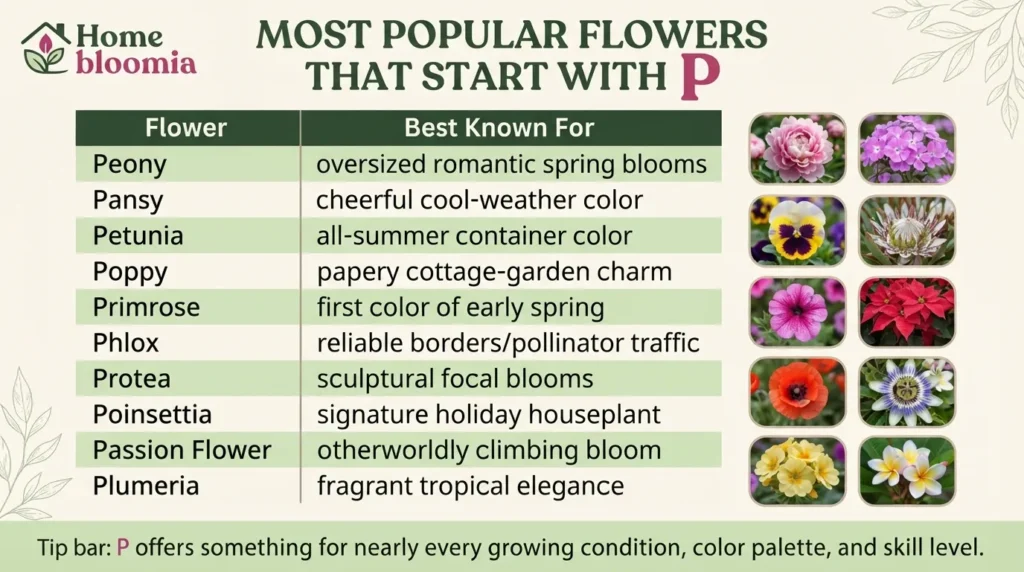
Quick Answer: What Are the Most Popular Flowers That Start With P?
| Flower | Best Known For |
|---|---|
| Peony | Oversized, romantic spring blooms |
| Pansy | Cheerful color in cool weather |
| Petunia | All-summer color in pots and hanging baskets |
| Poppy | Papery, wind-tossed cottage-garden charm |
| Primrose | The very first color of early spring |
| Phlox | Reliable borders and pollinator traffic |
| Protea | Sculptural, architectural focal blooms |
| Poinsettia | The signature holiday houseplant |
| Passion Flower | An almost otherworldly climbing bloom |
| Plumeria | Fragrant tropical elegance |
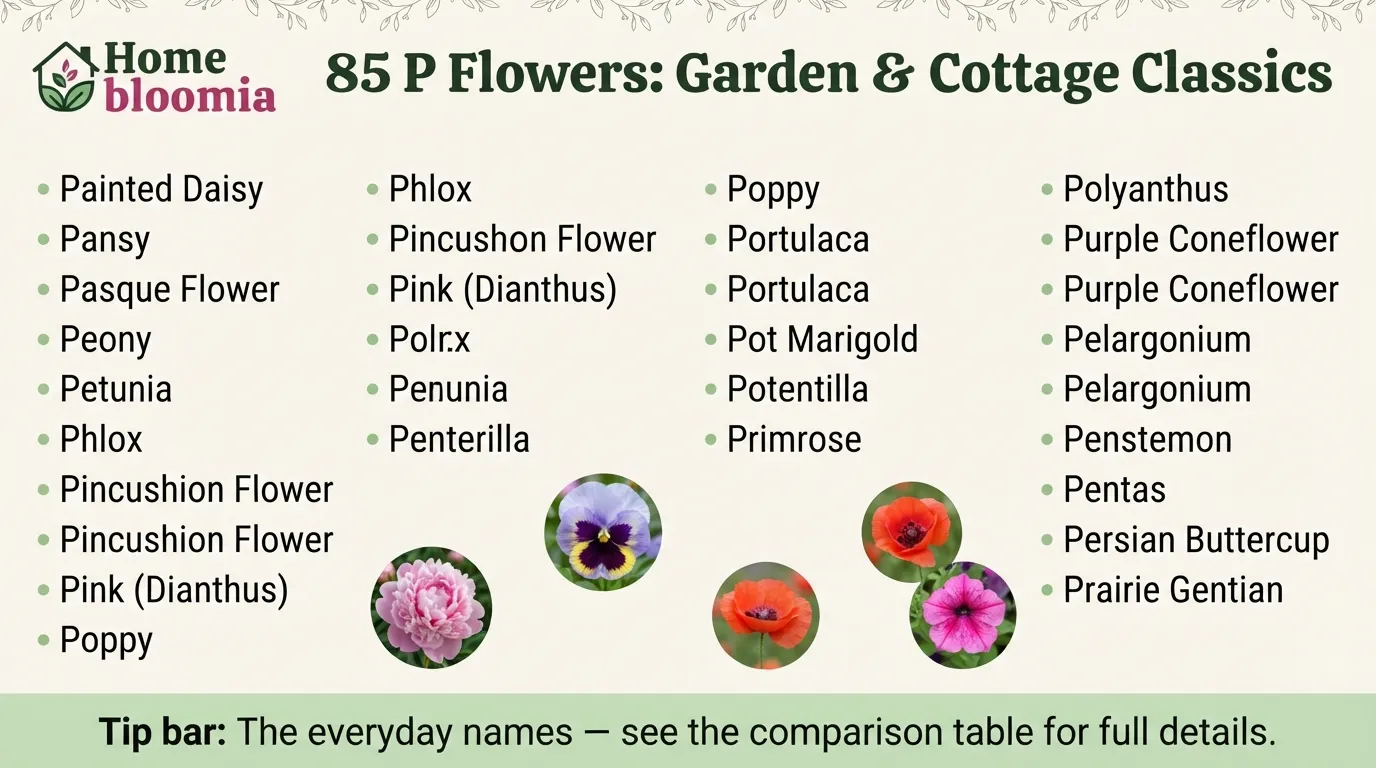
85 Flowers That Start With P
Below is the full master list. Botanical synonyms are folded into a single entry so nothing is double-counted.
Painted Daisy, Painted Tongue, Pansy, Pasque Flower, Passion Flower, Pavonia, Peace Lily, Pearly Everlasting, Peacock Orchid, Pelargonium, Penstemon, Pentas, Peony, Perilla Flower, Periwinkle, Persian Buttercup, Persian Candytuft, Persian Violet, Peruvian Lily, Petunia, Phacelia, Pheasant’s Eye, Phalaenopsis Orchid, Philadelphus, Phlomis, Phlox, Pigsqueak, Pimpernel, Pincushion Flower, Pine Lily, Pineapple Lily, Pink (Dianthus), Pink Jasmine, Pink Rain Lily, Pink Musk Mallow, Pink Turtlehead, Pitcher Plant Flower, Platycodon, Plectranthus Flower, Pleione Orchid, Pleurothallis Orchid, Plumbago, Plumeria, Poinsettia, Polemonium, Polyanthus, Poppy, Portulaca, Pot Marigold, Potentilla, Prairie Gentian, Prairie Smoke, Pride of Madeira, Primrose, Protea, Pulmonaria, Purple Coneflower, Purple Loosestrife, Purple Poppy Mallow, Ptilotus, Pua Kala, Prickly Pear Cactus Flower, Prickly Poppy, Paper Daisy, Parrot Tulip, Paintbrush Lily, Pachysandra Flower, Pomegranate Flower, Plum Blossom, Peach Blossom, Pearl Bush, Peruvian Daffodil, Paradise Flower (Strelitzia), Panama Rose, Pink Powder Puff, Peacock Flower, Paperwhite, Peppermint Stick Geranium, Perennial Sunflower relatives, Pincushion Protea, Pretty Face (Triteleia), Plains Coreopsis, Pink Fairy Duster, Purple Prairie Clover, Prickly Rose, Papyrus Umbrella Sedge (flower spikelets), Pincushion Cactus Bloom.
Master Comparison Table for Flowers Starting With P
Use this table to compare the strongest, most practical P flowers side by side.
| Flower | Botanical Name | Main Colors | Bloom Season | Type | Fragrance | Sun/Light | Difficulty | Pollinator Value |
|---|---|---|---|---|---|---|---|---|
| Painted Daisy | Tanacetum coccineum | Pink, red, white | Late spring–summer | Perennial | Light | Full sun | Easy–moderate | Medium |
| Pansy | Viola × wittrockiana | Purple, yellow, blue, white | Spring & fall | Bedding | Light | Sun–part shade | Easy | Medium |
| Pasque Flower | Pulsatilla vulgaris | Purple, white | Early spring | Perennial | Light | Full sun | Moderate | Medium |
| Passion Flower | Passiflora spp. | Purple, blue, white | Summer–fall | Vine | Light | Full sun | Moderate | High |
| Peace Lily | Spathiphyllum spp. | White | Indoor cycles | Houseplant | Light | Bright indirect | Easy | Low |
| Penstemon | Penstemon spp. | Purple, pink, red | Late spring–summer | Perennial | Light | Full sun | Easy–moderate | High |
| Peony | Paeonia spp. | Pink, white, red, coral | Spring–early summer | Perennial | Moderate–strong | Full sun | Moderate | Medium |
| Petunia | Petunia spp. | Mixed | Spring–frost | Annual | Light | Full sun | Easy | Medium |
| Phalaenopsis Orchid | Phalaenopsis spp. | White, pink, purple | Indoor cycles | Orchid | Light | Bright indirect | Moderate | Low |
| Phlox | Phlox spp. | Purple, pink, white, red | Spring–late summer | Annual/perennial | Moderate | Sun–part shade | Easy–moderate | High |
| Pincushion Flower | Scabiosa spp. | Purple, blue, pink, white | Summer–fall | Annual/perennial | Light | Full sun | Easy | High |
| Plumeria | Plumeria spp. | White, yellow, pink, red | Summer | Shrub/tree | Strong | Full sun | Moderate | Medium |
| Poinsettia | Euphorbia pulcherrima | Red, white, pink | Winter | Shrub | Light | Bright indirect | Moderate | Low |
| Poppy | Papaver spp. | Red, orange, pink, white | Spring–summer | Annual/perennial | Light | Full sun | Easy | Medium |
| Portulaca | Portulaca grandiflora | Pink, yellow, orange, red | Summer–frost | Annual | Light | Full sun | Easy | Medium |
| Primrose | Primula spp. | Yellow, pink, purple, blue | Early spring | Perennial | Light | Part shade | Easy–moderate | Medium |
| Protea | Protea spp. | Pink, red, cream | Late winter–spring | Shrub | Light | Full sun | Moderate–hard | Medium |
| Purple Coneflower | Echinacea purpurea | Purple, pink, white | Summer–fall | Perennial | Light | Full sun | Easy | High |
Types of Flowers That Begin With P
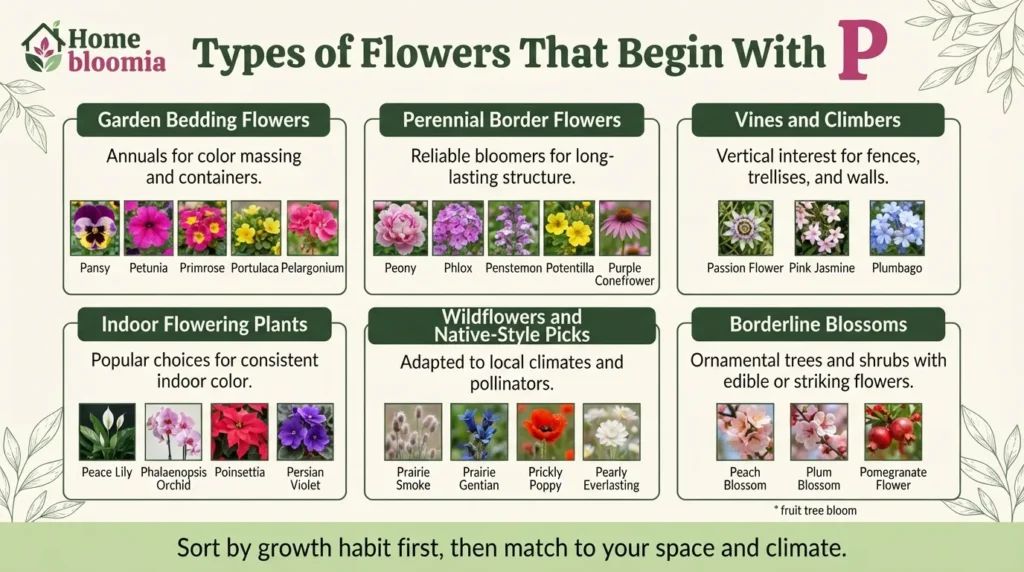
Sorting the P list by growth habit makes it far easier to plan a bed, patio, or windowsill.
Garden Bedding Flowers
Pansy, petunia, primrose, portulaca, pelargonium, pentas, painted daisy, pot marigold, and polyanthus are the workhorses of seasonal color. Pansy and polyanthus like cool weather; petunia, portulaca, and pentas prefer summer heat.
Perennial Border Flowers
Peony, phlox, penstemon, potentilla, pulmonaria, pasque flower, polemonium, purple coneflower, pink turtlehead, pigsqueak, and platycodon return year after year in the right climate, staggering bloom time from early spring through fall.
Vines and Climbers
Passion flower is the showstopper here, with pink jasmine adding fragrance and plumbago offering a loose, trainable habit in warm climates.
Indoor Flowering Plants
Peace lily, Phalaenopsis orchid, poinsettia, Persian violet, pelargonium, and Pleione orchid are the strongest choices for windowsills and bright rooms.
Wildflowers and Native-Style Picks
Prairie smoke, prairie gentian, prickly poppy, phacelia, pimpernel, pua kala, pine lily, and pearly everlasting suit meadow-style or naturalized plantings. Always check local invasiveness before introducing wildflowers outside their native range.
Borderline Blossoms
Peach blossom, plum blossom, pomegranate flower, perilla flower, pachysandra flower, plectranthus flower, pitcher plant flower, and prickly pear cactus flower are true blooms, but they come from fruit trees, herbs, groundcovers, or carnivorous plants rather than flower-first garden stock.
Common Flowers That Begin With P
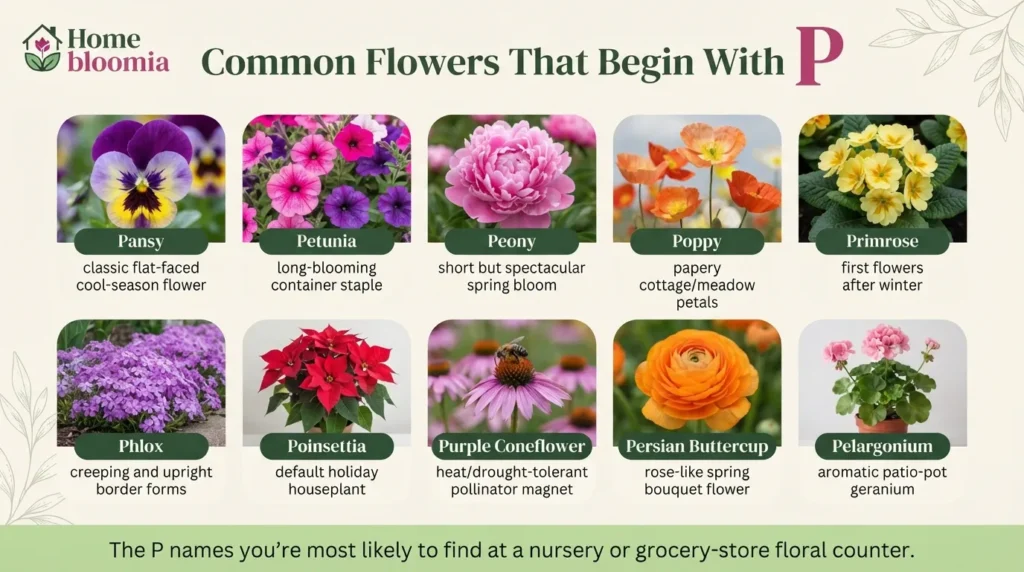
These are the P names you’re most likely to actually find at a nursery or grocery-store floral counter:
- Pansy — the classic flat-faced, cool-season bedding flower.
- Petunia — long-blooming, warm-season container and basket staple.
- Peony — a short but spectacular spring bloom prized for bouquets.
- Poppy — papery, wind-catching petals in cottage and meadow gardens.
- Primrose — one of the very first flowers to open after winter.
- Phlox — available in creeping and upright forms for edging or borders.
- Poinsettia — the default holiday flowering houseplant.
- Purple Coneflower — a pollinator magnet that tolerates heat and drought.
- Persian Buttercup — dense, rose-like petals popular in spring bouquets.
- Pelargonium — the reliable, aromatic-leaved geranium of patio pots.
Popular Flower Names Starting With P
Peony
Peony produces some of the largest, most photographed blooms in the entire garden, soft, layered petals in pink, white, red, coral, and blush. It wants full sun and rich, well-drained soil, and it’s closely tied to romance and prosperity in Western and East Asian traditions alike. Choose peony when you want a short but unforgettable bloom window.
Pansy
A cool-season bedding flower with a flat, almost face-like bloom, pansy shines in containers, window boxes, and spring or fall beds. Its color range, purple, yellow, white, blue, burgundy, and bicolor, makes it one of the easiest flowers to place in almost any color scheme.
Petunia
Petunia is the default answer for anyone who wants nonstop summer color with minimal fuss. Trailing varieties suit hanging baskets, mounding types work well in beds, and both need regular water and consistent sun to stay full through the season.
Poppy
Thin, tissue-paper petals give poppy a delicate, almost fluttering presence in cottage gardens and wildflower meadows. Depending on the species, poppy may be annual or perennial, and colors range from classic red to soft pink, orange, white, and purple.
Primrose
Primrose is prized for blooming before almost anything else in spring. It prefers part shade and consistently moist, well-drained soil, and its yellow, pink, purple, blue, and white flowers soften shaded borders and early containers.
Phlox
Phlox spans low, creeping groundcover types and taller upright border forms, which makes it one of the most versatile P flowers for both edging and vertical color. Many varieties are also fragrant and strongly attractive to pollinators.
Protea
With its sculptural, almost prehistoric shape, protea reads as a genuine focal point rather than filler. It needs full sun and sharp drainage, and it’s considerably more demanding to grow than common bedding flowers, but the payoff is a bloom unlike anything else on this list.
Passion Flower
Passion flower’s intricate, ringed structure makes it look almost engineered. As a vine, it needs a trellis, fence, or arbor, and in the right climate it will quickly cover vertical space with genuinely exotic blooms.
Plumeria
Best known from leis and tropical resort landscaping, plumeria is a fragrant flowering shrub or small tree that thrives in warm, bright conditions and can be container-grown and overwintered indoors in cooler climates.
Peruvian Lily
Also sold as alstroemeria, Peruvian lily is a florist favorite thanks to its long vase life and patterned, multicolor petals that blend easily with other cut stems.
Persian Buttercup
Persian buttercup (ranunculus) produces tightly layered, almost rose-like blooms that are increasingly popular in spring wedding work. It needs well-drained soil and cool growing conditions to perform at its best.
Portulaca
A low, spreading succulent-leaved flower, portulaca shrugs off heat and drought that would wilt most bedding plants, making it ideal for hot, exposed containers and rock gardens.
Penstemon
Tall spikes of tubular flowers make penstemon a magnet for bees and hummingbirds, and its upright form adds valuable vertical structure to pollinator borders.
Pentas
Star-shaped flower clusters in pink, red, white, and lavender make pentas a top pick for butterfly gardens, and it holds up well in summer heat.
Peace Lily
With glossy leaves and clean white spathes, peace lily is one of the most forgiving flowering houseplants it tolerates lower light better than most bloomers, though it dislikes overwatering.
Phalaenopsis Orchid
The most widely sold houseplant orchid, Phalaenopsis produces long-lasting flower spikes in white, pink, purple, and patterned shades under bright, indirect light.
Poinsettia
Poinsettia’s colorful red, pink, white, or cream parts are actually bracts, not petals, but the plant is still the reigning symbol of winter indoor color.
Pincushion Flower
Scabiosa’s rounded, pin-dotted bloom heads add texture and airy movement to both borders and cut-flower arrangements.
Platycodon
Also called balloon flower for its inflated pre-bloom buds, platycodon opens into star-shaped blue, purple, white, or pink flowers and is a dependable, low-maintenance perennial.
Pineapple Lily
Pineapple lily’s tufted flower spike genuinely resembles a pineapple, making it one of the most conversation-starting container plants on this list.
Pulmonaria
An early-spring shade perennial with spotted foliage, pulmonaria brings blue, pink, or purple flowers to woodland-style beds before most summer plants wake up.
Purple Coneflower
A daisy-like, drought-tolerant perennial, purple coneflower is one of the single best pollinator plants on this entire list and holds color from summer through fall.
Paper Daisy
Paper daisy’s stiff, papery petals hold their shape and color exceptionally well when dried, making it a top pick for both fresh beds and dried arrangements.
Ptilotus
With soft, feathery flower spikes in pink and silver, ptilotus brings unusual texture to dry gardens and containers that need something other than a typical round bloom.
Bouquet and Florist Favorites
P flowers punch well above their weight in the cut-flower world. The strongest choices are peony, Peruvian lily, protea, Persian buttercup, pincushion flower, prairie gentian, paper daisy, plumeria, and poinsettia for seasonal work.
| Flower | Bouquet Role | Approx. Vase Life | Best Pairing Style |
|---|---|---|---|
| Peony | Focal bloom | 5–7 days | Romantic arrangements |
| Peruvian Lily | Filler/color | 1–2 weeks | Everyday bouquets |
| Protea | Structural focal | Long-lasting | Modern arrangements |
| Persian Buttercup | Layered focal | 5–7 days | Spring arrangements |
| Pincushion Flower | Texture | 5–8 days | Garden-style bouquets |
| Prairie Gentian | Soft focal/filler | 7–10 days | Elegant mixed bouquets |
| Paper Daisy | Fresh or dried | Long when dried | Dried arrangements |
| Plumeria | Fragrant accent | Short after cutting | Tropical displays |
| Poinsettia | Seasonal accent | Variable | Winter decor |
Less Common and Distinctive Picks
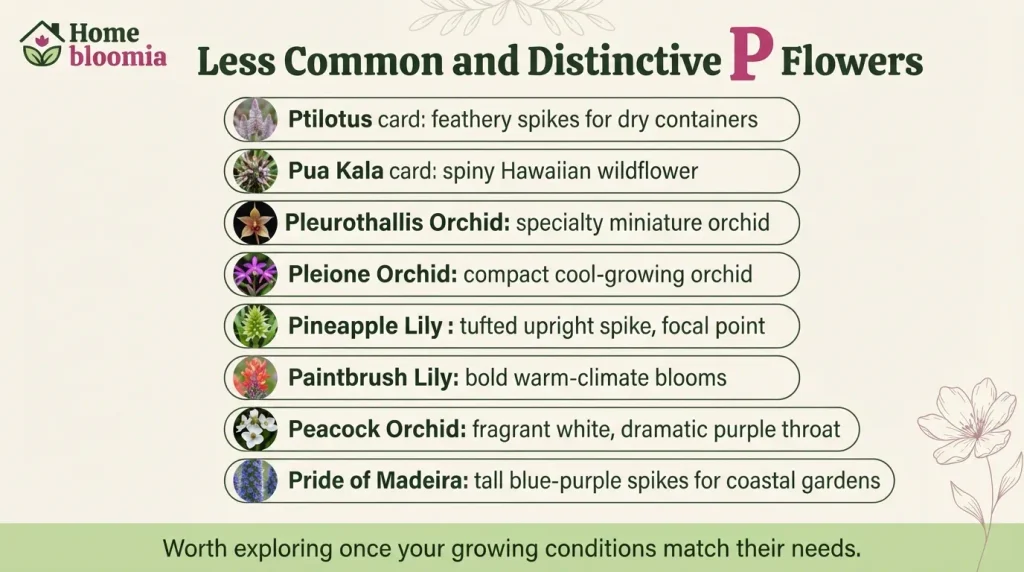
- Ptilotus — feathery spikes for dry containers and unusual texture.
- Pua Kala — a spiny Hawaiian wildflower for native-style dry planting.
- Pleurothallis Orchid — a specialty miniature orchid for collectors.
- Pleione Orchid — compact, cool-growing orchid blooms.
- Pineapple Lily — tufted, upright spike that doubles as a focal point.
- Paintbrush Lily — bold warm-climate blooms for patio pots.
- Peacock Orchid — fragrant white flowers with a dramatic purple throat.
- Pride of Madeira — tall blue-purple spikes for coastal, dry gardens.
- Pearl Bush — an underused spring shrub with clouds of white blossom.
- Peruvian Daffodil — a fragrant, spidery-petaled summer bulb.
Plants vs. Flowers That Start With P
Not every P-named plant belongs on a flower-first list. Some are primarily grown for foliage, structure, or fruit, with flowers as a secondary trait.
| Entry | Why It Appears in Lists | Best Label |
|---|---|---|
| Papyrus | Produces small flower clusters, but is mainly reed-like | Borderline plant |
| Parsley | An herb that can flower | Herb, not a main flower |
| Pothos | Grown almost entirely for foliage | Exclude from flower-first lists |
| Palms | Grown for form and structure | Exclude from flower-first lists |
| Peach Blossom | Flower of a fruit tree | Borderline blossom |
| Plum Blossom | Flower of an ornamental or fruiting tree | Borderline blossom |
| Pomegranate Flower | Flower of a fruiting shrub or tree | Borderline blossom |
| Perilla Flower | Herb flower | Borderline flowering plant |
| Pachysandra Flower | Groundcover flower | Borderline flowering plant |
| Pitcher Plant Flower | Flower of a carnivorous plant | Specialty flower |
P Flowers by Color
Purple Flowers That Start With P
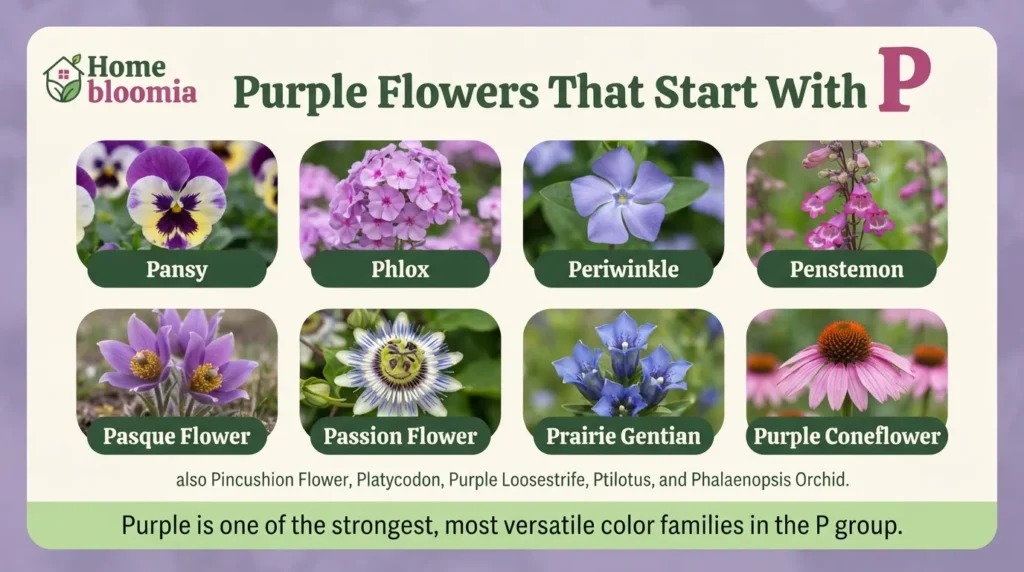
Pansy, phlox, periwinkle, penstemon, pasque flower, passion flower, prairie gentian, pincushion flower, platycodon, purple coneflower, purple loosestrife, ptilotus, and Phalaenopsis orchid all deliver strong purple tones.
Pink Flowers Beginning With P
Peony, petunia, pink jasmine, pink rain lily, pink turtlehead, pink musk mallow, Persian buttercup, pavonia, pentas, pincushion flower, and painted daisy cover everything from soft pastel to bold tropical pink.
White Flowers Beginning With P
Peace lily, Phalaenopsis orchid, pearly everlasting, philadelphus, paper daisy, plumeria, primrose, pansy, petunia, and Persian buttercup all appear in clean white forms suited to moon gardens and indoor display.
Red and Orange Flowers Beginning With P
Poppy, pelargonium, poinsettia, pentas, paintbrush lily, pot marigold, pheasant’s eye, portulaca, Persian buttercup, and petunia deliver the warmest tones in the P group.
Perennials That Start With P
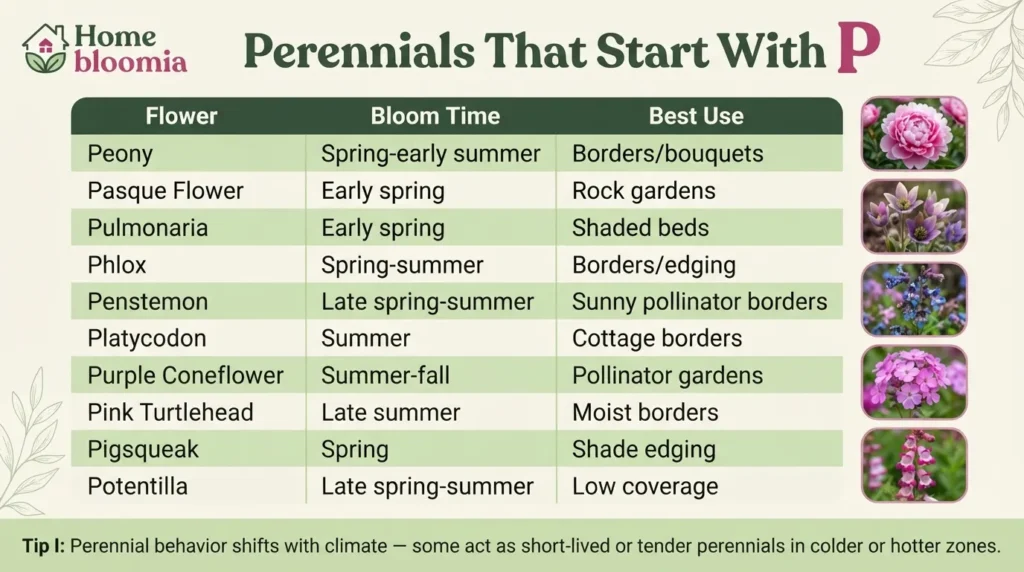
- Peony — spring to early summer; borders and bouquets.
- Pasque Flower — early spring; rock gardens and early color.
- Pulmonaria — early spring; shaded beds and woodland edges.
- Phlox — spring to summer; borders, edging, and pollinator planting.
- Penstemon — late spring to summer; sunny pollinator borders.
- Platycodon — summer; cottage borders and neat perennial beds.
- Purple Coneflower — summer to fall; pollinator gardens.
- Pink Turtlehead — late summer; moist borders and partial shade.
- Pigsqueak — spring; shade edging and foliage interest.
- Potentilla — late spring to summer; borders and low coverage.
Perennial behavior shifts with climate — some entries on this list act as short-lived or tender perennials in colder or hotter zones.
Annual Flowers That Start With P
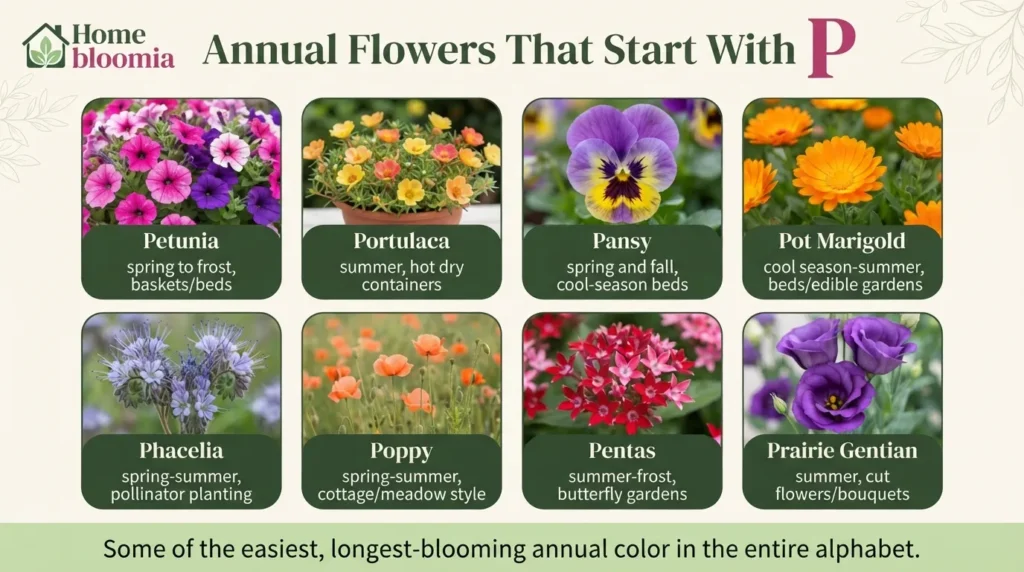
- Petunia — spring to frost; baskets, beds, and containers.
- Portulaca — summer; hot, dry containers and edging.
- Pansy — spring and fall; cool-season beds and pots.
- Pot Marigold — cool season to summer; beds, cut flowers, edible gardens.
- Phacelia — spring to summer; pollinator planting.
- Poppy — spring to summer; cottage and meadow-style planting.
- Pentas — summer to frost; butterfly gardens and patio pots.
- Prairie Gentian — summer; cut flowers and soft bouquet blooms.
Indoor or Protected Space Picks
| Indoor Flower | Best Feature | Light Needs | Ease Level |
|---|---|---|---|
| Peace Lily | Clean white bloom | Bright indirect | Easy–moderate |
| Phalaenopsis Orchid | Long flower spikes | Bright indirect | Moderate |
| Poinsettia | Winter color | Bright indirect | Moderate |
| Persian Violet | Compact blooms | Bright light | Moderate |
| Pelargonium | Bright flower clusters | Strong bright light | Easy with enough sun |
| Pleione Orchid | Specialty orchid blooms | Cool bright conditions | Advanced |
Pothos is often lumped into indoor “P plant” lists, but it is best treated purely as a foliage plant rather than a flower-first entry.
P Flowers by Bloom Season
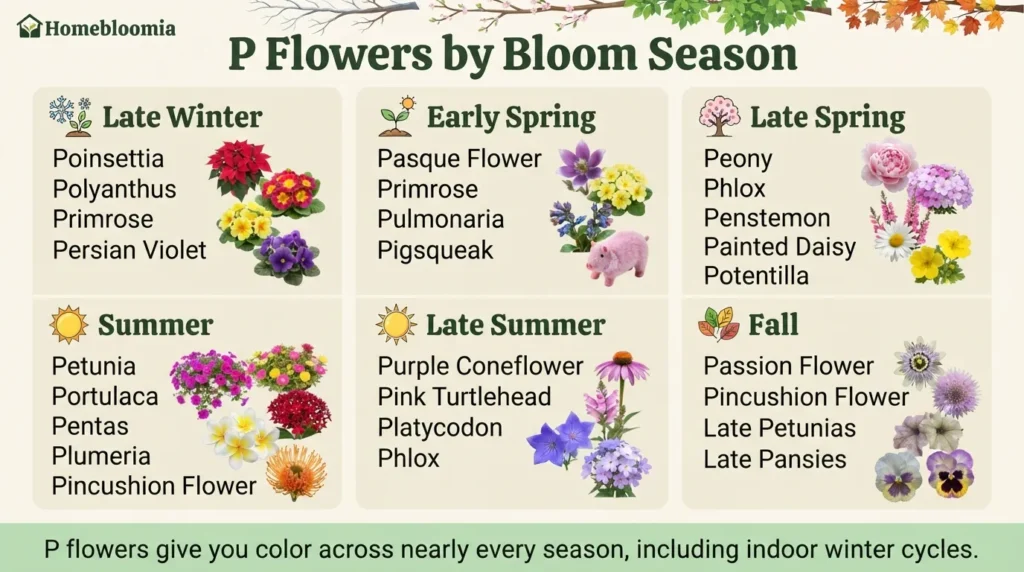
| Season | Best P Flowers |
|---|---|
| Late Winter | Poinsettia, Polyanthus, Primrose, Persian Violet |
| Early Spring | Pasque Flower, Primrose, Pulmonaria, Pigsqueak |
| Late Spring | Peony, Phlox, Penstemon, Painted Daisy, Potentilla |
| Summer | Petunia, Portulaca, Pentas, Plumeria, Pincushion Flower |
| Late Summer | Purple Coneflower, Pink Turtlehead, Platycodon, Phlox |
| Fall | Passion Flower, Pincushion Flower, Late Petunias, Late Pansies |
| Indoor Cycles | Peace Lily, Phalaenopsis Orchid, Persian Violet |
P Flowers by Growing Condition
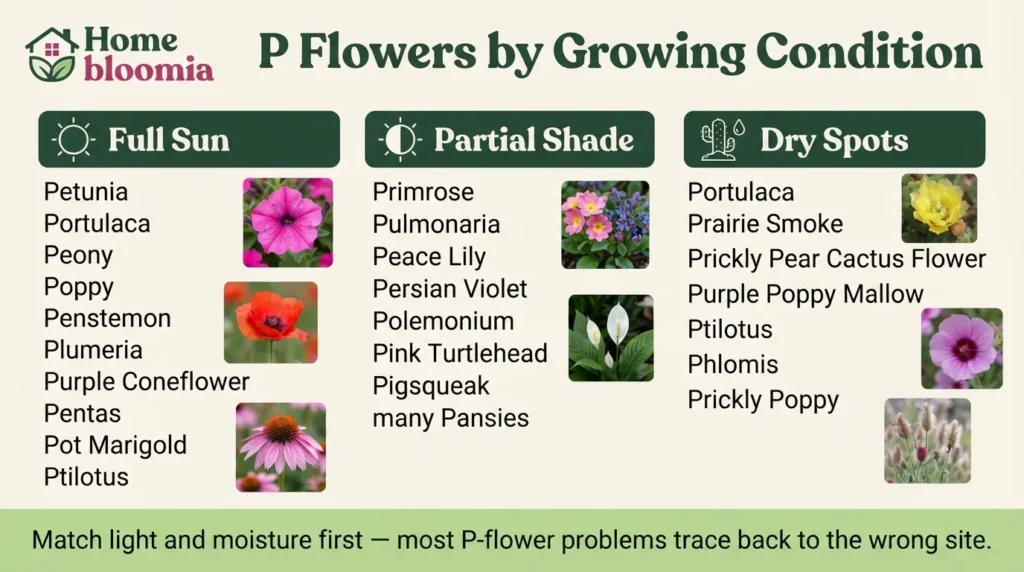
Full sun: petunia, portulaca, peony, poppy, penstemon, plumeria, purple coneflower, pentas, pot marigold, ptilotus.
Partial shade: primrose, pulmonaria, peace lily, Persian violet, polemonium, pink turtlehead, pigsqueak, and many pansies.
Dry spots: portulaca, prairie smoke, prickly pear cactus flower, purple poppy mallow, ptilotus, phlomis, and prickly poppy.
Best P Flowers by Use Case
| Goal | Best P Flowers |
|---|---|
| Beginners | Petunia, Pansy, Portulaca, Pelargonium |
| Fragrance | Plumeria, Peony, Phlox, Pink Jasmine, Philadelphus |
| Pollinators | Penstemon, Pentas, Phlox, Pincushion Flower, Phacelia |
| Containers | Petunia, Pansy, Portulaca, Pelargonium, Primrose |
| Bouquets | Peony, Peruvian Lily, Protea, Persian Buttercup, Prairie Gentian |
| Indoor | Peace Lily, Phalaenopsis Orchid, Poinsettia, Persian Violet |
| Wedding work | Peony, Persian Buttercup, Peruvian Lily, Protea |
| Cottage gardens | Poppy, Phlox, Pink (Dianthus), Pincushion Flower |
Flower Meanings and Symbolism
| Flower | Common Meaning | Best Use |
|---|---|---|
| Peony | Romance, prosperity | Weddings, spring bouquets |
| Poppy | Remembrance, rest | Memorial gardens |
| Pansy | Thoughtfulness | Gift pots, cool-season displays |
| Protea | Strength, transformation | Modern bouquets |
| Primrose | New beginnings | Spring gifts |
| Poinsettia | Celebration, warmth | Holiday decor |
| Plumeria | Beauty, welcome | Tropical arrangements |
| Passion Flower | Faith, wonder | Symbolic gardens |
| Periwinkle | Lasting affection | Soft borders |
| Pink Jasmine | Grace, affection | Fragrant gardens |
Treat symbolism as a light guide rather than a rule — meanings shift by culture, region, and occasion.
Side-by-Side Comparisons
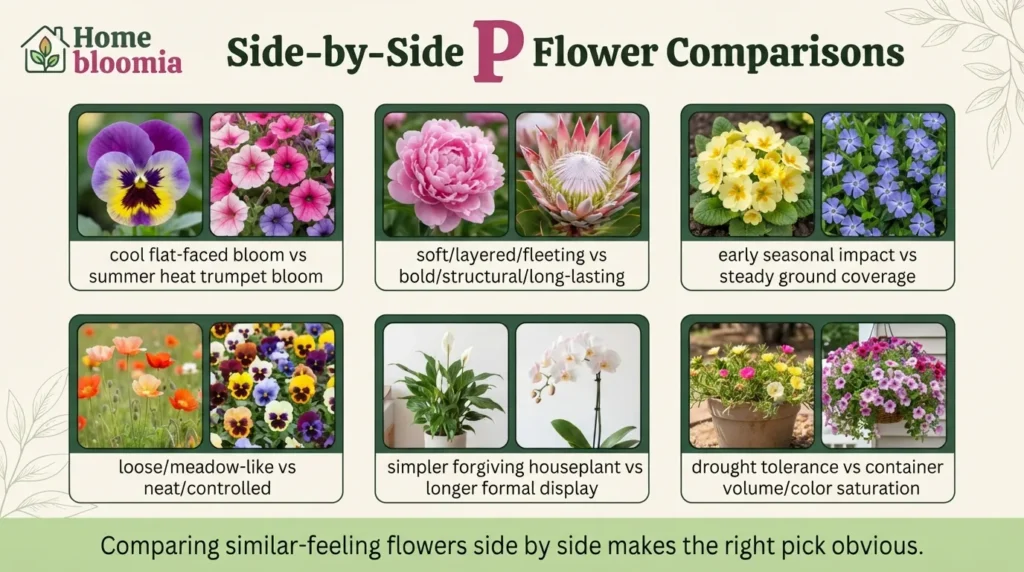
Pansy vs. Petunia — Pansy handles cool spring and fall weather with a flat, face-like bloom; petunia performs in summer heat with trumpet-shaped flowers and more basket volume.
Peony vs. Protea — Peony is soft, layered, and fleeting; protea is bold, structural, and long-lasting as a cut stem.
Primrose vs. Periwinkle — Primrose gives early seasonal impact in beds and pots; periwinkle spreads low for steady ground-level coverage.
Poppy vs. Pansy — Poppy is loose and meadow-like; pansy is neat and controlled.
Peace Lily vs. Phalaenopsis Orchid — Peace lily is the simpler, more forgiving houseplant; Phalaenopsis offers a longer, more formal flower display.
Portulaca vs. Petunia — Portulaca wins on drought tolerance; petunia wins on container volume and color saturation.
Borderline Entries Better Treated Separately
| Borderline Entry | Best Treatment |
|---|---|
| Papyrus | Mention as a plant, not a main flower |
| Parsley | Exclude unless discussing herb flowers |
| Pothos | Exclude from flower-first lists |
| Palms | Exclude from flower-first lists |
| Peach Blossom | Label as a tree blossom |
| Plum Blossom | Label as a tree blossom |
| Pomegranate Flower | Label as a fruit shrub/tree blossom |
| Perilla Flower | Label as an herb flower |
| Pachysandra Flower | Mention as a groundcover, not a main flower |
Final Thoughts
P flowers stretch from effortless bedding plants to rare orchids, tropical shrubs, native wildflowers, and long-lasting bouquet stems. Peony, pansy, petunia, poppy, primrose, phlox, and protea make excellent starting points for most gardens, while passion flower, ptilotus, pineapple lily, and Pleurothallis orchid reward anyone looking for something more unusual. Choose by light, season, available space, and intended use, and this letter will fill nearly every gap in a year-round garden plan.
FAQs
Which flower starting with P smells the best?
Plumeria and philadelphus are widely considered the most fragrant, with pink jasmine a close third for climbing, patio-adjacent scent.
Which flowers that start with P are perennials?
Peony, phlox, penstemon, potentilla, pulmonaria, pasque flower, polemonium, purple coneflower, pink turtlehead, and platycodon are the most dependable perennial choices, though hardiness varies by zone.
Are there indoor flowers that start with P?
Yes, peace lily, Phalaenopsis orchid, poinsettia, Persian violet, and Pleione orchid all perform well indoors with bright, indirect light.
Which P flowers are good for beginners?
Petunia, pansy, portulaca, and pelargonium are the most forgiving choices for new gardeners.
What are rare flowers that start with P?
Pleurothallis orchid, Pleione orchid, ptilotus, pua kala, and paintbrush lily are among the least commonly grown P flowers.
What flower starts with P and is purple?
Pansy, phlox, penstemon, passion flower, and purple coneflower all commonly bloom in shades of purple.
How many flowers start with the letter P?
This guide covers 85 distinct flowers, flowering shrubs, and flowering vines beginning with P, though smaller curated lists often stop closer to 50–70.
What is the difference between plants and flowers that start with letter P?
Some P-named plants, like pothos, palms, and parsley, are grown mainly for foliage or culinary use rather than for their blooms, so they’re better treated separately from true flower-first entries.
Which P flowers are best for bouquets?
Peony, Peruvian lily, protea, Persian buttercup, and prairie gentian are the top florist picks.
Which P flowers are best for full sun?
Petunia, portulaca, peony, poppy, penstemon, and purple coneflower all thrive in full sun.
Which P flowers grow in shade?
Primrose, pulmonaria, pigsqueak, and pink turtlehead tolerate partial shade well.
Which flower names starting with P bloom in spring?
Peony, pasque flower, primrose, pulmonaria, painted daisy, and Persian buttercup are among the strongest spring bloomers.
Which P flowers are best for pots?
Petunia, pansy, pelargonium, portulaca, and primrose all perform reliably in containers.
Is poinsettia a flower that starts with P?
Yes, the colorful parts are technically bracts, but poinsettia is still widely and correctly grouped with flowering plants.
What is the most unusual flower that starts with P?
Passion flower and pineapple lily are frequently cited as the most visually unusual, thanks to their layered or tufted structures.
Which P flowers attract pollinators?
Penstemon, pentas, phlox, pincushion flower, and purple coneflower are especially strong for bees, butterflies, and hummingbirds.
Which P flowers are best for dried arrangements?
Paper daisy and pearly everlasting hold their shape and color best when dried.