105+ Flowers That Start With T: Full Guide, Types & Care
Quick Answer: Flower names starting with T include tulip, tuberose, tiger lily, trillium, torenia, toad lily, treasure flower, and torch lily. The group also covers flowering ornamentals like tibouchina, tithonia, twinspur, and Texas bluebell.
Tulip, tuberose, tiger lily, and trillium are the names most people think of first, but the letter T covers far more ground than a short, familiar list suggests, spring bulbs, woodland shade flowers, cottage garden classics, tropical ornamentals, prairie wildflowers, and reliable container plants all show up here.
How This List Was Built
The count favors clear, recognizable flower names first, then adds widely known flowering ornamentals that people reasonably expect in a broad alphabetical guide. The aim is a list that feels complete without turning into a padded nursery index.
Where a name leans more toward a flowering shrub, vine, herb, or broader ornamental group, that’s flagged clearly rather than folded silently into the flower count. That keeps this guide broader than a short flower post, but cleaner than a general plant index.
T Flower Names: At a Glance
| Common Name | Botanical Name | Plant Type | Main Color | Bloom Season | Best Use |
| Tulip | Tulipa spp. | Bulb flower | Red, pink, yellow, white | Spring | Beds, borders, bouquets |
| Tuberose | Agave amica | Tuberous perennial | White, blush | Summer–early fall | Fragrance, cutting |
| Tiger Lily | Lilium lancifolium | Bulb flower | Orange with spots | Summer | Borders, cottage gardens |
| Trillium | Trillium spp. | Woodland perennial | White, red, pink | Spring | Shade gardens |
| Toad Lily | Tricyrtis spp. | Perennial | Purple, white, spotted | Late summer–fall | Shade borders |
| Torenia | Torenia fournieri | Warm-season bedding | Purple, blue, pink, white | Summer | Containers, edging |
| Treasure Flower | Gazania rigens | Flowering ornamental | Orange, yellow, pink | Late spring–fall | Dry borders, pots |
| Torch Lily | Kniphofia uvaria | Perennial | Red, orange, yellow | Summer | Accent planting |
| Texas Bluebell | Eustoma exaltatum | Wildflower | Blue, lavender, pink | Summer | Wildflower planting |
| Twinspur | Diascia spp. | Soft perennial/annual | Pink, apricot, coral | Spring–fall | Containers, front edges |
| Thrift | Armeria maritima | Perennial | Pink, white | Spring | Rock gardens |
| Tithonia | Tithonia rotundifolia | Annual | Orange, red | Summer–fall | Pollinator gardens |
Full List of Flowers That Start With T
Tacca (Tacca spp.) — The “bat flower” genus produces genuinely strange dark, whiskered blooms that draw serious collector interest in warm, shaded conditions.
Tagetes (Tagetes spp.) — Better known through marigold cultivars, Tagetes brings warm gold, orange, and copper blooms for sunny beds, edging, and pots.
Tahitian Gardenia (Gardenia taitensis) — Creamy white pinwheel flowers and a rich tropical scent make this a standout for warm climates and patio containers.
Talinum (Talinum paniculatum) — Also called Jewels of Opar, this heat-loving perennial produces tiny pink flowers on airy, branching stems above succulent foliage.
Tansy (Tanacetum vulgare) — Flat yellow button flowers in summer give tansy a bold, textured cottage-garden presence.
Tassel Flower (Emilia sonchifolia) — Small tufted blooms in red or orange give this airy annual a light, floating look in loose beds.
Tea Rose (Rosa tea group*)* — Valued for elegant buds, soft fragrance, and layered petals suited to borders and cutting gardens.
Teasel (Dipsacus fullonum) — Spiny, cone-shaped flower heads add structure, wildlife value, and striking dried material.
Teddy Bear Sunflower (Helianthus annuus ‘Teddy Bear’) — A compact, fully double sunflower cultivar with shaggy golden petals, ideal for containers and cutting.
Tecophilaea (Tecophilaea cyanocrocus) — A collector’s bulb prized for its vivid, genuinely rare blue blooms.
Telipogon (Telipogon spp.) — Unusual, intricately patterned orchids that appeal more to collectors than casual gardeners.
Telopea (Telopea speciosissima and relatives*)* — Commonly called waratah, this shrub carries bold crimson flower heads with real architectural presence.
Temple Bells (Smithiantha spp.) — A tropical gesneriad with velvety leaves and bell-shaped orange or red flowers, best suited to warm, humid indoor growing.
Tennessee Coneflower (Echinacea tennesseensis) — A native coneflower with rose-pink petals suited to wildlife gardens and prairie-style beds.
Tephroseris (Tephroseris spp.) — Yellow, daisy-like flowers give this botanical group a clean meadow or alpine feel.
Texas Bluebell (Eustoma exaltatum) — Cup-shaped blue, lavender, pink, or white blooms give this wildflower a refined look in cutting gardens.
Texas Bluebonnet (Lupinus texensis) — One of the best-known Texas wildflowers, forming bold blue spikes in spring mass plantings.
Texas Lantana (Lantana urticoides) — Bright orange and yellow flower clusters draw butterflies and thrive in hot, sunny, dry spots.
Texas Mountain Laurel (Dermatophyllum secundiflorum) — A flowering shrub or small tree with hanging purple clusters for warm-climate landscapes.
Texas Paintbrush (Castilleja indivisa) — Brilliant red-orange bracts give this wildflower a painted, flame-like look each spring.
Texas Primrose (Oenothera speciosa) — Pale pink blooms spread easily and brighten open ground in spring and early summer.
Texas Sage (Leucophyllum frutescens) — A shrub whose purple flowers are the major ornamental feature in hot, dry landscapes.
Texas Star Hibiscus (Hibiscus coccineus) — Large scarlet star-shaped flowers make this a strong focal plant for damp ground and bold summer borders.
Texas Yellow Star (Lindheimera texana) — A cheerful annual wildflower with bright yellow, star-shaped blooms native to Texas prairies and roadsides.
Thalia (Thalia dealbata) — A tall aquatic perennial with violet flowers above blue-green foliage, ideal near ponds and wet soil.
Thalictrum (Thalictrum spp.) — Also called meadow rue, this graceful perennial produces airy sprays in lilac, cream, or yellow.
Thevetia (Thevetia peruviana) — A warm-climate ornamental with bright yellow trumpet blooms and a tropical feel.
Thermopsis (Thermopsis spp.) — False-lupine-style yellow spikes give this perennial a sturdy presence in sunny planting.
Thespesia (Thespesia populnea and relatives*)* — Large hibiscus-like blooms give this warm-climate tree or shrub a lush ornamental quality.
Thimbleweed (Anemone virginiana) — Pale flowers followed by distinctive seed heads make this more valuable for texture than color alone.
Thistle (Cirsium and related genera*)* — Flowering thistles carry bold purple or pink heads and a rugged, pollinator-friendly presence.
Thlaspi (Thlaspi arvense) — Also called pennycress, this modest wildflower has small white blooms followed by distinctive flat seed pods.
Thrift (Armeria maritima) — Neat cushions topped with pink or white flower balls, a favorite for rock gardens and edging.
Thunbergia (Thunbergia alata and relatives*)* — Cheerful flowers and climbing or trailing growth make this useful for trellises, baskets, and warm-season color.
Thyme (Thymus spp.) — Known primarily as a herb, thyme also produces delicate pink, white, or lavender blooms that support pollinators.
Tiarella (Tiarella spp.) — Foamflower adds soft, bottlebrush-like blooms and attractive foliage to shade gardens.
Tidy Tips (Layia platyglossa) — White-tipped yellow petals give this annual daisy a crisp, cheerful look in sunny beds and wildflower mixes.
Tickseed (Coreopsis spp.) — Dependable, long-blooming, and bright, in yellow, gold, red, or pink depending on species.
Tick Trefoil (Desmodium spp.) — Small pea-like flowers and strong wildlife value make this useful in meadow and natural planting.
Tiger Flower (Tigridia pavonia) — Opens dramatic, patterned blooms in vivid orange, red, pink, or yellow shades.
Tiger Lily (Lilium lancifolium) — One of the most recognizable T flowers, with orange, recurved, dark-spotted petals.
Tiger’s Jaw (Faucaria tigrina) — A succulent with toothed, jaw-like leaves and bright yellow daisy flowers that open in sunny, dry conditions.
Tithonia (Tithonia rotundifolia) — Often called Mexican sunflower, it brings fiery orange or red blooms and strong pollinator appeal.
Tibetan Blue Poppy (Meconopsis betonicifolia) — Famous for its rare, genuinely cool-blue color, one of the most coveted names in ornamental gardening.
Tibouchina (Tibouchina urvilleana) — Deep royal-purple flowers and velvety foliage make it a standout in warm gardens and large pots.
Toad Lily (Tricyrtis spp.) — Spotted, orchid-like flowers appear late in the season and suit part shade beautifully.
Toadflax (Linaria vulgaris and related species*)* — Upright spikes in yellow, purple, or mixed shades give a loose, naturalized look.
Tobacco Flower (Nicotiana alata and relatives*)* — Tubular or starry blooms with evening fragrance make this a classic moon-garden choice.
Toothpick Weed (Ammi visnaga) — Delicate, lacy white flower umbels resemble Queen Anne’s Lace and work well in cut-flower and wildflower borders.
Toothwort (Cardamine concatenata and relatives*)* — A woodland spring flower with pale blooms suited to native shade planting.
Torch Ginger (Etlingera elatior) — Large, waxy blooms in pink or red make this one of the boldest tropical ornamentals in the alphabet.
Torch Lily (Kniphofia uvaria) — Tall red, orange, and yellow flower spikes give strong vertical drama and hot-color energy.
Torenia (Torenia fournieri) — Blue, purple, pink, or white flowers that perform especially well in containers and bright shade.
Touch Me Not (Impatiens balsamina, older usage*)* — An old-fashioned bedding plant lining its stems with pink, red, white, or purple blooms.
Townsend Daisy (Townsendia spp.) — Compact plants with daisy-like flowers in lavender, pink, or white, suited to alpine and gravel gardens.
Tower of Jewels (Echium wildpretii) — A towering flower spike packed with rosy blooms gives this biennial dramatic architectural effect.
Trachelium (Trachelium caeruleum) — Dense heads of blue, violet, or white flowers, useful in cutting gardens and airy borders.
Tradescantia (Tradescantia spp.) — Spiderwort types produce clear blue, violet, pink, or white flowers for borders and natural planting.
Trailing Abutilon (Abutilon megapotamicum) — Lantern-shaped red and yellow blooms hang from arching stems, suited to containers or warm walls.
Trailing Lobelia (Lobelia erinus, trailing forms*)* — Blue, white, purple, or pink flowers spill neatly from baskets and front edges.
Trailing Verbena (Verbena, trailing forms*)* — Long-blooming clusters in red, pink, white, or purple, reliable as a pot and border filler.
Transvaal Daisy (Gerbera jamesonii) — Also known as the gerbera daisy, valued for broad, colorful blooms and strong cutting potential.
Traveller’s Joy (Clematis vitalba) — A flowering vine with clouds of pale blooms that bring softness and movement to vertical planting.
Trautvetteria (Trautvetteria caroliniensis) — A moisture-loving woodland perennial with pale, airy flowers and a gentle, natural look.
Treasure Flower (Gazania rigens) — Opens brightly colored blooms in the sun and excels in dry, bright conditions.
Tree Dahlia (Dahlia imperialis) — A towering dahlia sending up tall stems with large pale pink to lilac blooms late in the season.
Tree Lupin (Lupinus arboreus) — Yellow flower spikes and silvery foliage give this shrub coastal and dry-bank charm.
Tree Mallow (Lavatera arborea and related species*)* — Bears soft pink to purple flowers and fits windy, informal gardens.
Tree Peony (Paeonia suffruticosa) — Massive, silky spring blooms make this one of the most dramatic flowering shrubs.
Tree Tobacco (Nicotiana glauca) — A tall flowering ornamental with yellow tubular blooms and a strong presence in warm climates.
Trientalis (Lysimachia europaea, formerly Trientalis europaea) — Star-shaped pale blooms give this plant a delicate woodland look.
Trifolium (Trifolium spp.) — Clover flowers in white, pink, crimson, or red add value to meadow planting and pollinator mixes.
Trillium (Trillium spp.) — Three petals and three leaves define trillium, one of the most recognized woodland flowers of spring.
Trimezia (Trimezia spp.) — Sometimes called yellow walking iris, offering starry yellow blooms above iris-like foliage.
Triteleia (Triteleia laxa and relatives*)* — Slender stems topped with blue or purple star-shaped flowers for spring to early summer displays.
Tritonia (Tritonia spp.) — A corm flower with bright orange, red, yellow, or pink blooms that thrive in sunny planting.
Triodanis (Triodanis perfoliata and relatives*)* — Linked with Venus-looking-glass types, adding small violet-blue flowers to native planting.
Trollius (Trollius europaeus and relatives*)* — Globe-shaped yellow or orange flowers give a rounded, cheerful form in moisture-loving borders.
Tropaeolum (Tropaeolum majus and relatives*)* — Commonly known as nasturtium, offering bright edible blooms and rounded leaves.
Trumpet Honeysuckle (Lonicera sempervirens) — Slender red or coral tubular flowers make this vine excellent for hummingbird gardens.
Trumpet Lily (Lilium regale and related forms*)* — Large flared blooms and noticeable fragrance make it a standout cut and border flower.
Trumpet Vine (Campsis spp.) — A vigorous flowering climber with showy trumpet-shaped blooms and strong summer color.
Tuberaria (Tuberaria guttata and related species*)* — Small, rock-rose-like flowers suited to dry soils and alpine-style planting.
Tuberose (Agave amica) — Famous for intense perfume and waxy white blooms, one of the most memorable T flowers.
Tuberose Geranium (Pelargonium triste and related fragrant types*)* — A scented geranium grown more for fragrance and curiosity than showy bloom.
Tuberous Begonia (Begonia tuberhybrida) — Large ruffled blooms in rich colors, a favorite for shaded containers and patios.
Tulbaghia (Tulbaghia violacea) — Also called society garlic, carrying lilac flowers on upright stems, useful in borders.
Tulip (Tulipa spp.) — The most recognized T flower, offering an enormous range of colors, forms, and spring uses.
Tulip Poppy (Papaver glaucum, in some references*)* — Scarlet, cup-shaped blooms make a vivid annual accent.
Tufted Pansy (Viola cornuta types, ornamental usage*)* — Compact plants with cheerful, face-like flowers for edging, pots, and cool-season displays.
Tundra Aster (Aster sibiricus and related use*)* — Purple or blue daisy-like blooms bring cool late-season color in colder climates.
Turkish Sage (Phlomis russeliana and related species*)* — Whorled yellow flowers and textured foliage give strong structure and drought tolerance.
Turk’s Cap (Malvaviscus arboreus) — Folded red blooms draw hummingbirds and thrive in warm gardens with filtered light or sun.
Turk’s Cap Lily (Lilium superbum and relatives*)* — Dramatically recurved petals make this lily form especially striking in summer borders.
Turk’s Cap Mallow (Malvaviscus penduliflorus, garden use*)* — A warm-climate flowering shrub with lantern-like blooms and tropical character.
Turnera (Turnera ulmifolia and relatives*)* — Carries bright yellow blooms that open freely in sunny conditions.
Turtlehead (Chelone spp.) — Snap-like blooms in pink or white give a distinct shape and a place in moist borders.
Twayblade (Neottia and older Listera group naming*)* — Small, subtle orchids of interest to native and botanical collectors.
Tweedia (Oxypetalum coeruleum) — Admired for its soft blue flowers and airy cottage-garden quality.
Twinflower (Linnaea borealis) — Paired pink bells and low growth make this gentle and charming in woodland settings.
Twin-leaf (Jeffersonia diphylla) — A spring woodland perennial with delicate white flowers above distinctive paired, butterfly-shaped leaves.
Twinspur (Diascia spp.) — Flowers over a long season in soft pink, coral, or apricot shades, especially in containers.
Throatwort (Campanula trachelium, common-name usage*)* — Bell-shaped violet-blue flowers and a classic old-border look.
Popular and Common Flowers That Begin With T
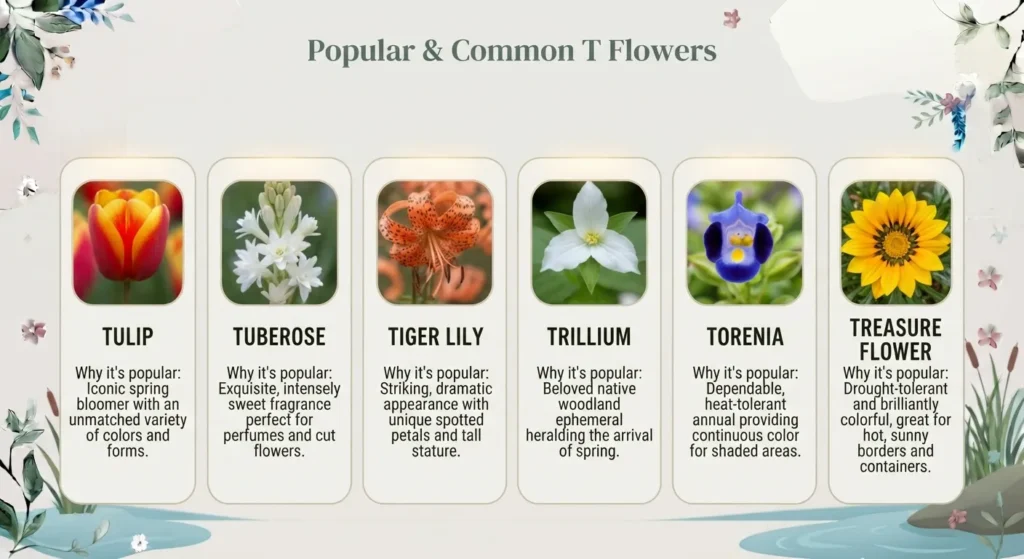
A handful of T flowers stand out quickly because of how often they appear in gardens, bouquets, and seasonal planting.
Tulip leads the group as a globally recognized flower available in a huge range of colors and forms. Tuberose is especially valued for fragrance. Tiger Lily is a bold summer favorite, and Trillium is one of the best-known woodland spring flowers. Torenia is popular for containers, and Treasure Flower is a go-to wherever bright sun and dry conditions dominate.
Plants vs. Flowers That Start With T
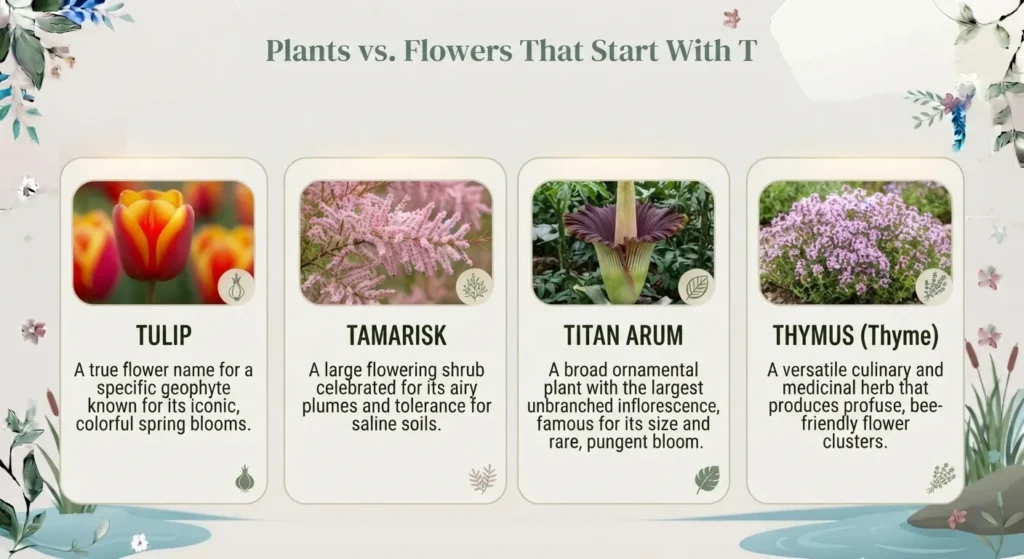
Some T names appear often in alphabet flower lists even though they’re better understood as broader flowering plants, shrubs, herbs, or vines. Examples include Tamarisk, Tecoma, Titan Arum, Trachelospermum, Thymus, and some Tradescantia group names. They can still be useful in a wider ornamental guide, but they don’t always fit a straightforward flower-name list, so this guide flags them separately rather than padding the flower count with them.
Types of Flowers That Start With T
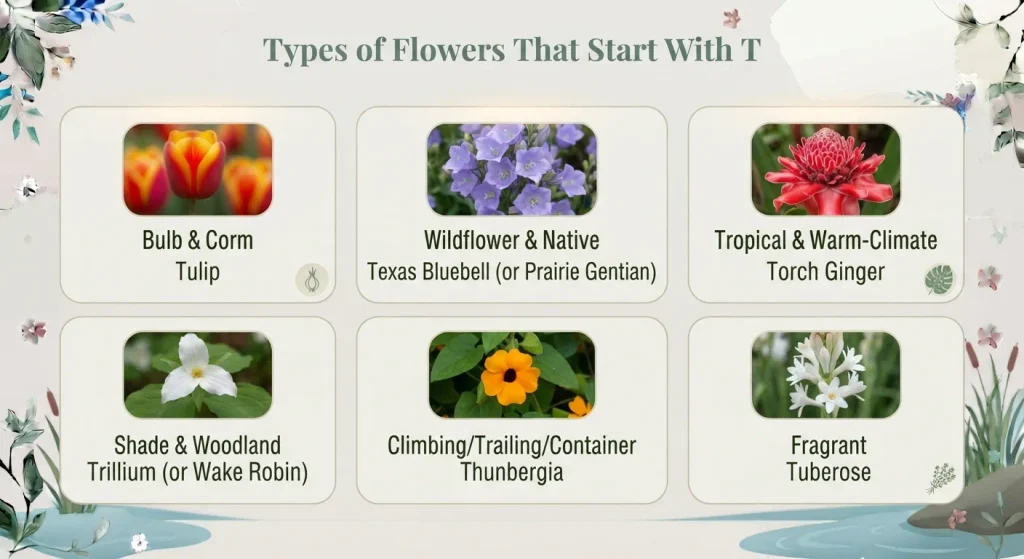
Bulb and Corm Flowers
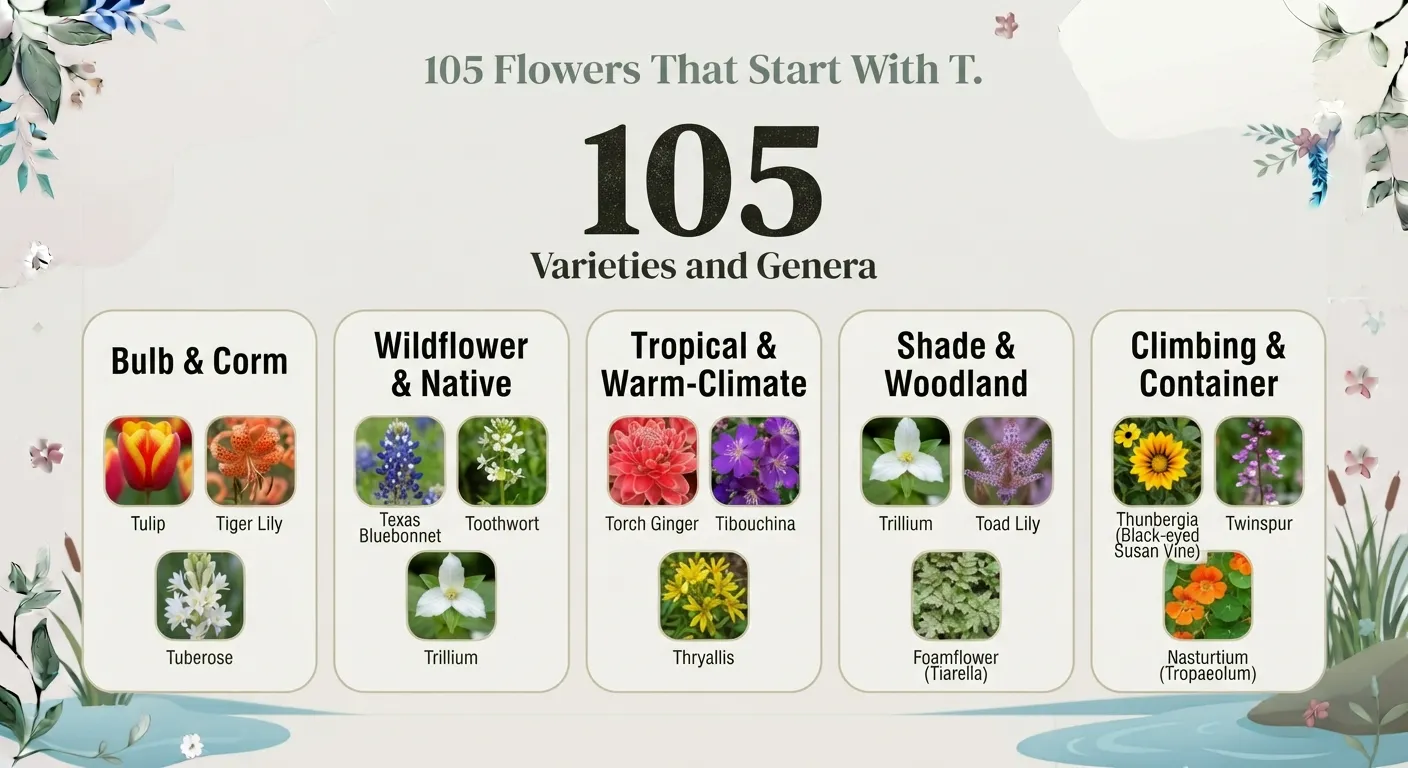
Tulip, Tiger Lily, Trumpet Lily, Triteleia, and Tritonia are among the most recognizable T flowers grown from bulbs or corms, valued for clean flower form and reliable seasonal impact.
Wildflowers and Native-Style Blooms
Texas Bluebell, Texas Bluebonnet, Texas Paintbrush, Toothwort, and Triodanis bring a natural, meadow-like character suited to regional wildflower planting and looser garden styles.
Tropical and Warm-Climate Ornamentals
Torch Ginger, Tibouchina, Tahitian Gardenia, Thevetia, and Turnera bring bold, exotic presence, best grown in warm regions, sheltered gardens, or large patio containers.
Shade and Woodland Flowers
Trillium, Toad Lily, Tiarella, and Turtlehead are among the strongest picks for softer light and cooler garden spaces, offering texture and delicate bloom detail rather than bright, open-sun color.
Climbing, Trailing, and Container Flowers
Thunbergia, Trumpet Honeysuckle, Trailing Lobelia, Trailing Verbena, and Twinspur suit baskets, patio pots, trellises, and front-edge displays where height or spill matters.
Fragrant T Flowers
Tuberose is the best-known example, with Tea Rose, Tobacco Flower, and Tahitian Gardenia also standing out for scent — good picks for cutting gardens, seating areas, and paths.
Purple Flowers That Start With T
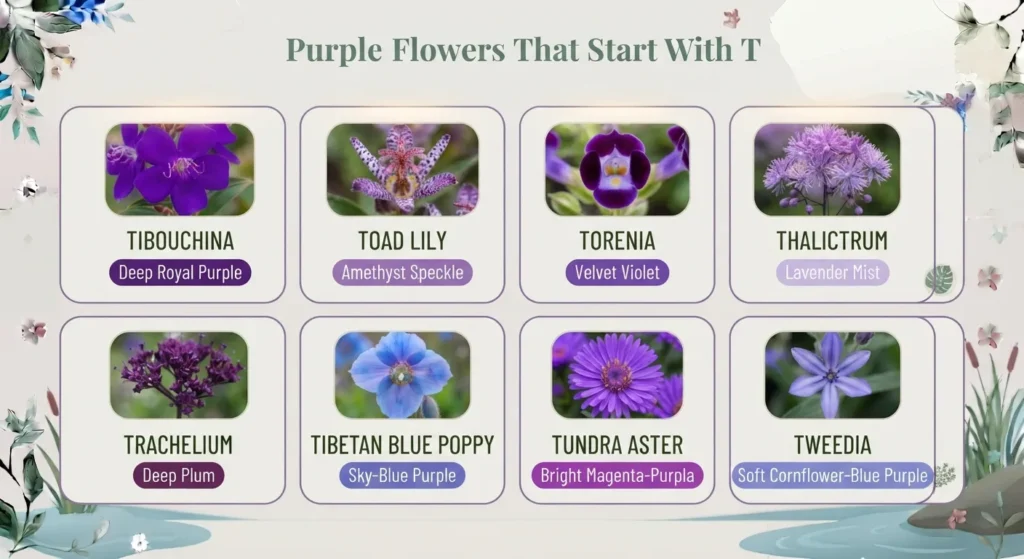
Purple is one of the strongest color themes in the T group, ranging from violet-blue to rich plum and royal purple.
| Flower | Typical Purple Tone | Best Garden Use |
| Tibouchina | Rich royal purple | Warm-climate focal planting |
| Toad Lily | Spotted violet-purple | Shade borders |
| Torenia | Blue, purple to violet | Containers and edging |
| Thalictrum | Soft lilac-purple | Woodland-style beds |
| Trachelium | Blue-violet | Cutting and airy fillers |
| Tibetan Blue Poppy | Blue-purple | Cool-climate collector gardens |
| Tundra Aster | Violet-purple | Late-season perennial borders |
| Tweedia | Soft sky blue | Cottage-style planting |
Perennials That Start With T
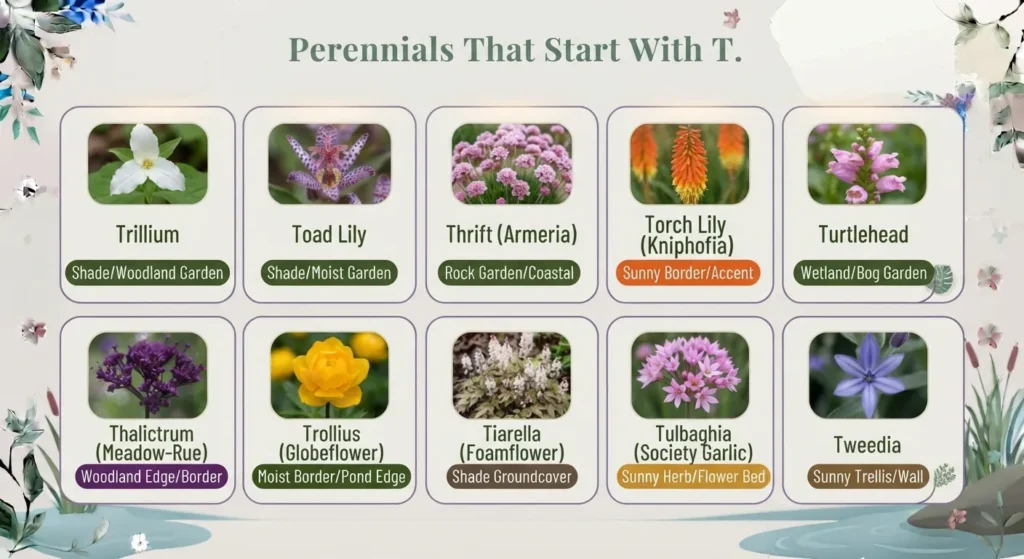
Many of the most dependable T flowers are perennials, especially for borders, rock gardens, and shade planting. Strong choices include Trillium, Toad Lily, Thrift, Torch Lily, Turtlehead, Thalictrum, Trollius, Tiarella, Tulbaghia, and the tickseed (Coreopsis) group. Twinspur and Treasure Flower may persist longer in mild climates but are usually treated more like seasonal plants elsewhere.
Annual Flowers That Start With T
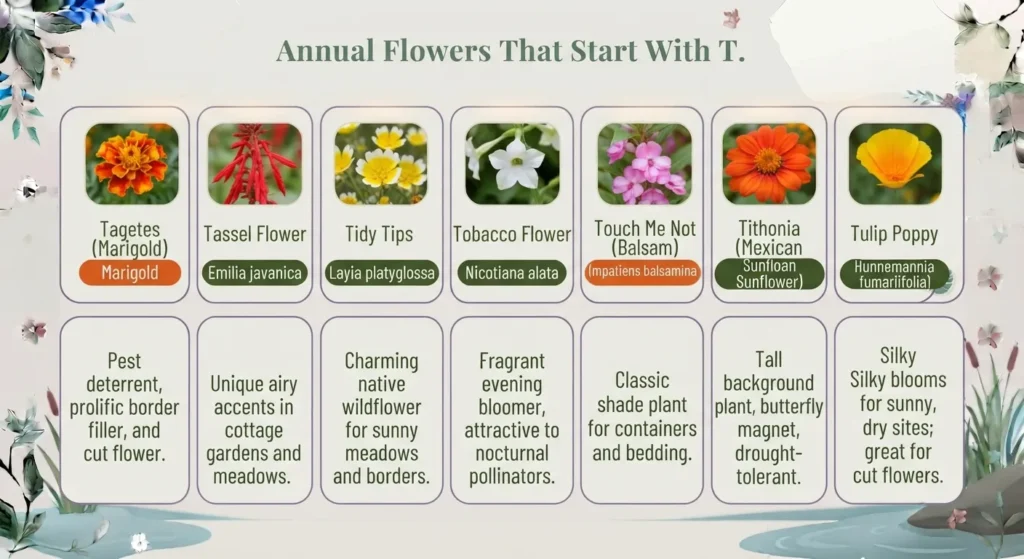
Annual T flowers bring quick color for one-season beds, warm-weather containers, and pollinator planting. Good choices include Tagetes, Tassel Flower, Tidy Tips, Tobacco Flower, Touch Me Not, Tithonia, and Tulip Poppy. In some climates, Torenia and Treasure Flower are also grown as seasonal bedding flowers even though they can persist longer in warm regions.
Rare Flowers Beginning With T
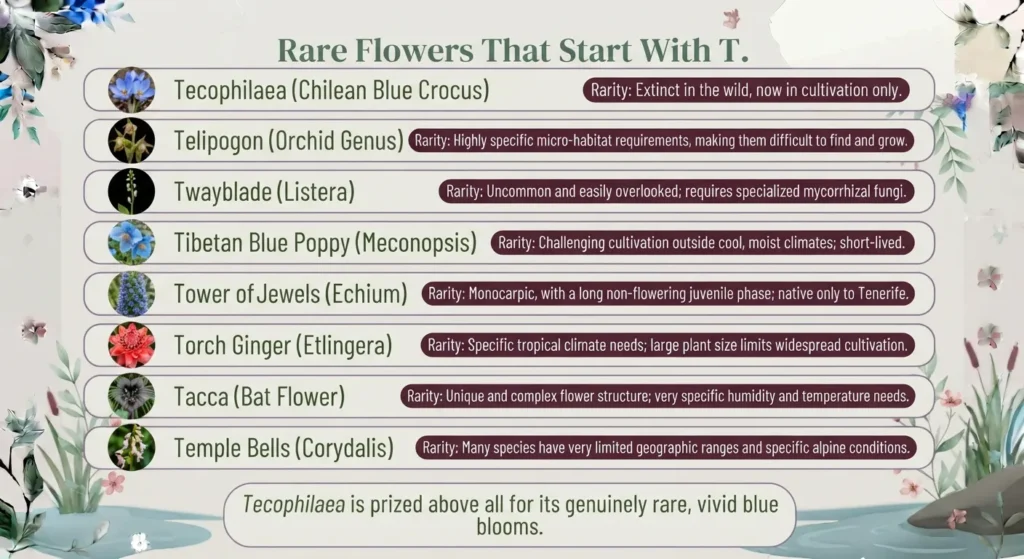
Some T flowers stand out because they’re hard to find, demanding to grow, or visually unlike common garden flowers. Tecophilaea is prized for rare, vivid blue blooms. Telipogon and Twayblade lean toward collector appeal. Tibetan Blue Poppy is admired for its cool blue color and fussy growing needs. Tower of Jewels brings a dramatic flower spike unlike most bedding flowers. Torch Ginger, Tacca, and Temple Bells are typically chosen for striking visual impact rather than familiarity.
Indoor and Container-Friendly Options
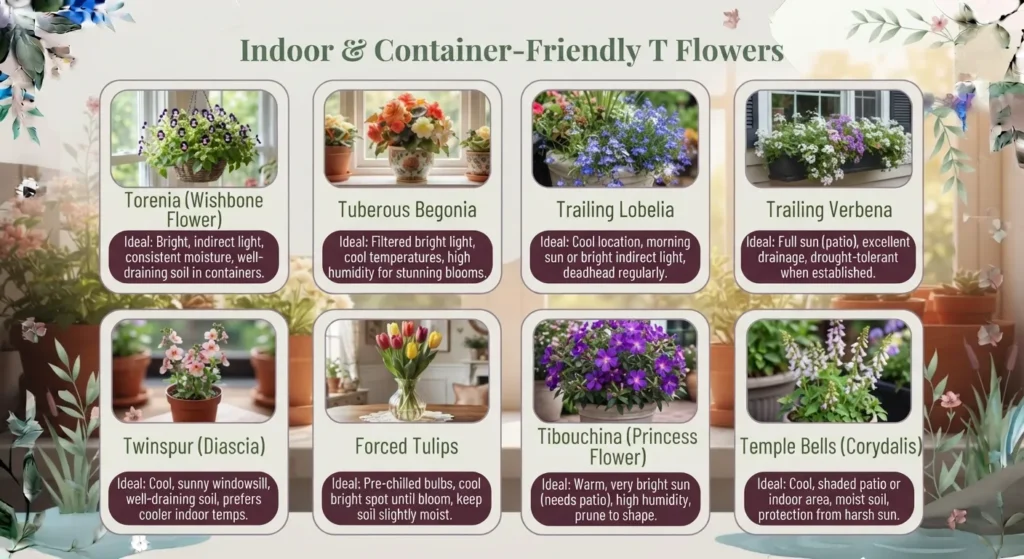
A smaller group of T flowers adapts well to pots, patios, bright sheltered spaces, or seasonal indoor forcing. Torenia is one of the best for containers because it flowers freely and stays tidy. Tuberous Begonia performs very well in shaded pots. Trailing Lobelia and Trailing Verbena are strong basket choices. Twinspur works beautifully in cool-season containers. Tulips can be forced indoors for a spring display, Tibouchina suits large patio pots in warm regions, and Temple Bells is a genuine indoor gesneriad for bright, humid rooms.
Pollinator Friendly and Meadow Picks
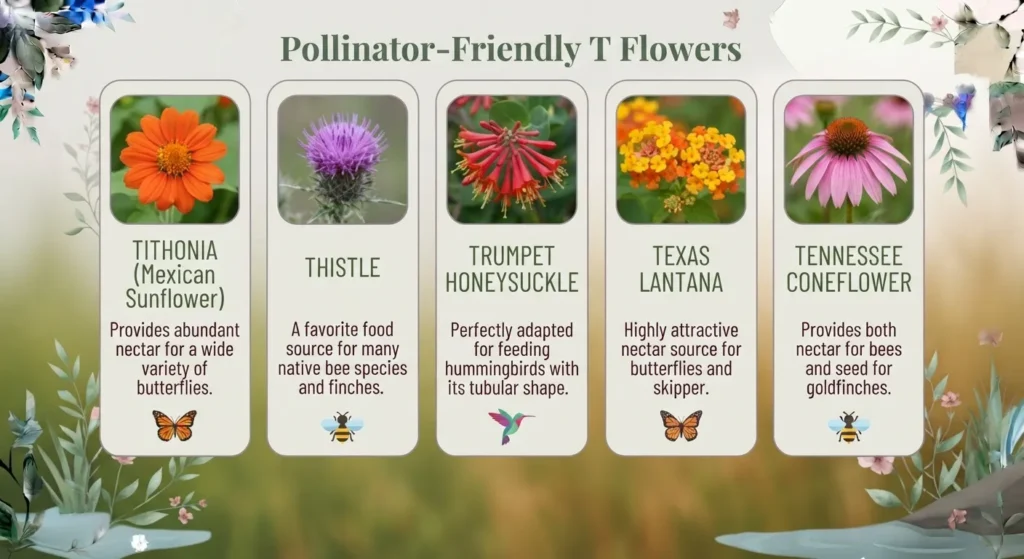
Tithonia, Thistle, Trumpet Honeysuckle, Texas Lantana, and Tennessee Coneflower are some of the strongest T flowers for pollinator-friendly planting. Tithonia gives bright late color with strong butterfly value, while Thistle and Tennessee Coneflower fit more natural meadow-style layouts. Trumpet Honeysuckle is especially useful where hummingbird interest matters, and Texas Lantana thrives in hot, sunny, wildlife-friendly beds. A mix built around Tithonia, Trumpet Honeysuckle, and Tennessee Coneflower covers warm-season color, climbing bloom, and a looser native-style finish without feeling forced.
Cut Flower and Bouquet Favorites
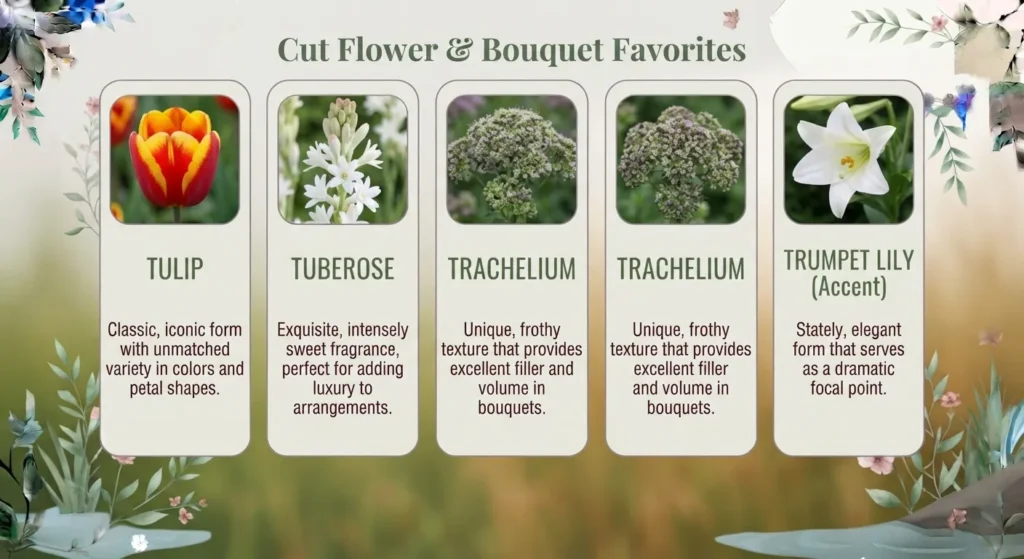
Tulip and Tuberose are the strongest cut-flower choices, offering form, scent, and broad arrangement appeal. Trachelium adds airy filler texture, while Trumpet Lily brings larger, more dramatic blooms to mixed stems. A cutting patch built around Tulip, Tuberose, and Trachelium covers clean spring form, strong fragrance, and a lighter bouquet finish.
Water and Pond Flower Picks
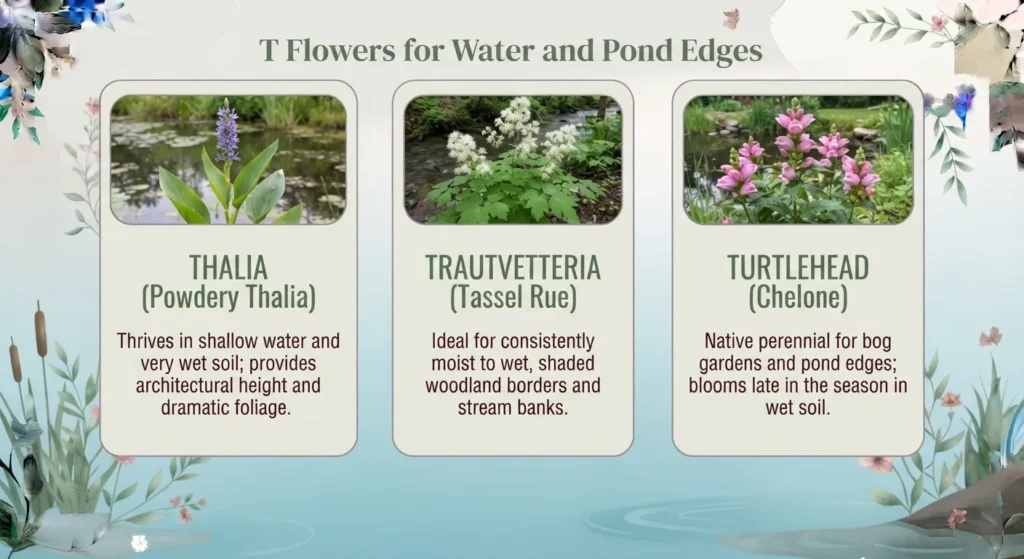
True water and moisture-loving flowers are a smaller part of the T group, but a few stand out. Thalia is the clearest choice for pond edges and wet soil, bringing height and violet bloom above bold foliage. Trautvetteria and Turtlehead also suit damp ground well, especially in naturalistic rather than formal plantings.
Beginner Friendly Choices
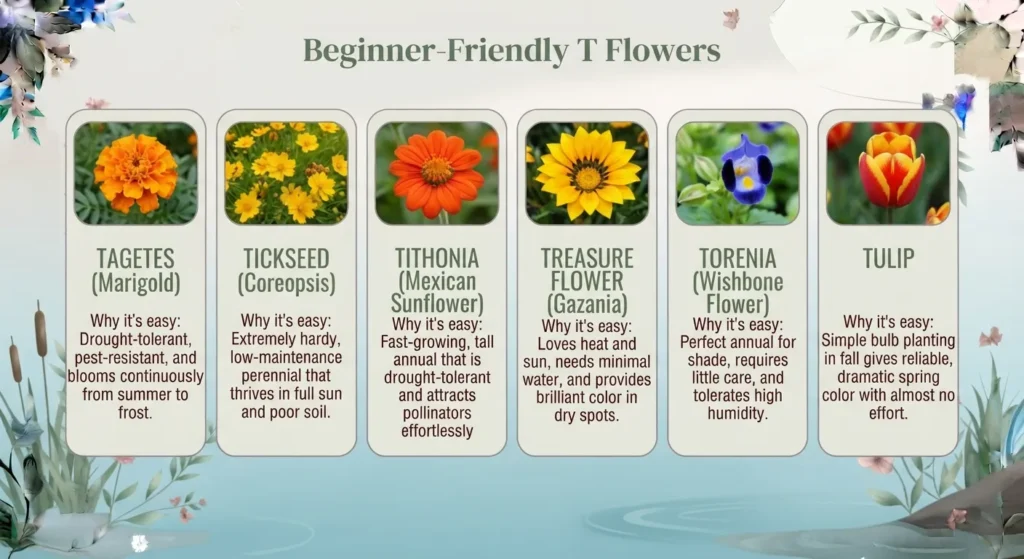
Beginner-friendly flowers usually offer good bloom power without demanding much care. Tagetes is easy and bright. Tickseed is dependable and long-blooming. Tithonia grows fast and attracts pollinators. Treasure Flower handles bright, dry spots well. Torenia is simple for containers and part shade. Tulips are also beginner-friendly when planted at the right time of year.
How to Choose the Right T Flower
- For spring beds: Tulip, Trillium, or Triteleia.
- For fragrance: Tuberose, Tea Rose, or Tobacco Flower.
- For shade: Toad Lily, Trillium, Tiarella, and Turtlehead.
- For dry sunny areas: Treasure Flower, Tithonia, Thrift, and Tagetes.
- For wildlife value: Texas Lantana, Trumpet Honeysuckle, Tithonia, and Thistle.
- For containers: Torenia, Tuberous Begonia, Twinspur, and Trailing Verbena.
- For late-season interest: Toad Lily, Turtlehead, Torch Lily, and Tundra Aster.
A balanced planting usually combines one focal bloom, one long-blooming filler, and one steady structural perennial.
Conclusion
T-named flowers range from familiar classics like Tulip and Tuberose to shade favorites like Trillium and Toad Lily, out toward genuinely unusual names like Tecophilaea and Tibetan Blue Poppy. The easiest way to narrow a list this long is to choose by season, color, light, and growing style first, that turns 105 names into a practical shortlist that actually fits your space.
FAQs
How many flowers start with the letter T?
This guide covers 105 distinct flowers and flowering ornamentals starting with T, though shorter curated lists often stop closer to 80–95.
What is the most popular flower that starts with T?
Tulip is the most globally recognized, with Tuberose a close second for fragrance-driven popularity.
Which flower starting with T smells the best?
Tuberose is widely considered the standout, with Tea Rose and Tahitian Gardenia also strong contenders for fragrance.
Which flowers that start with T are perennials?
Trillium, Toad Lily, Thrift, Torch Lily, Turtlehead, Thalictrum, Trollius, and Tiarella are among the most dependable perennial choices.
Are there annual flowers that start with T?
Yes, Tagetes, Tassel Flower, Tidy Tips, Tobacco Flower, Tithonia, and Tulip Poppy are all reliable true annuals
Are there indoor flowers that start with T?
Yes, Tuberous Begonia, Temple Bells, and forced Tulip bulbs are the strongest indoor and seasonal indoor options.
Which T flowers are good for beginners?
Tagetes, Tickseed, Tithonia, Treasure Flower, and Torenia are all forgiving choices for new gardeners.
What are rare flowers that start with T?
Tecophilaea, Telipogon, Twayblade, Tibetan Blue Poppy, and Tacca are among the least commonly available T flowers.
Are there purple flowers that start with T?
Yes, Tibouchina, Toad Lily, Torenia, Thalictrum, Trachelium, and Tibetan Blue Poppy all commonly bloom in shades of purple or violet-blue.
What is the difference between T flowers and T plants?
A T flower, like Tulip or Toad Lily, is grown and recognized primarily for its bloom. A T plant, like Tamarisk or Thymus, may be a valid garden plant but is valued mainly for foliage, structure, or culinary use rather than flower display.
What flower starts with T and is purple?
Tibouchina, Toad Lily, Torenia, and Thalictrum are the most reliable purple-flowering choices in the T group.