50 Flowers That Start With R: Full Guide, Types & Care
Quick Answer: Flowers That Start With R include Rose, Ranunculus, Rain Lily, Rhododendron, Rudbeckia, Rock Rose, Red Hot Poker, and Ruellia. The group also includes meadow flowers, flowering shrubs, and a few broader blooming plants commonly grouped into R flower lists.
Flowers starting with R include some of the most familiar blooms in gardening, alongside a surprising number of lesser-known meadow flowers, shrubs, vines, and bold landscape plants. Rose and ranunculus come to mind first, but the list quickly opens up to rain lily, red hot poker, rhododendron, ruellia, ragged robin, and many more.
List of Flower Names That Start With R at a Glance
| Flower Name | Scientific Name | Plant Type | Main Color | Native Region/Origin |
| Rose | Rosa spp. | Flowering shrub | Red, pink, white, yellow | Asia, Europe, North America |
| Ranunculus | Ranunculus asiaticus | Flowering perennial | Red, pink, orange, yellow, white | Mediterranean, Southwest Asia |
| Rain Lily | Zephyranthes spp. | Bulbous perennial | Pink, white, yellow | Americas |
| Rhododendron | Rhododendron spp. | Flowering shrub | Pink, purple, red, white | Asia, Europe, North America |
| Rudbeckia | Rudbeckia spp. | Flowering perennial | Yellow, orange, bronze | North America |
| Rock Rose | Cistus spp. | Flowering shrub | Pink, white, purple | Mediterranean |
| Red Hot Poker | Kniphofia spp. | Flowering perennial | Red, orange, yellow | Africa |
| Ruellia | Ruellia simplex | Flowering perennial | Purple, pink, white | Central and South America |
| Rondeletia | Rondeletia odorata | Flowering shrub | Red, orange | Caribbean |
| Rattlesnake Master | Eryngium yuccifolium | Wildflower perennial | White, pale green | North America |
| Rhodora | Rhododendron canadense | Flowering shrub | Pink, lavender | North America |
| Rocket Larkspur | Consolida ajacis | Annual flower | Purple, blue, pink, white | Mediterranean |
| Red Clover | Trifolium pratense | Meadow flower | Pink, red, purple | Europe, Western Asia |
| Rose Campion | Silene coronaria | Short-lived perennial | Magenta, white | Europe, Western Asia |
| Rose of Sharon | Hibiscus syriacus | Flowering shrub | Pink, white, purple, blue | East Asia |
| Rosinweed | Silphium integrifolium | Prairie perennial | Yellow | North America |
| Rafflesia | Rafflesia arnoldii | Parasitic flowering plant | Red, maroon | Southeast Asia |
| Red Spider Lily | Lycoris radiata | Bulbous perennial | Red | East Asia |
| Red Valerian | Centranthus ruber | Flowering perennial | Red, pink, white | Mediterranean |
| Restharrow | Ononis spinosa | Flowering subshrub | Pink | Europe, Western Asia |
| Rice Flower | Ozothamnus diosmifolius | Flowering shrub | White, pink | Australia |
| Rock Soapwort | Saponaria ocymoides | Groundcover perennial | Pink | Europe |
| Rockfoil | Saxifraga spp. | Alpine perennial | White, pink, yellow | Europe, Asia, North America |
| Rocktrumpet | Mandevilla spp. | Flowering vine | Pink, red, white | Tropical Americas |
| Rose Mallow | Hibiscus moscheutos | Flowering perennial | Pink, white, red | North America |
| Rosebay Willowherb | Chamerion angustifolium | Wildflower perennial | Pink-purple | Northern Hemisphere |
| Rue | Ruta graveolens | Herb with flowers | Yellow | Mediterranean |
| Russelia | Russelia equisetiformis | Flowering shrub | Red, coral | Mexico, Central America |
| Rangoon Creeper | Combretum indicum | Flowering vine | Red, pink, white | South and Southeast Asia |
| Ratibida | Ratibida columnifera | Wildflower perennial | Yellow, maroon | North America |
| Romneya | Romneya coulteri | Flowering perennial | White | California, Mexico |
| Romulea | Romulea spp. | Corm perennial | Purple, pink, yellow | Africa, Mediterranean |
| Redbud | Cercis spp. | Flowering tree | Pink, purple | North America, Europe, Asia |
| Russian Sage | Salvia yangii | Flowering perennial | Lavender-blue | Central Asia |
| Reseda | Reseda odorata | Flowering plant | Greenish white, yellow | Mediterranean, North Africa |
| Rhodochiton | Rhodochiton atrosanguineus | Flowering vine | Purple, maroon | Mexico |
| Ragged Robin | Silene flos-cuculi | Wildflower perennial | Pink | Europe, parts of Asia |
| Rue Anemone | Thalictrum thalictroides | Woodland perennial | White, pink | Eastern North America |
| Red Cranesbill | Geranium sanguineum | Flowering perennial | Magenta, pink | Europe, Western Asia |
| Regal Geranium | Pelargonium grandiflorum | Tender perennial | Purple, pink, red, white | Southern Africa |
| Rose Vervain | Glandularia canadensis | Perennial | Purple, pink | North America |
| Rocket (Arugula Flower) | Eruca sativa | Annual | White, pale purple veining | Mediterranean |
| Roselle | Hibiscus sabdariffa | Annual/tender perennial | Yellow with red center | Africa |
| Red Ginger | Alpinia purpurata | Tropical perennial | Red bracts | Southeast Asia, Pacific Islands |
| Rock Jasmine | Androsace spp. | Alpine perennial | White, pink | Europe, Asia |
| Rain Daisy | Dimorphotheca pluvialis | Annual | White with dark center | South Africa |
| Rocky Mountain Columbine | Aquilegia caerulea | Perennial | Blue, white | North America |
| Rosy Pussytoes | Antennaria rosea | Groundcover perennial | Pink | North America |
| Rockcress | Arabis alpina | Perennial | White, pink | Europe, Asia |
| Ruby Grass | Melinis nerviglumis | Ornamental grass | Pink, ruby plumes | Africa |
Bloom Season, Growing Zones, and Habitat at a Glance
| Flower Name | Main Bloom Window | USDA Zone or Climate Note | Best Habitat or Garden Setting |
| Rose | Late spring–fall | Zones 4–10, varies by type | Borders, cutting gardens, mixed beds |
| Ranunculus | Spring | Mild winters, often seasonal elsewhere | Cutting gardens, containers, cool-season beds |
| Rain Lily | Summer–early fall after rain | Zones 7–10 | Containers, borders, bulb pockets |
| Rhododendron | Spring | Zones 4–9, varies by species | Woodland edge, shrub borders |
| Rudbeckia | Summer–fall | Zones 3–9 | Pollinator beds, prairie-style borders |
| Rock Rose | Late spring–summer | Zones 8–10, dry climates | Gravel beds, sunny dry slopes |
| Red Hot Poker | Summer–fall | Zones 5–9 | Bold borders, focal planting |
| Ruellia | Summer–fall | Zones 8–10, warm climates | Borders, moist beds, containers |
| Rocket Larkspur | Spring–early summer | Often grown as an annual in cool seasons | Cutting gardens, cottage beds |
| Rose of Sharon | Summer–early fall | Zones 5–9 | Hedges, screens, shrub borders |
| Red Spider Lily | Late summer–early fall | Zones 6–10 | Bulb borders, naturalized drifts |
| Red Valerian | Late spring–summer | Zones 5–9 | Walls, dry banks, cottage gardens |
| Rock Soapwort | Spring–early summer | Zones 3–8 | Rock gardens, edging |
| Rose Mallow | Mid–late summer | Zones 4–9 | Moist borders, rain gardens |
| Russelia | Warm season, often long-flowering | Frost-free or warm climates | Containers, walls, cascading displays |
| Rattlesnake Master | Summer | Zones 3–8 | Native meadows, pollinator gardens |
| Romneya | Late spring–summer | Zones 8–10, dry warm regions | Mediterranean-style beds |
| Russian Sage | Summer–fall | Zones 4–9 | Dry borders, hot sunny beds |
| Rhodora | Mid–late spring | Zones 3–7 | Moist acidic woodland margins |
| Red Clover | Late spring–summer | Zones 3–9 | Meadow plantings, bee-friendly spaces |
| Rice Flower | Winter–spring | Mild climates | Shrub borders, floral gardens |
| Rockfoil | Spring–summer | Zones 4–8, depending on species | Rock gardens, alpine troughs |
| Ratibida | Summer–fall | Zones 4–9 | Prairie beds, native borders |
| Rhodochiton | Summer–fall | Warm climates or seasonal annual use | Trellises, patio containers |
| Ragged Robin | Late spring–summer | Zones 4–8 | Damp meadows, cottage gardens |
| Red Cranesbill | Late spring–summer | Zones 4–8 | Borders, edging, sunny banks |
| Rocky Mountain Columbine | Late spring–summer | Zones 3–8 | Cool mountain borders, cottage beds |
| Rock Jasmine | Spring–summer | Zones 3–7 | Alpine troughs, rock gardens |
What Counts as an R Flower in This Guide
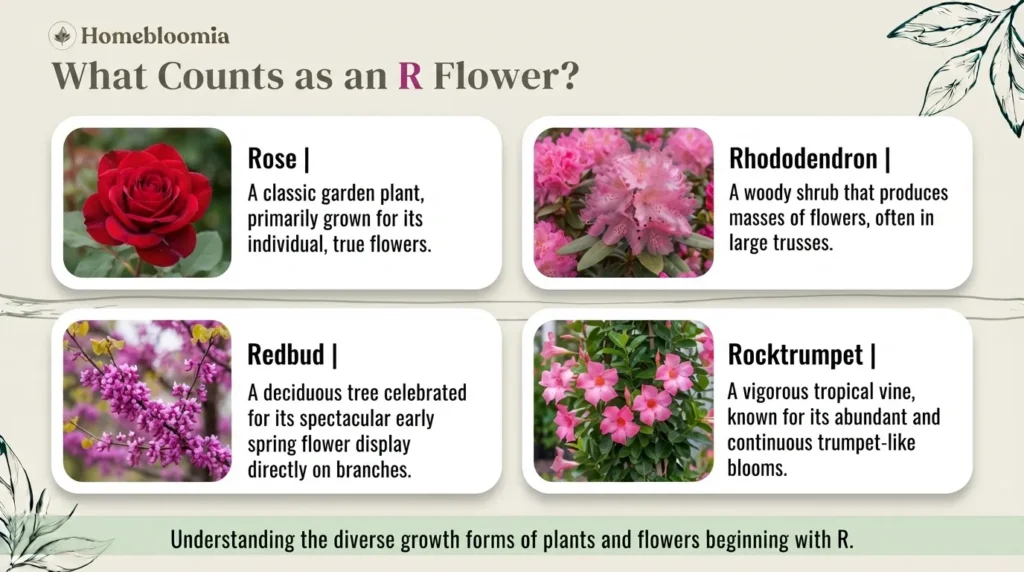
This list uses common names first, with shrubs, trees, vines, and broader flowering plants labeled clearly where relevant, keeping the guide easier to trust and easier to use.
Rose, ranunculus, and rudbeckia fit naturally into standard flower lists. Rhododendron and Rose of Sharon are flowering shrubs. Redbud is a flowering tree. Rocktrumpet and rhodochiton are vines. A few names, like Russian Sage or rue, appear because their blooms are familiar even when the plant itself is discussed in a broader gardening context.
Types of Flowers That Start With R
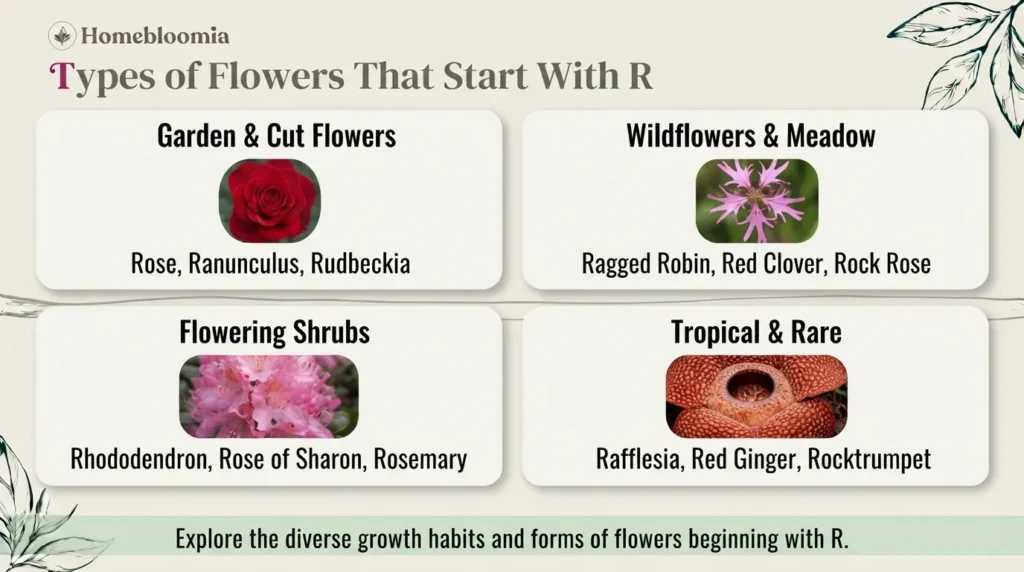
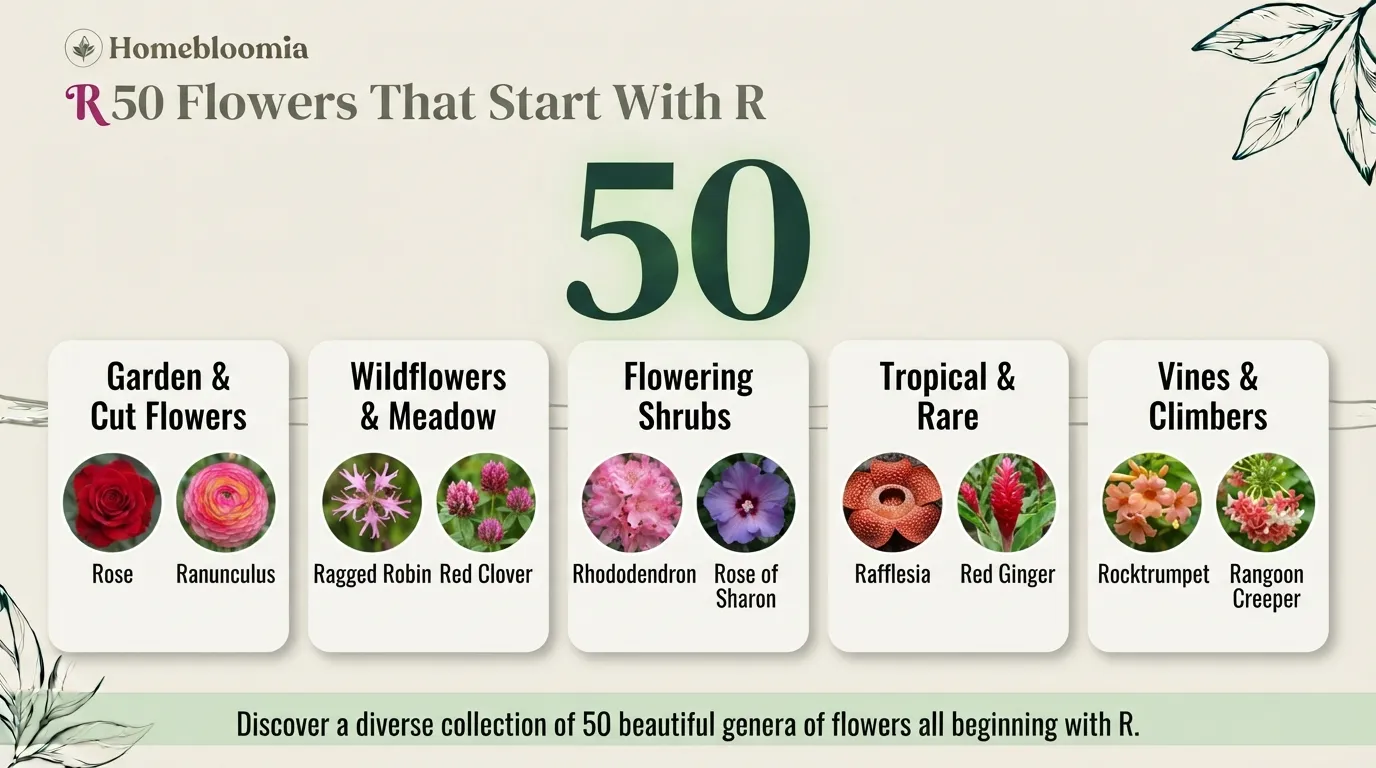
Garden Flowers and Cut Flowers
Rose, ranunculus, rain lily, rocket larkspur, and regal geranium belong to the more ornamental side of the list, tied to bouquets, decorative beds, and planted displays where color and form matter first. Most work best in borders, containers, or cutting patches where their flowers can be appreciated up close.
Wildflowers and Meadow Flowers
Ragged Robin, rattlesnake master, red clover, ratibida, rosebay willowherb, and rue anemone lean toward a looser look, with value coming from pollinator support, movement, or naturalized planting. These fit meadow edges, native gardens, and soft cottage-style layouts.
Flowering Shrubs and Woody Bloomers
Rhododendron, rock rose, Rose of Sharon, rhodora, rice flower, and rondeletia bring height, structure, and longer-term garden presence, suiting shrub borders, foundation beds, screens, and mixed landscapes.
Tropical, Unusual Picks, and Rare Flowers Beginning With R
Rafflesia, rhodochiton, Russelia, Romneya, Rangoon creeper, Romulea, and red ginger bring a more unusual angle, some rare in ordinary home gardens, some warm-climate specific, and some notable mainly for shape or growth habit. These add variety for themed collections and unusual borders.
Most Popular Flower Names Starting With R
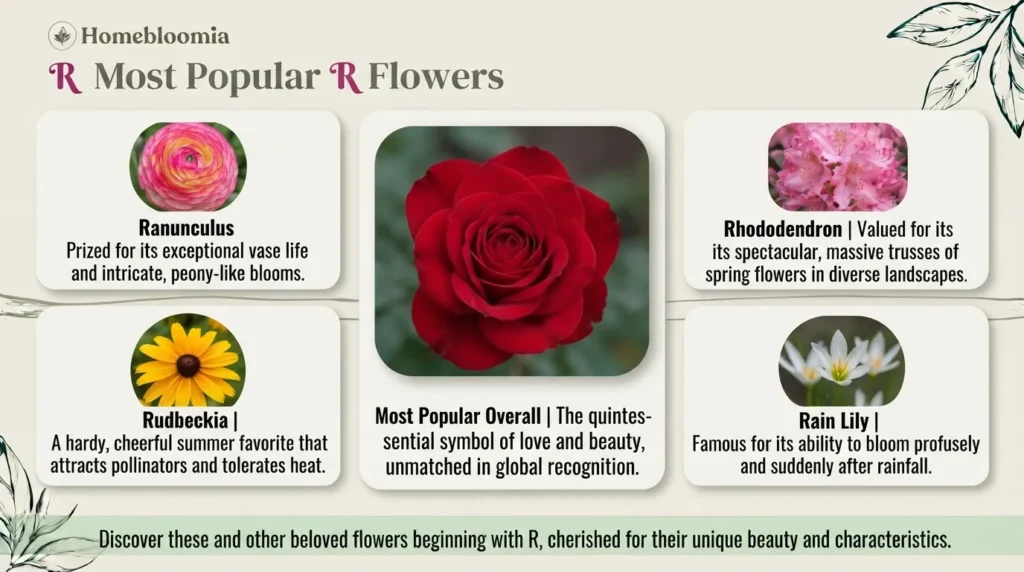
Some R flowers are recognized almost immediately, even by people with only casual gardening experience, appearing again and again in bouquets, landscapes, nursery labels, and flower-themed gifts.
Rose leads by a wide margin for recognition and symbolism. Ranunculus is a florist’s favorite. Rhododendron remains a familiar spring shrub, while Rudbeckia and Rain Lily are both well known for reliable seasonal color.
Full List of Flowers That Start With R
1. Rose — the most familiar flower in the R group, known for layered petals, fragrance, and a huge range of colors and forms. Works in cutting gardens, mixed borders, and cottage-style planting. Bloom: late spring–fall | Origin: Asia, Europe, North America
2. Ranunculus — densely layered blooms with a soft, paper-like finish, one of the strongest picks for spring arrangements. Bloom: spring | Origin: Mediterranean, Southwest Asia
3. Rain Lily — a small bulb flower that often appears after rainfall, appealing in containers and bulb pockets. Bloom: summer–early fall | Origin: Americas
4. Rhododendron — large clusters of spring flowers with strong shrub presence, suited to woodland-edge gardens and acidic beds. Bloom: spring | Origin: Asia, Europe, North America
5. Rudbeckia — bright daisy-like blooms in yellow, bronze, and orange, performing well in pollinator gardens. Bloom: summer–fall | Origin: North America
6. Rock Rose — a sun-loving shrub with papery flowers, a natural fit for dry, bright spaces. Bloom: late spring–summer | Origin: Mediterranean
7. Red Hot Poker — tall, torch-like spikes in orange, red, and yellow, giving bold vertical impact. Bloom: summer–fall | Origin: Africa
8. Ruellia — trumpet-shaped flowers, most often purple, blooming generously in warm conditions. Bloom: summer–fall | Origin: Central and South America
9. Rondeletia — a flowering shrub with clustered warm red-orange blooms, adding a soft tropical feel where winters stay mild. Bloom: warm season | Origin: Caribbean
10. Rattlesnake Master — upright leaves and rounded, architectural flower heads for native and pollinator gardens. Bloom: summer | Origin: North America
11. Rhodora — a smaller shrub with early pink-to-lavender blooms, giving a soft woodland feel. Bloom: mid–late spring | Origin: North America
12. Rocket Larkspur — tall spires in purple, blue, pink, or white, often grown for cutting gardens. Bloom: spring–early summer | Origin: Mediterranean
13. Red Clover — rounded pink-red flower heads closely tied to meadow planting and bee activity. Bloom: late spring–summer | Origin: Europe, Western Asia
14. Rose Campion — silver foliage paired with vivid magenta blooms for striking contrast in sunny beds. Bloom: late spring–summer | Origin: Europe, Western Asia
15. Rose of Sharon — hibiscus-like flowers arriving when many earlier shrubs have finished, good for screens and hedge lines. Bloom: summer–early fall | Origin: East Asia
16. Rosinweed — a prairie perennial with yellow blooms and upright growth, best in native-style planting. Bloom: summer | Origin: North America
17. Rafflesia — one of the most famous unusual flowers in the world for its massive bloom size; not practical for home gardens but memorable. Bloom: irregular, species-dependent | Origin: Southeast Asia
18. Red Spider Lily — narrow, arching petal segments creating a dramatic starburst look, blooming late in drifts or path edges. Bloom: late summer–early fall | Origin: East Asia
19. Red Valerian — airy clusters of small flowers over a long season, suited to cottage gardens and dry banks. Bloom: late spring–summer | Origin: Mediterranean
20. Restharrow — a wiry subshrub with pink pea-like blooms, better suited to dry, open ground than formal beds. Bloom: summer | Origin: Europe, Western Asia
21. Rice Flower — many small clustered blooms creating a fine, airy texture, valued in mild climates and floral work. Bloom: winter–spring | Origin: Australia
22. Rock Soapwort — a spreading perennial with bright pink flowers that soften stone edges and sunny slopes. Bloom: spring–early summer | Origin: Europe
23. Rockfoil — a wide group of compact Saxifraga flowering plants suited to alpine settings and troughs. Bloom: spring–summer | Origin: Europe, Asia, North America
24. Rocktrumpet — often associated with mandevilla types, a vine with bold trumpet blooms for trellises and warm patios. Bloom: warm season | Origin: Tropical Americas
25. Rose Mallow — a large-flowered perennial hibiscus loving warmth and moisture, effective in rain gardens. Bloom: mid–late summer | Origin: North America
26. Rosebay Willowherb — upright spikes of pink-purple flowers with a natural, open habit for wilder plantings. Bloom: summer | Origin: Northern Hemisphere
27. Rue — better known as an herb, but its small yellow flowers still earn it a place here, with blue-green foliage for hot, dry beds. Bloom: summer | Origin: Mediterranean
28. Russelia — a fountain of fine stems with small coral-red tubular flowers, shining in pots and cascading displays in warm climates. Bloom: warm season, often extended | Origin: Mexico, Central America
29. Rangoon Creeper — a tropical vine with fragrant blooms that shift color as they mature, lush on arches and fences. Bloom: warm season | Origin: South and Southeast Asia
30. Ratibida — commonly called Mexican hat, with a strong cone and drooping petals giving a lively prairie look. Bloom: summer–fall | Origin: North America
31. Romneya — also called matilija poppy, with very large white blooms and a striking central cluster. Bloom: late spring–summer | Origin: California, Mexico
32. Romulea — a corm-forming plant with crocus-like flowers, small enough for pots and rock planting. Bloom: late winter–spring | Origin: Africa, Mediterranean
33. Redbud — a flowering tree whose blooms appear along bare branches in spring. Bloom: spring | Origin: North America, Europe, Asia
34. Russian Sage — airy lavender-blue flower spikes and aromatic foliage over a long summer period. Bloom: summer–fall | Origin: Central Asia
35. Reseda — often linked with mignonette, valued more for scent and old-fashioned charm than showy petals. Bloom: spring–summer | Origin: Mediterranean, North Africa
36. Rhodochiton — a vine with trailing purple-maroon, lantern-like blooms, appealing where stems can climb or spill freely. Bloom: summer–fall | Origin: Mexico
37. Ragged Robin — finely cut pink petals giving a loose, airy appearance, suited to damp meadows and cottage planting. Bloom: late spring–summer | Origin: Europe, parts of Asia
38. Rue Anemone — a small woodland flower with delicate white or pale pink blooms for shady spring plantings. Bloom: spring | Origin: Eastern North America
39. Red Cranesbill — a hardy geranium with bright magenta-pink flowers and a neat mounding form. Bloom: late spring–summer | Origin: Europe, Western Asia
40. Regal Geranium — large, showy flowers in vivid shades with a refined patio look, best in containers and mild climates. Bloom: spring–summer | Origin: Southern Africa
41. Rose Vervain — low, spreading clusters of purple-pink flowers, useful for sunny groundcover and native borders. Bloom: spring–summer | Origin: North America
42. Rocket (Arugula Flower) — a fast-growing annual herb whose white, purple-veined flowers also attract pollinators. Bloom: spring–summer | Origin: Mediterranean
43. Roselle — grown for its edible calyx as much as its yellow, red-centered flowers, thriving in warm, sunny conditions. Bloom: warm season | Origin: Africa
44. Red Ginger — a tropical perennial with bold red bracts rather than true showy petals, striking in humid, warm gardens. Bloom: warm season | Origin: Southeast Asia, Pacific Islands
45. Rock Jasmine — a tight, cushion-forming alpine perennial with small white or pink flowers for troughs and rock gardens. Bloom: spring–summer | Origin: Europe, Asia
46. Rain Daisy — a cheerful South African annual with white, dark-centered daisy blooms that close in overcast weather. Bloom: spring | Origin: South Africa
47. Rocky Mountain Columbine — blue-and-white nodding blooms on a graceful, cold-hardy perennial. Bloom: late spring–summer | Origin: North America
48. Rosy Pussytoes — a low, mat-forming groundcover with fuzzy pink flower clusters, useful in dry, sunny rock gardens. Bloom: spring–summer | Origin: North America
49. Rockcress — a spreading perennial with white or pink spring flowers, ideal for walls, edging, and rock gardens. Bloom: spring | Origin: Europe, Asia
50. Ruby Grass — an ornamental grass grown for fluffy, ruby-pink plumes that catch the light in late summer borders. Bloom: summer–fall | Origin: Africa
Common Flowers That Begin With R
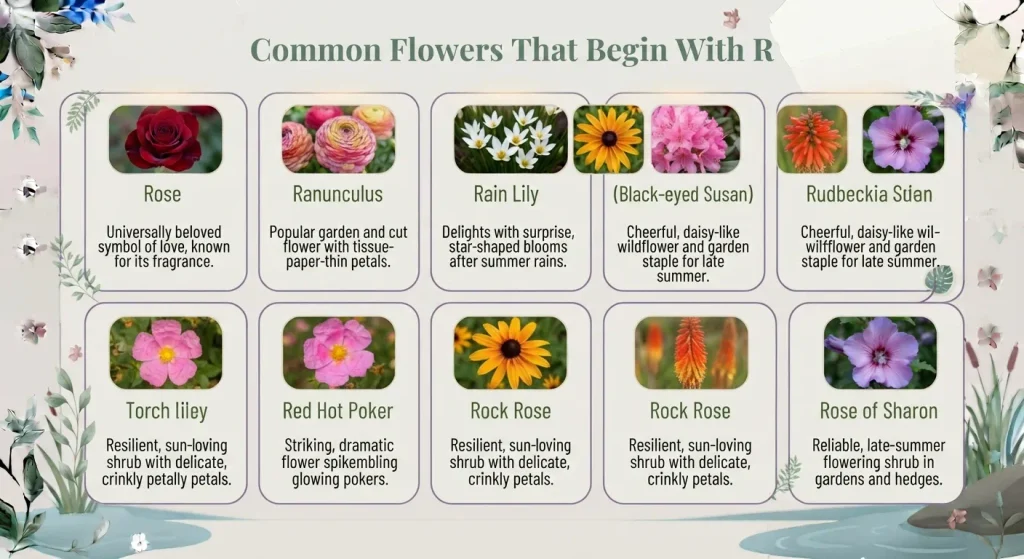
Some names in the R group appear far more often in home gardens, florist work, and familiar landscape planting. Rose sits at the top, followed by ranunculus for bouquet use and rhododendron for shrub borders. Rain lily, rudbeckia, rock rose, red hot poker, and Rose of Sharon also belong in the more familiar category because they appear regularly in planting guides, nursery labels, and everyday garden discussions. For more familiar garden staples, continue with flowers that start with L.
Purple Flowers That Start With R
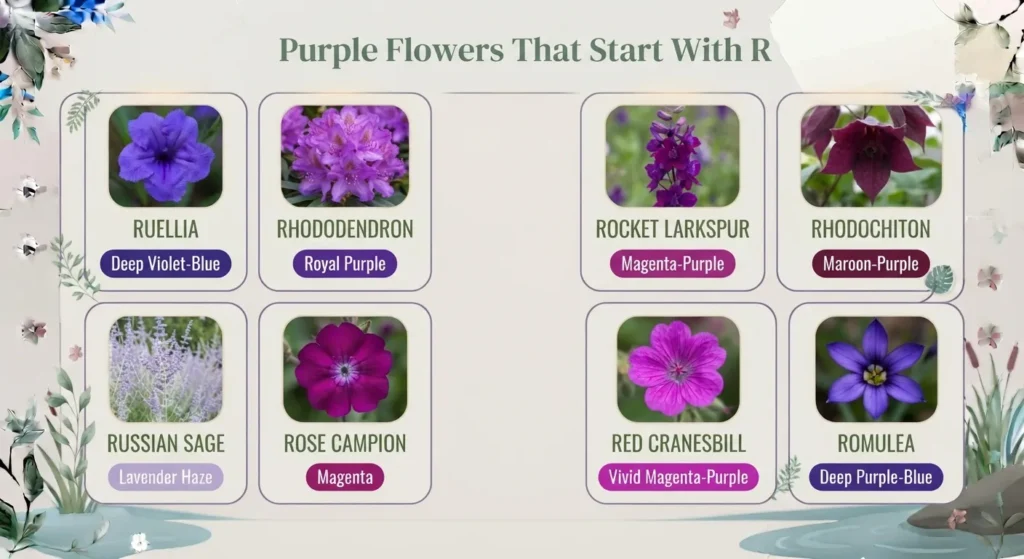
Good purple-leaning options include Ruellia, rhododendron, rocket larkspur, rhodochiton, Russian Sage, Rose Campion, Red Cranesbill, and some forms of Romulea. For tighter color matching, cultivar choice matters, since not every plant in the group holds a single shade across all varieties. For another color-rich alphabetical list, explore flowers that start with P.
Perennials That Start With R
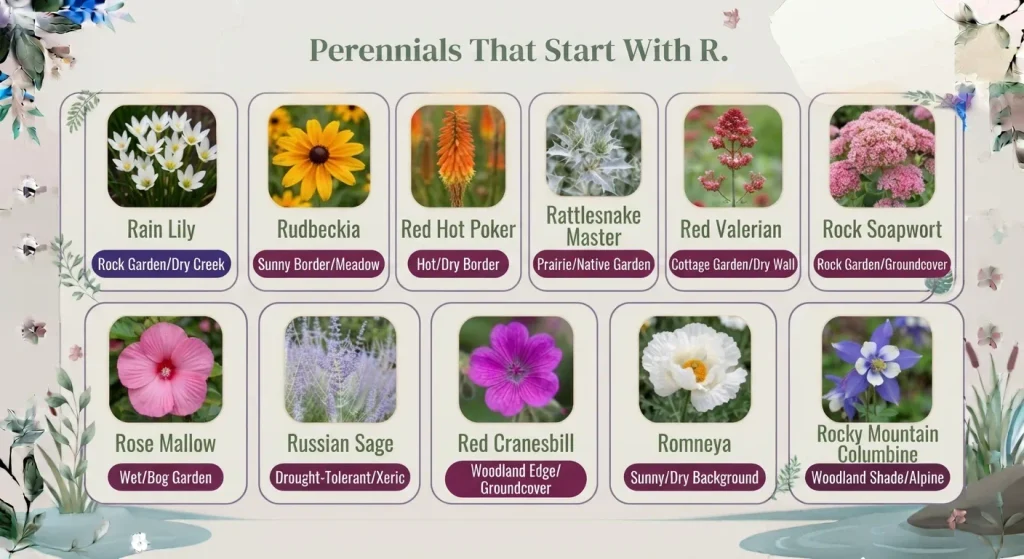
Strong perennial choices include Rain Lily, Rudbeckia, Red Hot Poker, Rattlesnake Master, Red Valerian, Rock Soapwort, Rose Mallow, Russian Sage, Red Cranesbill, Romneya, and Rocky Mountain Columbine. Together, they cover sunny borders, dry beds, prairie planting, rain gardens, and naturalized spaces.
Annual Flowers That Start With R
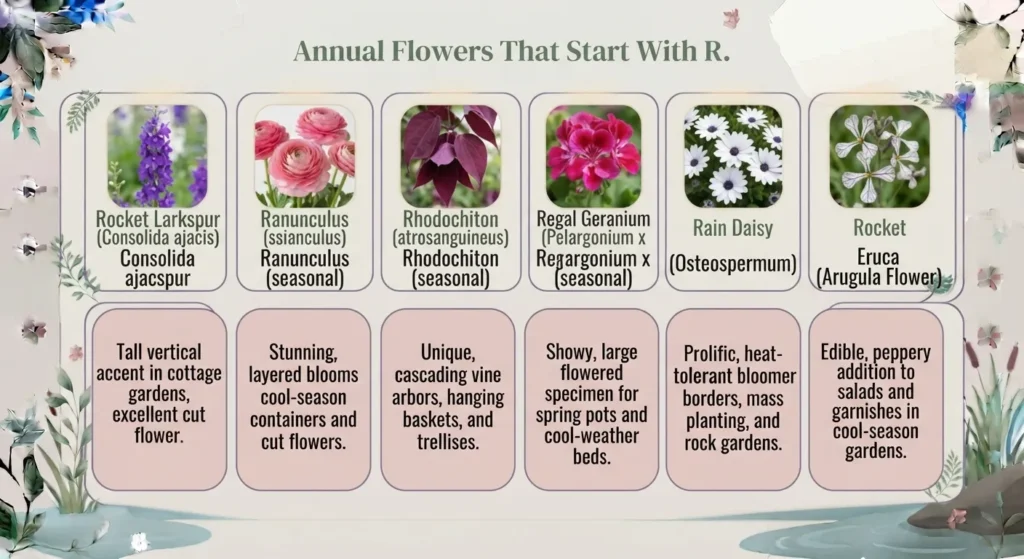
The annual side of the R group is smaller but still useful for quick seasonal color. Rocket larkspur is the clearest true annual. Ranunculus is often treated as a seasonal planting outside mild regions. Rhodochiton may be grown as an annual where winters are cold, regal geranium is commonly used seasonally despite not being a true annual, and Rain Daisy and Rocket (arugula) are both dependable warm-season annuals. If quick seasonal color is the main goal, flowers that start with M is another useful list to check.
Meaning and Symbolism of Flowers With R
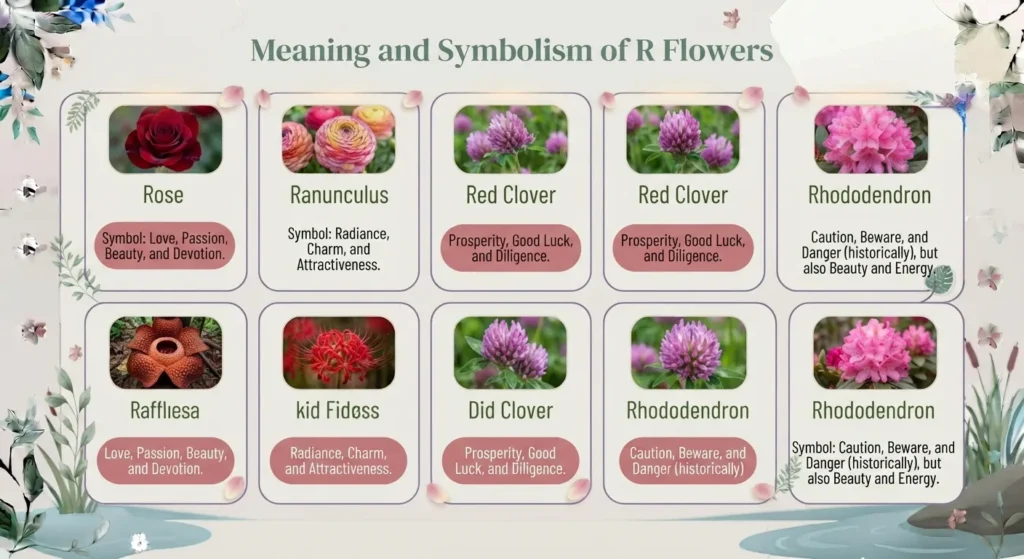
Rose carries the strongest symbolic weight in the group, often tied to love, admiration, friendship, remembrance, or devotion depending on color. Ranunculus is often linked with charm and attraction. Red clover is sometimes associated with luck or abundance, and rhododendron has been linked with beauty, reserve, and caution in different traditions. Meanings shift by culture and tradition, so treat these as broad associations rather than fixed rules.
How to Choose the Right R Flower
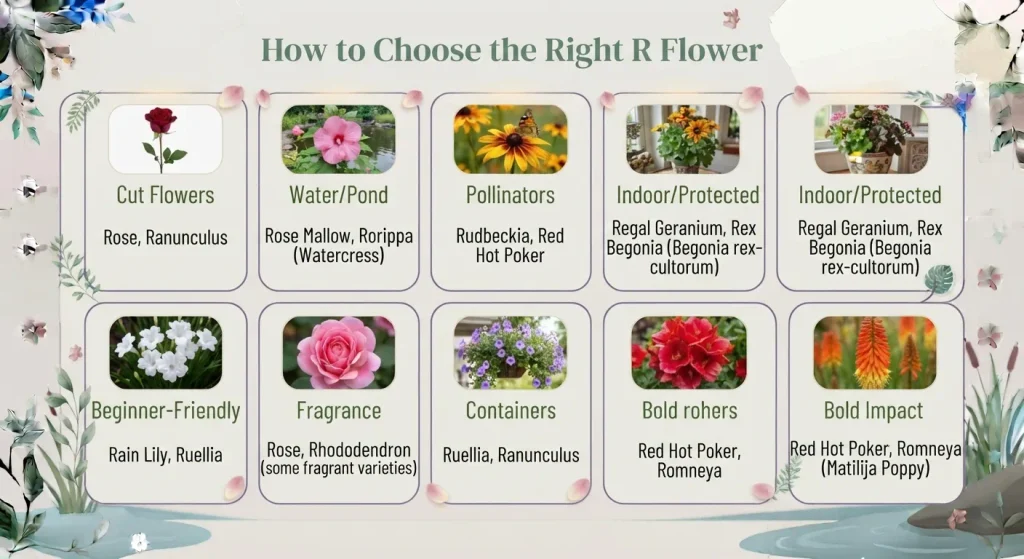
The best choice depends on bloom season, climate, space, and how the flower will be used. A flower that works beautifully in a bouquet may not be the best option for a pollinator bed, and a striking shrub may not suit a small container garden.
Cut Flower and Bouquet Favorites
Rose and ranunculus are the strongest cut-flower choices, offering form, color range, and arrangement appeal. Rocket larkspur adds height, while Rudbeckia brings a looser seasonal look. A cutting patch built around rose, ranunculus, and rocket larkspur covers rounded blooms, upright spires, and a softer field-style finish.
Water and Pond Flower Picks
True water flowers are limited in the R group, so the best choices lean toward pond edges, damp borders, and rain-garden planting. Rose mallow is the clearest fit, handling moisture well and giving large summer flowers where soil stays rich and damp. Ragged robin also suits softer wet-ground planting, while rain lily can work near watered edges without being a true aquatic flower.
Pollinator Friendly and Meadow Picks
Rudbeckia, red clover, rattlesnake master, ratibida, and red valerian all work well where bee and butterfly activity matters, fitting prairie-style layouts, native gardens, and mixed pollinator borders with a natural look.
Indoor or Protected Space Picks
Regal geranium is one of the strongest choices for containers and mild, sheltered spots. Rhodochiton and rocktrumpet also fit protected spaces well where stems can climb or spill freely, while Russelia works best in warm containers or cascading displays.
Beginner Friendly Choices
Rain lily, rudbeckia, red valerian, rock soapwort, and ratibida are some of the easiest starting points in the R group, simpler to place than rarer tropical vines or specialty bloomers, and more forgiving of ordinary garden conditions.
Fragrant R Flowers
Rose is the strongest fragrance flower in the group, combining scent with wide garden use and strong recognition. Reseda is a good choice when fragrance matters more than flower size, and Rangoon creeper adds a warmer-scented vine effect in suitable climates. A scented planting built around rose, reseda, and Rangoon creeper covers classic shrub fragrance, softer old-style perfume, and climbing scent for paths and patios.
Container and Small Space Picks
Rain lily, Ruellia, regal geranium, rocktrumpet, and Russelia are practical choices for pots and compact planting zones — they either stay small, flower well in containers, or show best up close.
Best for Bold Impact
Red hot poker, rhododendron, Rose of Sharon, Romneya, and rose mallow all create a stronger visual statement than smaller edging flowers, suiting larger borders and feature beds where shape and scale matter as much as color.
Plants vs. Flowers That Start With R
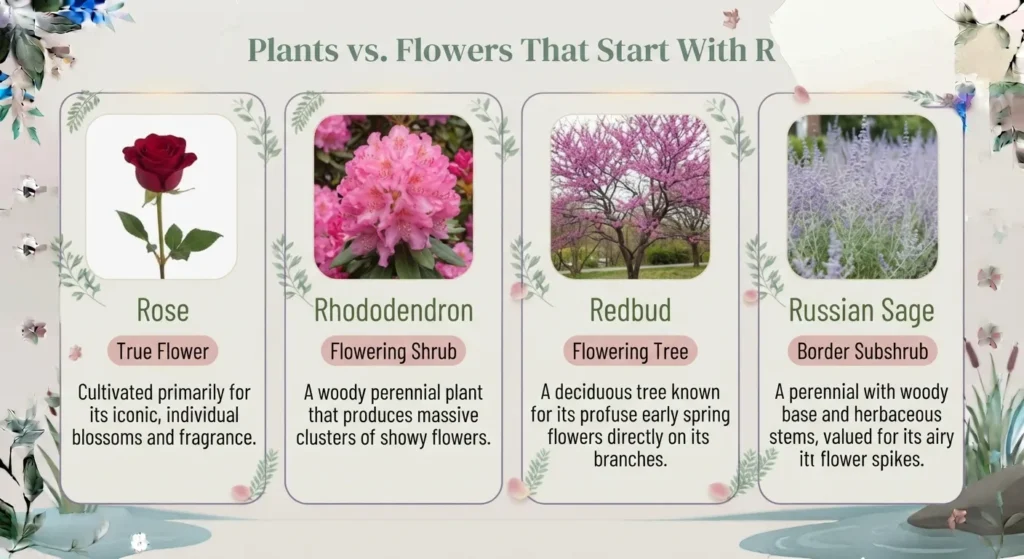
Rose, ranunculus, rudbeckia, and rain lily fit comfortably into a classic flower list. Rhododendron, Rose of Sharon, and rice flower are flowering shrubs. Redbud is a flowering tree. Russian Sage behaves like a flowering border plant, though it’s often discussed in a broader perennial or subshrub context. Clear labels make side-by-side comparison much easier, the same distinction shows up in flowers that start with M and flowers that start with G.
Conclusion
Flower names that start with R cover far more than roses alone. This group of 50 spans cut flowers, meadow plants, shrubs, vines, bulbs, herbs, and bold landscape bloomers, giving it real range. A classic border may lean toward rose, ranunculus, or rudbeckia. A warm, dry bed may suit rock rose or Russian Sage. A pollinator-focused planting may call for rattlesnake master, ratibida, or red clover. The right choice depends less on the letter and more on color, bloom timing, climate fit, and the role a flower needs to play.
If you’re working through the alphabet, continue with flowers that start with F, flowers that start with G, flowers that start with M, flowers that start with N, flowers that start with P, flowers that start with T, and flowers that start with Z.
FAQs
What are some common flowers that start with R?
Rose, ranunculus, rhododendron, rain lily, rudbeckia, and Rose of Sharon are the most common and recognizable R flowers.
What is the most popular flower that starts with R?
Rose is by far the most popular and widely recognized, with ranunculus a strong second for floral design.
Are there purple flowers that start with R?
Yes, Ruellia, rhododendron, rocket larkspur, rhodochiton, Russian Sage, and Red Cranesbill all commonly bloom in purple or violet tones.
Are there perennials that start with R?
Yes, Rain Lily, Rudbeckia, Red Hot Poker, Rattlesnake Master, Red Valerian, Rock Soapwort, and Rose Mallow are all dependable perennials.
Are there annual flowers that start with R?
Yes, Rocket Larkspur, Rain Daisy, and arugula’s Rocket flower are true annuals, with ranunculus and regal geranium often grown seasonally.
Is rhododendron a flower or a shrub?
It’s a flowering shrub, the blooms are the main reason it’s grown and recognized, but the plant itself is a woody shrub, not a soft bedding flower.
Is Rose of Sharon a flower?
Yes, in the sense that it’s a flowering shrub whose hibiscus-like blooms are its defining garden feature, even though the plant itself is woody.
What is the largest flower that starts with R?
Rafflesia holds this title by a wide margin, its blooms can exceed three feet across, making it one of the largest flowers in the world.
Which R flowers are good for bouquets?
Rose and ranunculus are the top picks, with rocket larkspur and rudbeckia as strong supporting choices.
Which R flowers are good for pollinators?
Rudbeckia, red clover, rattlesnake master, ratibida, and red valerian are all excellent pollinator plants.
Are there rare flowers that start with R?
Yes, Rafflesia, Romulea, Rhodochiton, and Rangoon Creeper are among the least commonly grown R flowers in home gardens.
Why do some R flower lists include shrubs and plants?
Because names like rhododendron, Rose of Sharon, and redbud are recognized primarily by their blooms, even though they’re technically shrubs or trees rather than soft bedding flowers, leaving them out would make the list feel incomplete to most readers.