75+ Beautiful Flowers That Start With N: Names, Full Guide & Photos
Quick Answer: Flowers That Start With N are Narcissus, the most recognizable N flowers are Nasturtium, Nemesia, Nigella, Nicotiana, Nerine, Nymphaea, and Nepeta. Nasturtium is a go-to for edible gardens, Nymphaea is the standard water lily for ponds, Nicotiana brings evening fragrance to patios, and Nepeta is one of the most dependable pollinator perennials you can plant.
Flowers beginning with N cover an unusually wide range of growing styles, spring bulbs, easy seed-grown annuals, fragrant evening bloomers, pond and bog plants, native wildflowers, and specialty orchids. Because so many of these names double up between common names and botanical names (Narcissus/daffodil, Nymphaea/water lily, Nasturtium/Tropaeolum), a clean N list has to be careful not to count the same plant twice.
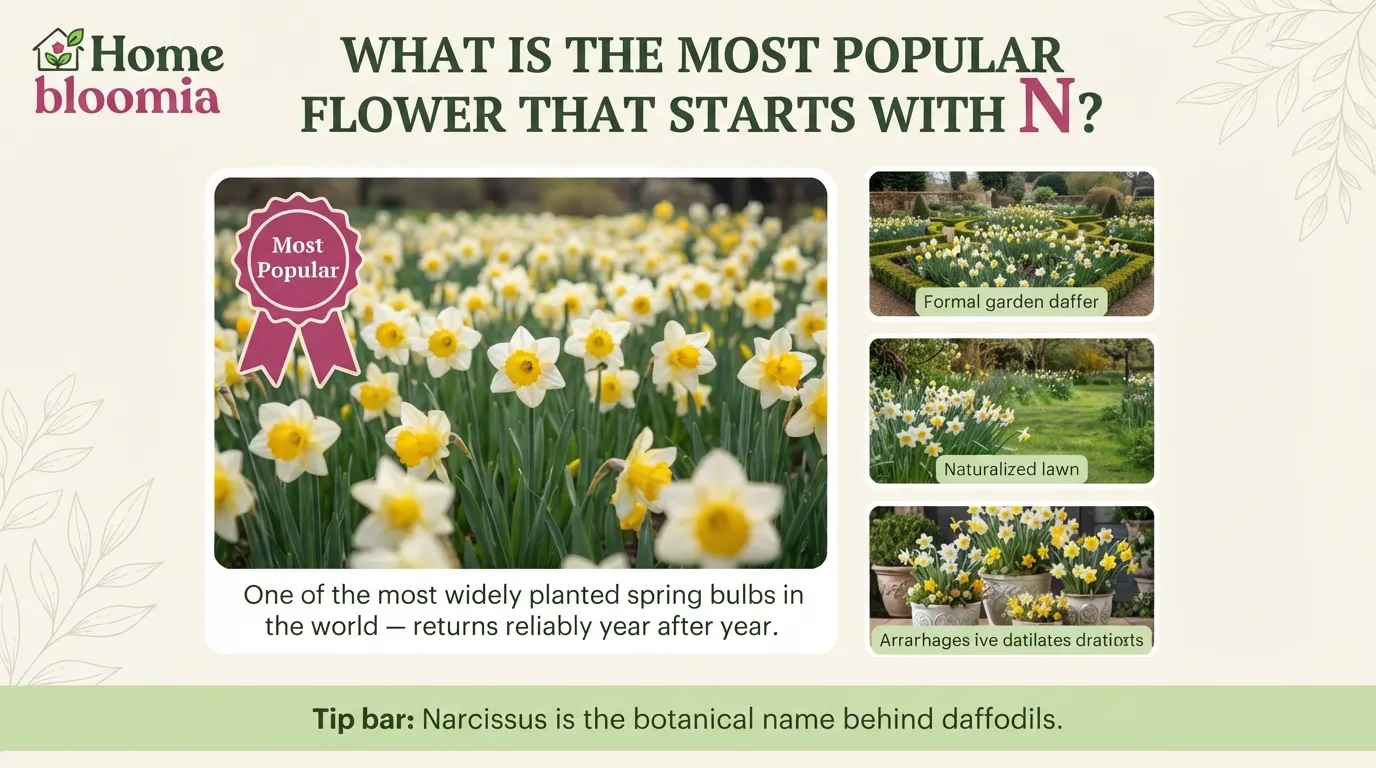
What Is the Most Popular Flower That Starts With N?
Narcissus is the clear answer. It’s the botanical name behind daffodils, one of the most widely planted spring bulbs in the world, and it returns reliably year after year in beds, naturalized lawns, and containers.
75 Flower Names Starting With N: At a Glance
| # | Flower Name | Botanical Name | Type | Main Colors | Best Use |
| 1 | Narcissus | Narcissus spp. | Bulb perennial | Yellow, white, orange | Spring borders, pots, cut flowers |
| 2 | Nasturtium | Tropaeolum majus | Annual | Orange, red, yellow, cream | Containers, edging, edible gardens |
| 3 | Nemesia | Nemesia spp. | Annual/tender perennial | Pink, purple, white, yellow | Pots, window boxes |
| 4 | Nemophila | Nemophila menziesii | Annual | Blue, white | Spring edging, wildflower planting |
| 5 | Nicotiana | Nicotiana spp. | Annual/tender perennial | White, pink, lime, red | Evening fragrance, borders |
| 6 | Nigella | Nigella damascena | Annual | Blue, white, pink | Cottage gardens, seed pods |
| 7 | Nierembergia | Nierembergia spp. | Tender perennial | White, blue, lavender | Edging, containers |
| 8 | Nerine | Nerine bowdenii | Bulb perennial | Pink, red, white | Late color, cut flowers |
| 9 | Neapolitan Garlic | Allium neapolitanum | Bulb perennial | White | Natural planting |
| 10 | Neomarica | Neomarica spp. | Rhizomatous perennial | White, blue, purple | Warm patios, shade pots |
| 11 | Nolana | Nolana spp. | Annual | Blue, violet, white | Dry gardens, trailing pots |
| 12 | Nothoscordum | Nothoscordum spp. | Bulb perennial | White, yellow | Naturalized bulb planting |
| 13 | Nodding Onion | Allium cernuum | Perennial | Pink, mauve | Native gardens, pollinators |
| 14 | Nodding Ladies’ Tresses | Spiranthes spp. | Orchid | White | Naturalistic planting |
| 15 | Northern Blue Flag | Iris versicolor | Perennial | Blue, violet | Wet soil, pond edges |
| 16 | Nuphar | Nuphar spp. | Aquatic perennial | Yellow | Ponds, water gardens |
| 17 | Nymphaea | Nymphaea spp. | Aquatic perennial | White, pink, red, yellow, blue | Water gardens |
| 18 | Night Blooming Cereus | Epiphyllum/Selenicereus spp. | Cactus | White | Night bloom, containers |
| 19 | Night Phlox | Zaluzianskya capensis | Annual/tender perennial | White, dark reverse | Evening scent, patios |
| 20 | Natal Lily | Clivia miniata | Perennial | Orange, yellow, cream | Shade pots, patios |
| 21 | Nettle-leaved Bellflower | Campanula trachelium | Perennial | Purple, blue | Cottage borders |
| 22 | New England Aster | Symphyotrichum novae-angliae | Perennial | Purple, pink | Pollinator gardens |
| 23 | New York Aster | Symphyotrichum novi-belgii | Perennial | Purple, pink, lavender | Borders, pollinators |
| 24 | New Guinea Impatiens | Impatiens hawkeri | Tender perennial | Pink, red, white, orange | Shade pots, patio color |
| 25 | Nepeta | Nepeta spp. | Perennial | Blue, lavender, purple | Pollinator beds |
| 26 | Nyctanthes | Nyctanthes arbor-tristis | Flowering tree | White, orange center | Fragrance, warm gardens |
| 27 | New York Ironweed | Vernonia noveboracensis | Perennial | Purple | Native planting, rain gardens |
| 28 | Nodding Wakerobin | Trillium flexipes | Woodland perennial | White, cream, pink | Woodland gardens |
| 29 | Nelumbo | Nelumbo nucifera | Aquatic perennial | Pink, white | Ponds, large water tubs |
| 30 | Nerium | Nerium oleander | Flowering shrub | Pink, white, red, yellow | Warm climate hedges |
| 31 | Night-flowering Catchfly | Silene noctiflora | Annual/biennial | White, pale pink | Wildflower interest |
| 32 | Night-scented Stock | Matthiola longipetala | Annual | Lilac, pink, white | Evening scent, pots |
| 33 | Nymphoides | Nymphoides spp. | Aquatic perennial | Yellow, white | Small ponds, water bowls |
| 34 | Navarretia | Navarretia spp. | Wildflower | Blue, purple, white | Native wildflower planting |
| 35 | Nemastylis | Nemastylis spp. | Bulb/corm perennial | Blue, violet | Prairie gardens |
| 36 | Nuttallanthus | Nuttallanthus canadensis | Wildflower | Blue, violet | Meadow planting |
| 37 | Narthecium | Narthecium spp. | Bog perennial | Yellow | Wetland gardens |
| 38 | Nectaroscordum | Nectaroscordum siculum | Bulb perennial | Cream, pink, green | Cottage borders |
| 39 | Nematanthus | Nematanthus spp. | Tender perennial | Orange, red, yellow | Hanging pots |
| 40 | Neotinea | Neotinea spp. | Orchid | Pink, purple, white | Orchid collections |
| 41 | Neottia | Neottia spp. | Orchid | Green, brown, white | Woodland orchid interest |
| 42 | Notylia Orchid | Notylia spp. | Orchid | White, green, yellow | Orchid collections |
| 43 | Napeanthus | Napeanthus spp. | Tropical flowering plant | White, purple | Specialty collections |
| 44 | Nama | Nama spp. | Wildflower | Purple, blue, pink, white | Dry wildflower planting |
| 45 | Nassauvia | Nassauvia spp. | Daisy family | White, pink, purple | Alpine/specialty gardens |
| 46 | Nabalus | Nabalus spp. | Wildflower | White, cream, pink | Native meadow planting |
| 47 | Nicandra | Nicandra physalodes | Annual | Blue, violet, white | Ornamental beds |
| 48 | Nuytsia | Nuytsia floribunda | Flowering tree | Orange, yellow | Warm climate feature tree |
| 49 | Nyctaginia | Nyctaginia capitata | Wildflower | Pink, purple | Dry gardens |
| 50 | Nyctocalos | Nyctocalos brunfelsiiflorus | Flowering vine | White, cream | Tropical vine display |
| 51 | Naked Lady Lily | Amaryllis belladonna | Bulb perennial | Pink, white | Dry borders, bulb beds |
| 52 | Noble Dendrobium | Dendrobium nobile | Orchid | White, pink, purple, yellow | Indoor orchid displays |
| 53 | New Zealand Tea Tree | Leptospermum scoparium | Flowering shrub | White, pink, red | Shrub borders, bees |
| 54 | New Zealand Rock Lily | Arthropodium cirratum | Perennial | White | Coastal gardens |
| 55 | New Zealand Christmas Bush | Metrosideros excelsa | Flowering tree | Red | Coastal warm gardens |
| 56 | Nodding Catchfly | Silene nutans | Perennial | White, pale pink | Wildflower gardens |
| 57 | Nodding Bur Marigold | Bidens cernua | Annual | Yellow | Wet soil, pond margins |
| 58 | Nodding Thistle | Carduus nutans | Biennial | Purple | Wildlife areas |
| 59 | Nodding Blue Lily | Stypandra glauca | Perennial | Blue, violet | Dry gardens, native planting |
| 60 | Narrowleaf Coneflower | Echinacea angustifolia | Perennial | Pink, purple | Prairie planting |
| 61 | Narrowleaf Sunflower | Helianthus angustifolius | Perennial | Yellow | Native borders |
| 62 | Narrowleaf Blue-eyed Grass | Sisyrinchium angustifolium | Perennial | Blue, violet | Edging, meadow gardens |
| 63 | Narrowleaf Evening Primrose | Oenothera fruticosa | Perennial | Yellow | Sunny borders |
| 64 | Nuttall’s Larkspur | Delphinium nuttallianum | Perennial wildflower | Blue, purple | Native wildflower planting |
| 65 | Nuttall’s Sunflower | Helianthus nuttallii | Perennial | Yellow | Meadow planting |
| 66 | Nolina | Nolina spp. | Perennial with flower spikes | Cream, white | Dry gardens, structural bloom |
| 67 | Neoregelia | Neoregelia spp. | Bromeliad | Purple center flower, colorful bracts | Tropical containers |
| 68 | Nasturtium Vine (Canary Creeper) | Tropaeolum peregrinum | Annual vine | Yellow | Trellises, fences |
| 69 | Nun’s Orchid | Phaius tankervilleae | Orchid | Brown, white, purple | Shade gardens, warm climates |
| 70 | Nakedwood Flower | Myrcianthes fragrans | Flowering shrub/tree | White | Fragrant hedges, warm gardens |
| 71 | Netted Iris | Iris reticulata | Bulb perennial | Purple, blue | Early spring rock gardens |
| 72 | Nootka Rose | Rosa nutkana | Native flowering shrub | Pink | Native hedgerows, wildlife gardens |
| 73 | Numbat Bush | Eremophila glabra | Flowering shrub | Yellow, orange, red | Dry native Australian gardens |
| 74 | Norfolk Island Hibiscus | Lagunaria patersonia | Flowering tree | Pink | Coastal landscape trees |
| 75 | Nootka Lupine | Lupinus nootkatensis | Perennial wildflower | Blue, purple | Native and coastal meadow planting |
What Counts as a Flower Starting With N?
A flower earns a spot on this list if its common name or botanical name begins with N and the plant is clearly grown, sold, or discussed for its blooms,garden flowers, bulbs, annuals, perennials, aquatic plants, orchids, flowering vines, shrubs, trees, and wildflowers all qualify.
Simply starting with N isn’t enough. The bloom itself needs to matter, through color, fragrance, shape, pollinator value, or genuine botanical interest for an entry to belong on a flower-first list rather than a general plant list.
Types of Flowers That Start With N
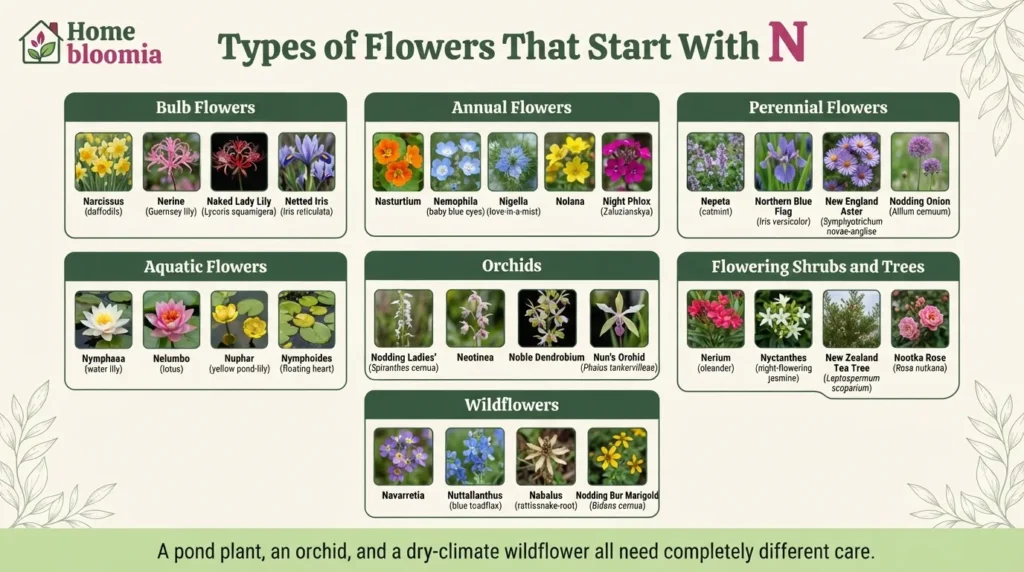
Sorting the N group by growth habit makes the list far easier to act on, since a pond plant, an orchid, and a dry-climate wildflower all need completely different care.
Bulb flowers: Narcissus, Nerine, Naked Lady Lily, Neapolitan Garlic, Nothoscordum, Nectaroscordum, Nemastylis, Netted Iris.
Annual flowers: Nasturtium, Nemophila, Nigella, Nolana, Night Phlox, Night-scented Stock, Nicandra, Night-flowering Catchfly, Canary Creeper.
Perennial flowers: Nepeta, Northern Blue Flag, New England Aster, New York Aster, Nodding Onion, Nettle-leaved Bellflower, Narrowleaf Coneflower, Narrowleaf Sunflower, Narrowleaf Evening Primrose.
Aquatic flowers: Nymphaea, Nelumbo, Nuphar, and Nymphoides — all suited to ponds, tubs, or wet margins rather than ordinary dry soil.
Orchids: Nodding Ladies’ Tresses, Neotinea, Neottia, Notylia Orchid, Noble Dendrobium, Nun’s Orchid.
Flowering shrubs and trees: Nerium, Nyctanthes, New Zealand Tea Tree, New Zealand Christmas Bush, Nuytsia, Nootka Rose, Norfolk Island Hibiscus.
Wildflowers: Navarretia, Nuttallanthus, Nama, Nabalus, Nodding Catchfly, Nodding Bur Marigold, Nodding Thistle, Nuttall’s Larkspur, Nuttall’s Sunflower, Nootka Lupine.
For similar type-by-type sorting on a different letter, see flowers that start with C.
Plants vs. Flowers That Begin With N
Not every N-named plant belongs on a flower-focused list. Some are grown mainly for foliage, structure, or general landscaping rather than bloom.
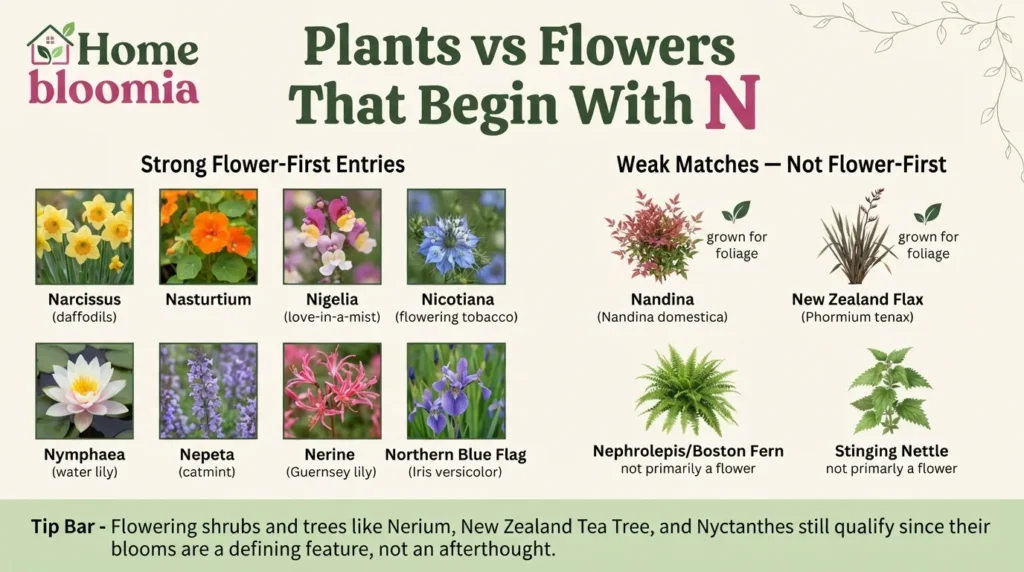
Strong flower-first entries include Narcissus, Nasturtium, Nemesia, Nigella, Nicotiana, Nymphaea, Nepeta, Nerine, and Northern Blue Flag, all widely grown or recognized specifically for their flowers.
Broader plant names like Nandina, New Zealand Flax, Nephrolepis (Boston fern), and stinging nettle shouldn’t be padded onto a flower count just to raise the number, they’re valid plants, but weak matches for a flower-first list. Flowering shrubs and trees like Nerium, New Zealand Tea Tree, New Zealand Christmas Bush, Nyctanthes, and Nuytsia still qualify because their blooms are a defining feature, not an afterthought.
How This List Was Curated
These 75 flowers were chosen for bloom value, garden use, wildflower relevance, fragrance, color range, aquatic and orchid interest, and genuine name fit. Duplicate names were removed so no plant is counted twice under both a common and botanical label.
Narcissus is not repeated as “daffodil.” Nymphaea is not repeated as “water lily.” Nelumbo is kept separate from Nymphaea because lotus and water lily are different genera and different garden uses. Night Phlox and Night-scented Stock are also kept as separate entries since they’re different plants entirely.
Common Flowers That Start With N in the Garden
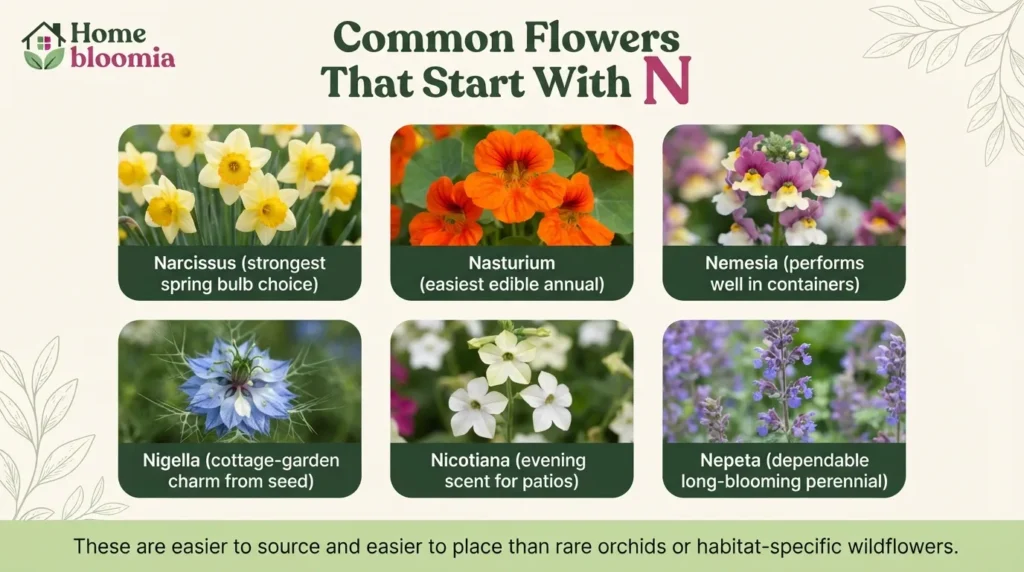
Common N flowers are the ones you’ll actually find at a garden center: easy to recognize, widely available, and simple to place in an ordinary design.
Narcissus is the strongest spring bulb choice. Nasturtium is the easiest edible annual. Nemesia and New Guinea Impatiens both perform well in containers. Nigella brings cottage-garden charm from seed. Nicotiana adds evening scent to a patio bed. Nepeta and the fall asters are dependable, long-blooming perennials.
These familiar names are better starting points than rare orchids, pond plants, or habitat-specific wildflowers, simply because they’re easier to source and easier to place. For more everyday choices on a different letter, browse flowers that start with S.
Rare Flowers Beginning With N
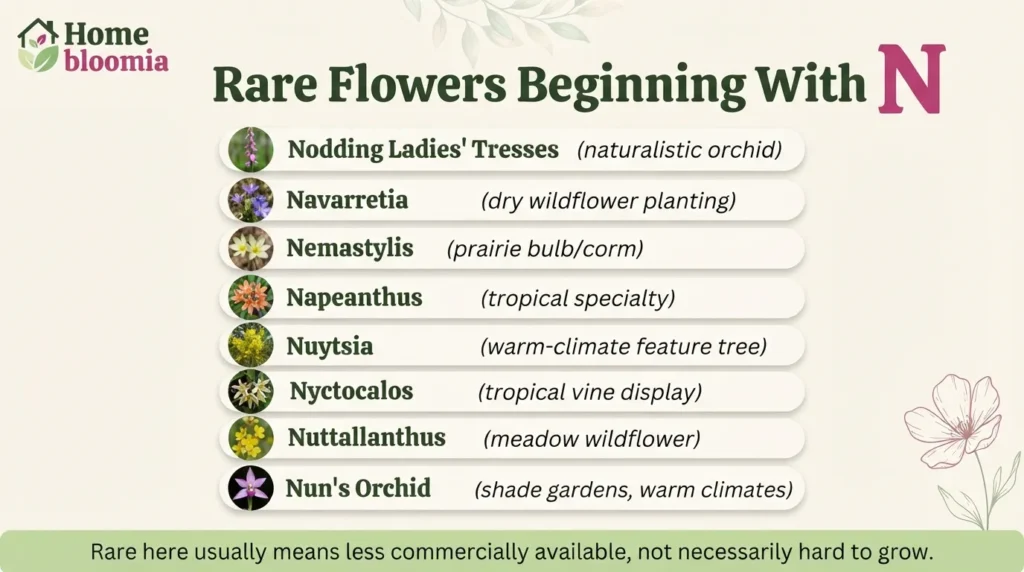
Rare N flowers are less likely to show up at a standard garden center, some are wildflowers, some are orchids, and some are regional plants that need specific sourcing.
Good rare examples: Nodding Ladies’ Tresses, Navarretia, Nemastylis, Napeanthus, Nuytsia, Nyctocalos, Nuttallanthus, Nassauvia, Neotinea, Neottia, Notylia Orchid, and Nun’s Orchid.
Rare doesn’t necessarily mean difficult it usually just means less familiar, less commercially available, or more closely tied to a native habitat, orchid culture, bog condition, or warm-climate setting than the average bedding flower.
Purple Flowers That Start With N
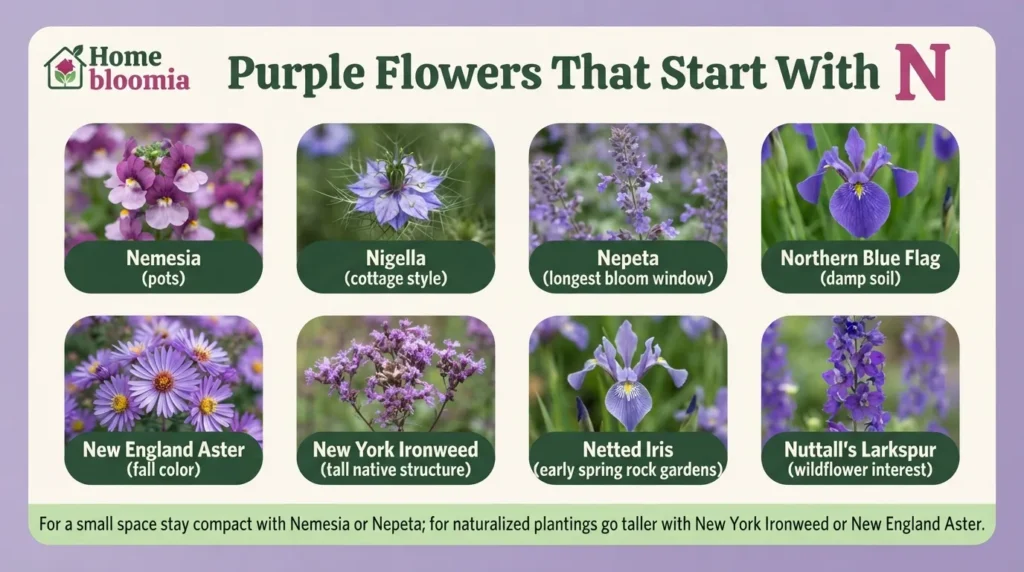
Purple and blue tones are especially strong across the N group, making this letter a good source of cool-toned color for cottage borders, pollinator beds, and meadow plantings.
Reach for Nemesia in pots, Nigella for cottage style, Nepeta for the longest bloom window, Northern Blue Flag for damp soil, New England Aster for fall color, New York Ironweed for tall native structure, Netted Iris for early spring rock gardens, and Nuttall’s Larkspur for wildflower interest.
For a small space, stay compact with Nemesia or Nepeta. For a larger naturalized planting, taller choices like New York Ironweed, New England Aster, and Nootka Lupine carry more presence, just confirm local guidance before introducing spreading species like Nodding Thistle.
Perennials That Start With N
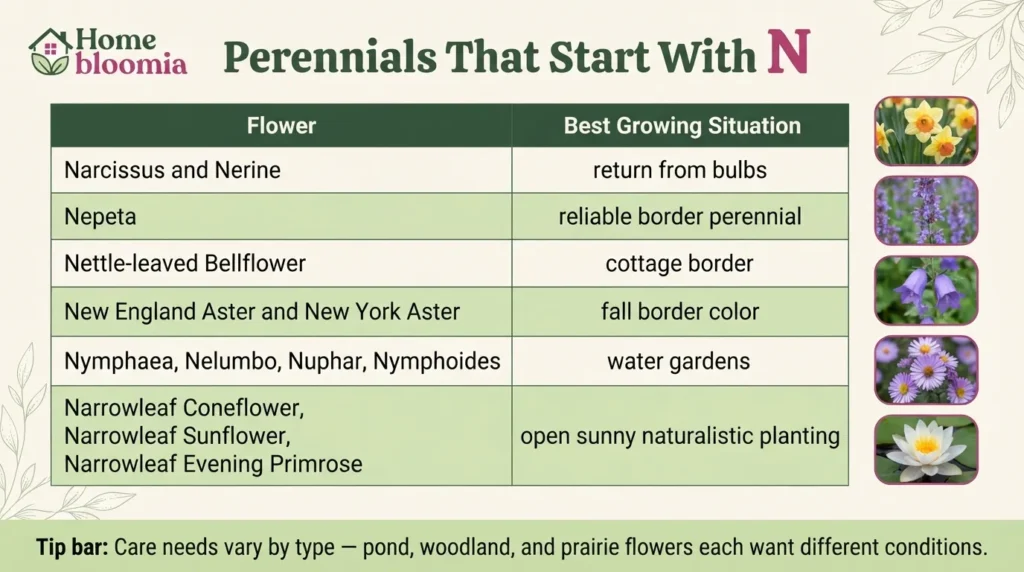
Perennial N flowers return from bulbs, rhizomes, crowns, roots, or aquatic root systems, which makes them the better choice when you want repeat bloom instead of yearly replanting.
Narcissus and Nerine return from bulbs. Nepeta, Nettle-leaved Bellflower, New England Aster, and New York Aster return as reliable border perennials. Nymphaea, Nelumbo, Nuphar, and Nymphoides are the perennial picks for water gardens. Narrowleaf Coneflower, Narrowleaf Sunflower, and Narrowleaf Evening Primrose suit open, sunny, naturalistic planting.
Care needs vary by type, a pond flower needs water depth and sun, a woodland flower needs shade and leaf-rich soil, and a prairie flower generally wants open sun with sharp drainage.
Annual Flowers That Start With N
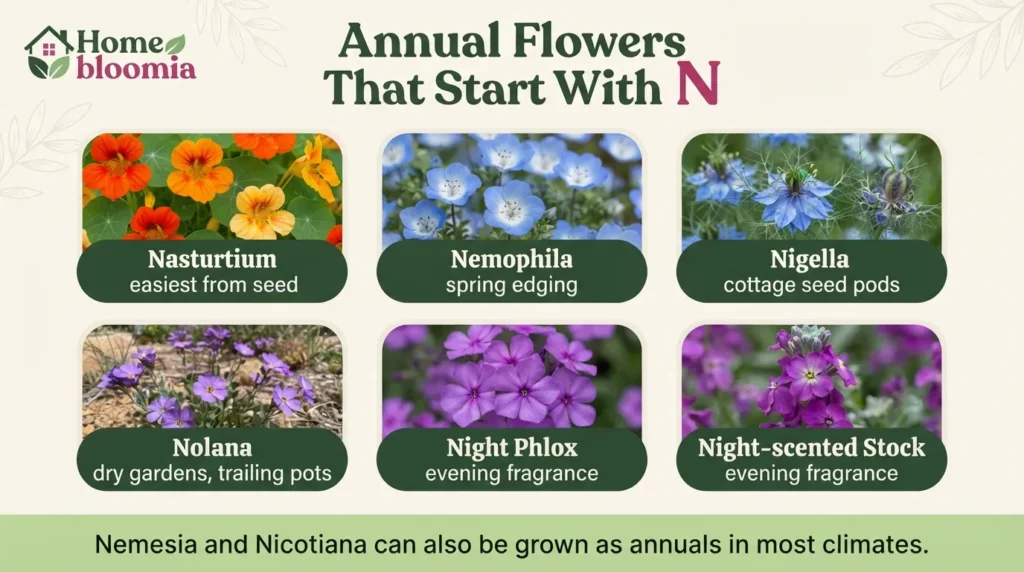
Annual N flowers deliver fast color in beds, containers, and seasonal displays. Some finish their life cycle in a single season; others are tender perennials commonly grown as annuals in colder climates.
Nasturtium, Nemophila, Nigella, Nolana, Night Phlox, Night-scented Stock, Nicandra, and Night-flowering Catchfly are the strongest annual picks. Nemesia and Nicotiana can also be grown as annuals in most climates.
Nasturtium and Nigella are the easiest from seed. Night-scented Stock and Night Phlox are chosen more for evening fragrance than for bold flower size, so plant them where you’ll actually smell them.
Indoor or Protected Space Picks
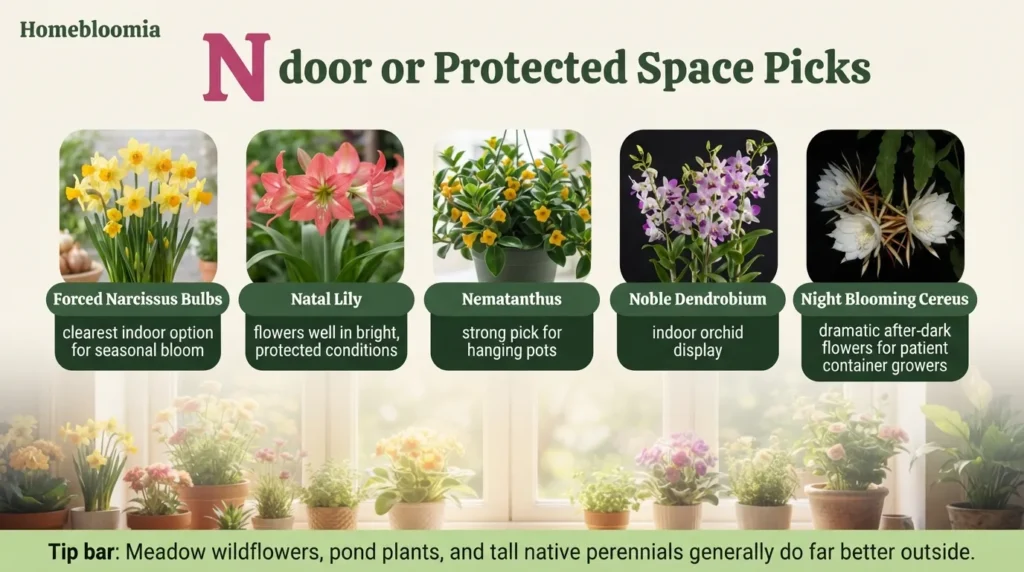
Several N flowers can work indoors or in protected containers, provided light, airflow, temperature, and watering are dialed in.
Forced Narcissus bulbs are the clearest indoor option for seasonal bloom. Natal Lily can flower well in bright, protected conditions. Nematanthus is a strong pick for hanging pots. Noble Dendrobium suits an indoor orchid display, and Night Blooming Cereus rewards patient container growers with its dramatic after-dark flowers.
Not every N flower belongs indoors, meadow wildflowers, pond plants, and tall native perennials generally do far better outside, where light, soil, and space match their natural growth habit.
Fragrant N Flowers
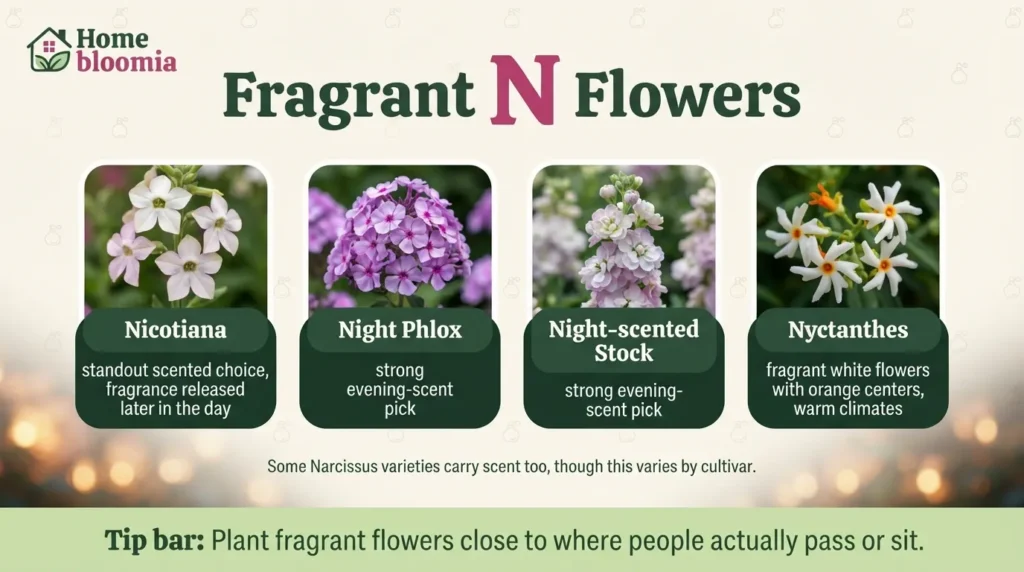
Nicotiana is one of the standout scented choices in this group, especially once evening falls, many varieties release fragrance later in the day, making them ideal near patios, doors, windows, and seating areas.
Night Phlox and Night-scented Stock are also strong evening-scent picks. Nyctanthes adds fragrant white flowers with orange centers in warm climates. Some Narcissus varieties carry scent as well, though this varies significantly by cultivar.
For the best effect, plant fragrant flowers close to where people actually pass or sit, a scented plant tucked at the back of the garden tends to go unnoticed.
Beginner Friendly Choices
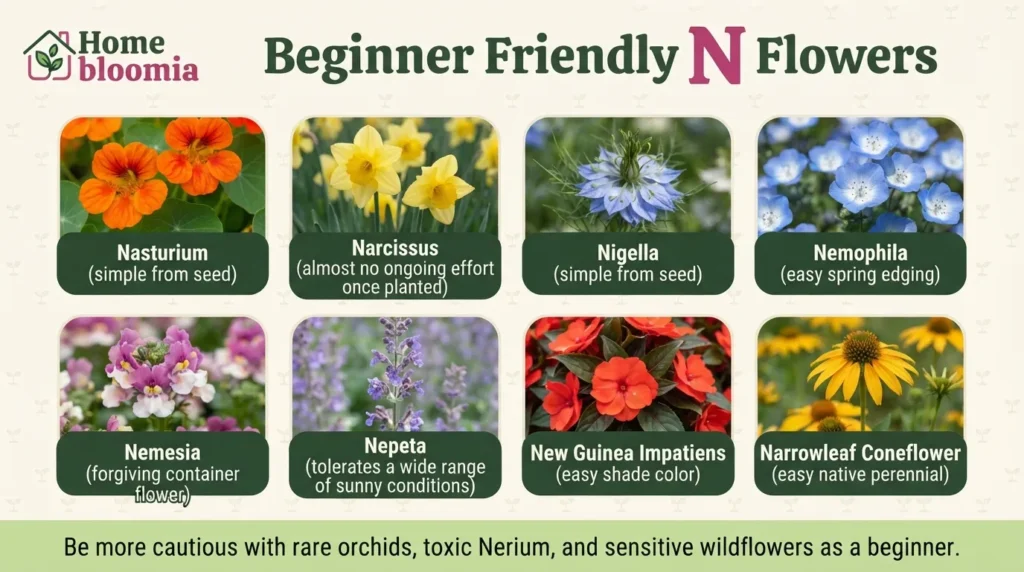
The best beginner N flowers are forgiving, widely available, and reliable without demanding special care. Nasturtium, Narcissus, Nigella, Nemophila, Nemesia, Nepeta, New Guinea Impatiens, and Narrowleaf Coneflower are all solid starting points.
Nasturtium and Nigella are simple from seed. Narcissus takes almost no ongoing effort once bulbs are planted at the right time. Nepeta tolerates a wide range of sunny conditions and blooms for an unusually long stretch with minimal care.
Beginners should be more cautious with rare orchids, Nerium (which is toxic), specialty aquatic plants, and sensitive wildflowers that may need specific conditions or responsible sourcing.
How to Use This List in Garden Planning
| Garden Goal | Best N Flower Choices | Best Fit |
| Spring color | Narcissus, Nemophila, Neapolitan Garlic, Netted Iris | Early borders, pots, light meadow planting |
| Easy seed growing | Nasturtium, Nigella, Nemophila | Beginners, containers, seasonal beds |
| Evening fragrance | Nicotiana, Night Phlox, Night-scented Stock | Patios, windows, seating areas |
| Water gardens | Nymphaea, Nelumbo, Nuphar, Nymphoides | Ponds, tubs, aquatic planting |
| Purple pollinator planting | Nepeta, New England Aster, New York Ironweed | Sunny borders, native beds, late color |
| Shade or protected pots | Natal Lily, New Guinea Impatiens, Neomarica | Patios, bright shade, containers |
| Rare flower interest | Navarretia, Nemastylis, Napeanthus, Nuytsia | Specialty gardens, plant collections |
| Coastal and wildlife planting | Nootka Rose, Nootka Lupine, New Zealand Christmas Bush | Hedgerows, coastal gardens |
For a small balcony, keep it compact with Nasturtium, Nemesia, New Guinea Impatiens, or Nematanthus. For a wildlife-friendly patch, lean on Nepeta, Nodding Onion, New England Aster, New York Ironweed, and Narrowleaf Sunflower. For ponds, stick to true aquatic flowers, Nymphaea, Nelumbo, Nuphar, and Nymphoides.
Container and Small Space Picks
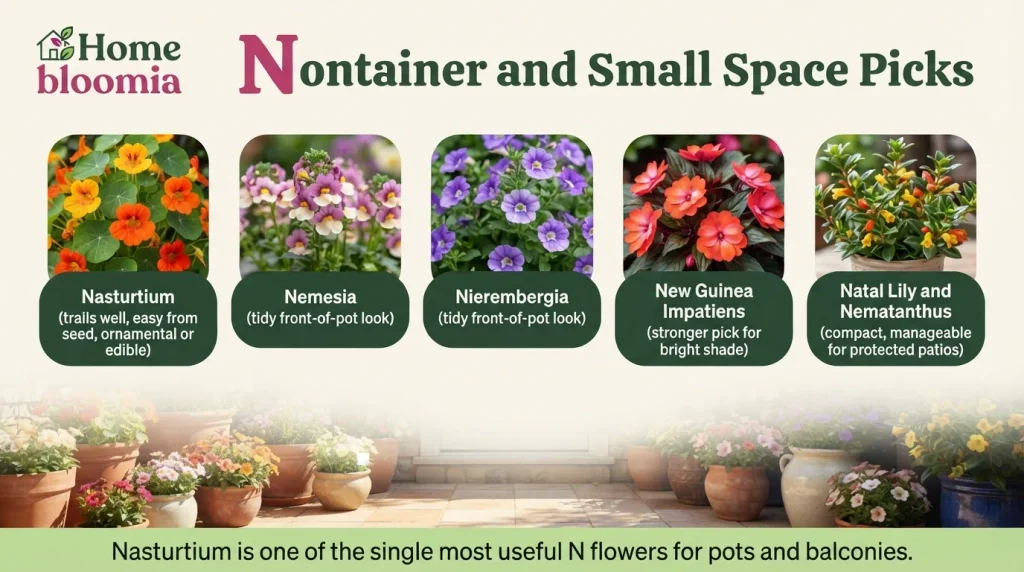
Nasturtium is one of the single most useful N flowers for pots and balconies, it trails well, grows easily from seed, and works in both ornamental and edible displays. Nemesia and Nierembergia give a tidier front-of-pot look, while New Guinea Impatiens is the stronger pick for bright shade. For protected patios, Natal Lily and Nematanthus also fit well since both stay compact and manageable.
Pollinator Friendly and Meadow Picks
Nepeta is the most reliable pollinator plant in the N group, it blooms freely in sunny borders with very little upkeep. New England Aster, New York Aster, New York Ironweed, Narrowleaf Coneflower, and Narrowleaf Sunflower suit meadow-style or native planting, extending color and insect activity later into the season. Nodding Onion is a good choice for smaller wildlife-friendly spaces since it adds flower value without overwhelming the border.
Cut Flower and Bouquet Favorites
The N group isn’t as bouquet-heavy as some other letters, but Narcissus and Nerine both stand out. Narcissus gives clean, recognizable spring stems for simple arrangements, while Nerine brings a finer, late-season look with good movement. Neapolitan Garlic can also add a softer, starry filler effect to looser, garden-picked bouquets.
Water and Pond Flower Picks
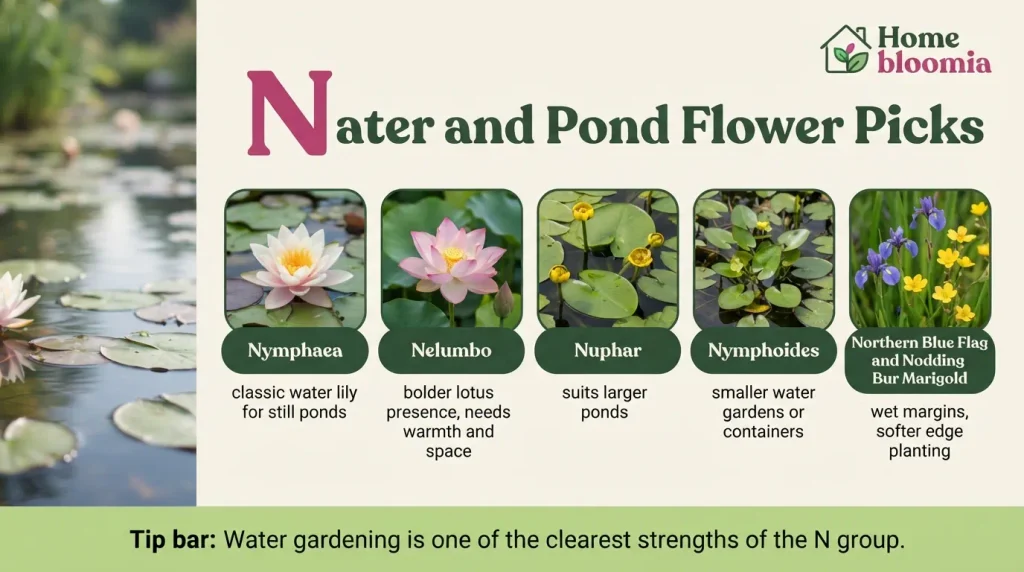
Water gardening is one of the clearest strengths of the N group. Nymphaea is the classic water lily for still ponds, while Nelumbo delivers a bolder lotus presence where there’s enough warmth and space. Nuphar suits larger ponds, and Nymphoides works better in smaller water gardens or containers. For wet margins rather than open water, Northern Blue Flag and Nodding Bur Marigold are the stronger edge-planting choices.
Final Thoughts
Flowers that start with N offer far more range than a simple alphabet list suggests, easy annuals like Nasturtium and Nigella, dependable bulbs like Narcissus and Nerine, fragrant evening bloomers like Nicotiana and Night-scented Stock, and aquatic standouts like Nymphaea, Nelumbo, Nuphar, and Nymphoides.
The most practical approach is to choose by garden need rather than by name alone: Narcissus for spring color, Nasturtium for easy seed growing, Nepeta for pollinators, New Guinea Impatiens for shade pots, and Nymphaea or Nelumbo for water features. Rarer entries like Navarretia, Nemastylis, Napeanthus, and Nuytsia are worth exploring once the basics are covered and your growing conditions match their needs.
FAQs
What are flowers that start with N?
They include spring bulbs like Narcissus and Nerine, easy annuals like Nasturtium and Nigella, fragrant bloomers like Nicotiana, aquatic plants like Nymphaea and Nelumbo, and native wildflowers like Nodding Onion and Nuttall’s Larkspur.
What are 10 common flowers with N?
arcissus, Nasturtium, Nemesia, Nigella, Nicotiana, Nerine, Nepeta, New Guinea Impatiens, New England Aster, and Nymphaea are the ten most widely grown and easiest to find.
What are rare flowers that start with N?
Nodding Ladies’ Tresses, Navarretia, Nemastylis, Napeanthus, Nuytsia, Nyctocalos, and Nun’s Orchid are among the least commonly available N flowers.
What purple flowers start with N?
Nemesia, Nigella, Nepeta, Northern Blue Flag, New England Aster, New York Ironweed, Netted Iris, and Nuttall’s Larkspur all commonly bloom in shades of purple or blue-violet.
Which flowers that start with N are perennials?
Nepeta, Northern Blue Flag, New England Aster, New York Aster, Narrowleaf Coneflower, Narrowleaf Sunflower, and the aquatic Nymphaea, Nelumbo, Nuphar, and Nymphoides are all reliable perennials.
Which flowers that start with N are annuals?
Nasturtium, Nemophila, Nigella, Nolana, Night Phlox, Night-scented Stock, and Nicandra are the strongest true-annual choices, though several are also grown as tender perennials in warmer zones.
What is the difference between N flowers and N plants?
An N flower is grown and recognized primarily for its bloom, like Narcissus or Nymphaea. An N plant, like Nandina or New Zealand flax, may be a legitimate garden plant, but it’s valued mainly for foliage or structure rather than flower display, so it doesn’t belong on a flower-first list.
Are any N flowers toxic to pets?
Yes, Nerium (oleander) is highly toxic to humans and animals and should be avoided around pets, children, and grazing livestock. Nuttall’s Larkspur can also be toxic to livestock in some regions, so it’s best reserved for areas animals can’t reach.
Which N flowers are best for a pond?
Nymphaea (water lily) and Nelumbo (lotus) are the two standout choices for open water, with Nuphar suited to larger ponds and Nymphoides working well in smaller water gardens or tubs.
Which N flowers smell the strongest at night?
Nicotiana, Night Phlox, and Night-scented Stock are the three most reliably fragrant after dark, making them ideal near evening seating areas.
References
- Missouri Botanical Garden Plant Finder — Narcissus, Nepeta, Nicotiana growing profiles
- Royal Horticultural Society (RHS) — Plant selection guides for bulbs, annuals, and perennials
- North Carolina State University Extension — Poisonous Plants database (Nerium oleander)
- USDA PLANTS Database — Native species records for Nodding Onion, Nuttall’s Larkspur, and Narrowleaf species
- Lady Bird Johnson Wildflower Center — Native plant profiles for Nabalus, Navarretia, and New England Aster
- American Orchid Society — Growing guides for Dendrobium, Neotinea, and Spiranthes