55 Flowers That Start With X: Full Guide, Types & Care
Quick Answer: The best-known flowers that start with x include Xeranthemum, Xerochrysum, Xanthisma, Xylobium, Xyris, Yellowhorn, and Xerophyllum. Because X is such an uncommon starting letter for plant names, a full 55-entry list works best by combining a handful of true common flower names with clearly labeled botanical genus and species entries.
X is the rarest starting letter in flower naming, which is why most alphabet flower guides either fall short or stretch the list awkwardly. The better approach is to separate the handful of familiar bloom names from the wider botanical entries, then label everything clearly so the list stays useful rather than just long.
This guide brings together X-flower entries: common ornamental picks, botanical genus names, orchids, wetland bloomers, and flowering plants that regularly appear in X flower lists. It includes quick filters, flower types, color sorting, symbolism, and garden-use guidance.
Most Common Flowers That Begin With X
| Name | Type | Best Known For | Why It Stands Out |
|---|---|---|---|
| Strawflower | Common ornamental flower | Dried arrangements, easy color | Colorful, simple to grow, useful fresh or dried — the most familiar entry in this letter group |
| Xeranthemum | Everlasting flower group | Papery blooms, dry gardens | One of the strongest true X-flower names, with a classic everlasting look |
| Xanthisma | Wildflower group | Native planting, meadow style | A soft, daisy-like wildflower well-suited to naturalistic borders |
| Yellowhorn | Flowering shrub/small tree | Showy spring bloom | A memorable woody bloomer with white flowers and striking colored centers |
| Xyris | Wetland flowering group | Bog and marsh planting | Genuinely useful for wet ground — tidy yellow flowers on grass-like foliage |
| Xylobium | Orchid group | Rare tropical growing | Best suited to greenhouse or collector culture rather than open garden beds |
For more unusual flower naming, Flowers That Start With U sits in a similarly uncommon-letter category.
Quick Picks by Scenario
| Scenario | Best Pick | Why It Works |
|---|---|---|
| Dried flowers | Strawflower | Holds shape and color especially well after cutting |
| Bog gardens | Xyris difformis | Suits moist ground and adds neat yellow flowers where many border plants fail |
| Beginners | Xeranthemum annuum | Tolerates sun and leaner soil, gives a classic papery bloom |
| Rare greenhouse pick | Xylobium | Strong tropical orchid feel and genuine collector appeal |
| Flowering shrub | Yellowhorn | Showy spring flowers on a woody plant with real landscape presence |
Flowers That Start With the Letter X: At a Glance
| Name | Scientific Name | Type | Main Color | Region | Life Cycle | Bloom Season | Sun Needs | Soil Preference | Water Need | Best Use |
|---|---|---|---|---|---|---|---|---|---|---|
| Xanthisma | Xanthisma | Wildflower genus | Purple, lavender | North America | Usually perennial by species | Spring–summer | Full sun | Light, open soil | Low–moderate | Native gardens |
| Yellowhorn | Xanthoceras sorbifolium | Flowering shrub/small tree | White, red-yellow centers | China, Korea | Perennial woody plant | Spring | Full sun | Well-drained fertile soil | Moderate | Specimen planting |
| Xerochrysum | Xerochrysum | Paper daisy genus | Yellow, white, pink, orange | Australia | Annual–perennial by species | Spring–fall | Full sun | Well-drained soil | Low–moderate | Borders, dried flowers |
| Strawflower | Xerochrysum bracteatum | Flowering plant | Yellow, orange, red, pink, white | Australia | Often grown as annual | Summer–fall | Full sun | Light, well-drained soil | Moderate | Beds, bouquets |
| Xeranthemum | Xeranthemum | Everlasting flower genus | Purple, lilac, white | Mediterranean–western Asia | Mostly annual | Summer | Full sun | Lean, dry soil | Low | Dried flowers |
| Annual Xeranthemum | Xeranthemum annuum | Flowering annual | Purple, pink, white | Europe–western Asia | Annual | Summer | Full sun | Dry to moderately poor soil | Low | Dry garden color |
| Xerophyllum | Xerophyllum | Lily-relative genus | Creamy white | North America | Perennial | Late spring–summer | Sun–part sun | Well-drained sandy/woodland soil | Moderate | Woodland, native settings |
| Eastern Turkeybeard | Xerophyllum asphodeloides | Flowering perennial | White | Eastern North America | Perennial | Late spring | Full sun–part shade | Sandy, open meadow soil | Moderate | Meadow-style planting |
| Xylobium | Xylobium | Orchid genus | Cream, yellow, green, bronze | Tropical Americas | Perennial orchid | Varies by species | Bright, filtered | Orchid medium, airflow | Moderate–high humidity | Collector plantings |
| Xyris | Xyris | Yellow-eyed grass genus | Yellow, sometimes pale | Tropical–temperate regions | Annual–perennial by species | Summer | Full sun | Moist–wet soil | High | Wet sites, bog gardens |
| Yellow-Eyed Grass | Xyris difformis | Wetland flower | Yellow | North America | Perennial | Summer | Full sun | Constantly moist ground | High | Rain gardens |
| Bear Grass | Xerophyllum tenax | Flowering perennial | White | Western North America | Perennial | Summer | Full sun | Well-drained mountain/woodland soil | Low–moderate once established | Naturalistic planting |
How We Chose and Verified These X Flower Names
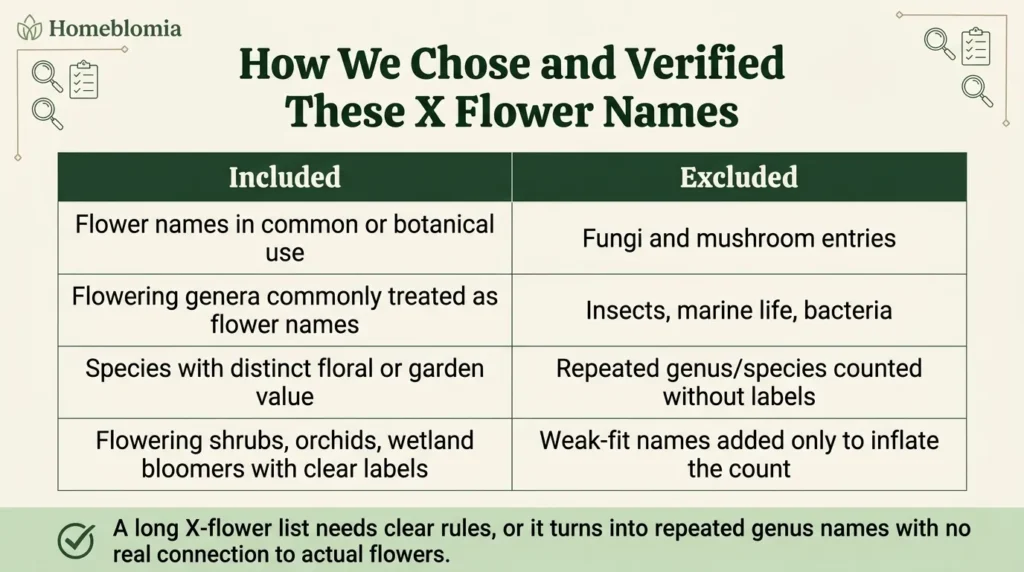
A long X-flower list needs clear rules, or it quickly turns into a mix of repeated genus names and entries only weakly connected to real flowers. For this list, true flower names were included first. Genus-level entries were kept where they’re regularly used as flower names in gardening or botanical writing. Species-level entries were included only where they carry a distinct identity of their own, a specific habitat, common name, or recognizable floral trait, rather than added purely to inflate the count.
| Included | Excluded |
|---|---|
| Flower names in common or botanical use | Fungi and mushroom entries |
| Flowering genera commonly treated as flower names | Insects, marine life, bacteria |
| Species with distinct floral or garden value | Repeated genus/species counted without labels |
| Flowering shrubs, orchids, wetland bloomers with clear labels | Weak-fit names added only to inflate the count |
For a similarly limited letter, see Flowers That Start With Q. For the letter before or after this one, see Flowers That Start With W or continue to Flowers That Start With Y.
Types of Flowers That Begin With X
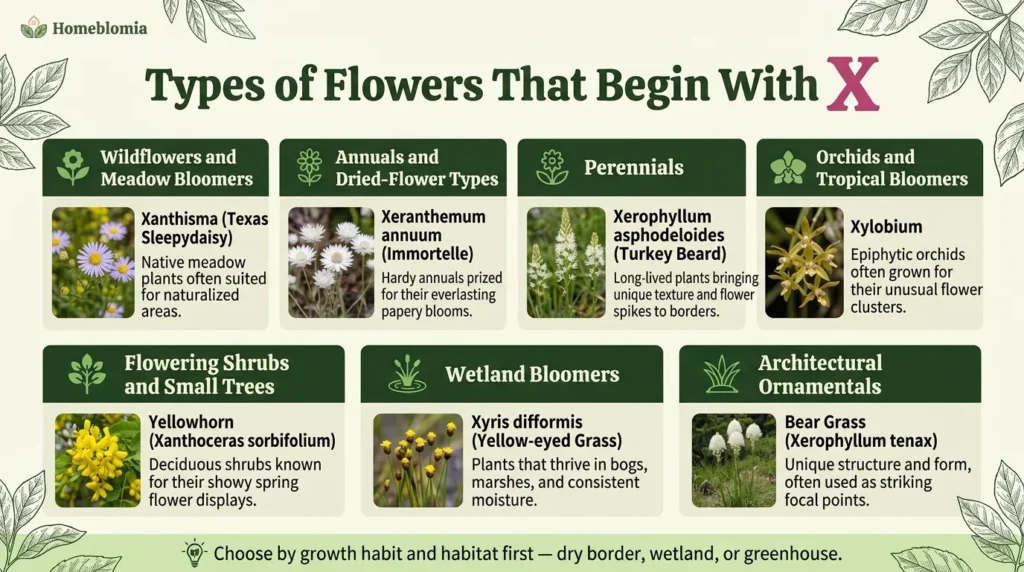
- Wildflowers and meadow bloomers: Xanthisma fits native-style borders and meadow areas well.
- Annuals and dried-flower types: Xeranthemum annuum is commonly used in dry beds and for cut or dried arrangements.
- Perennials: Xerophyllum asphodeloides suits long-term planting where lasting presence matters.
- Orchids and tropical bloomers: Xylobium needs warm indoor or greenhouse conditions, grown mainly by collectors.
- Flowering shrubs and small trees: Yellowhorn is a known spring specimen tree grown for its blooms.
- Wetland bloomers: Xyris difformis and its relatives grow well near ponds or in consistently damp soil.
- Architectural ornamentals: Bear Grass is valued for structure as much as flower.
For another letter blending familiar and less-common botanical names, see Flowers That Start With V.
Plants vs. Flowers That Start With X
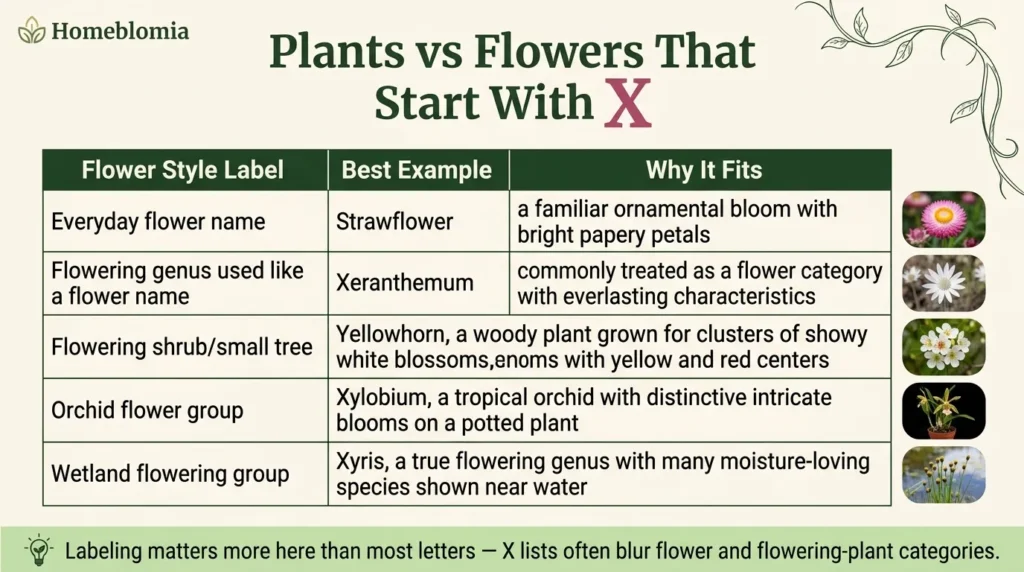
A flower is the bloom itself; a flowering plant is the whole plant that produces it. X lists often blur that line, which is why labeling matters here more than most letters.
| Flower Style Label | Best Example | Why It Fits |
|---|---|---|
| Everyday flower name | Strawflower | Familiar ornamental bloom, broad garden use |
| Flowering genus used like a flower name | Xeranthemum | Commonly treated as a flower category in list-style content |
| Flowering shrub/small tree | Yellowhorn | Grown for showy blossoms on a woody plant |
| Orchid flower group | Xylobium | Tropical orchid bloomers, not border flowers |
| Wetland flowering group | Xyris | A true flowering genus with many moisture-loving species |
The Full List of 55 Flowers Starting With X
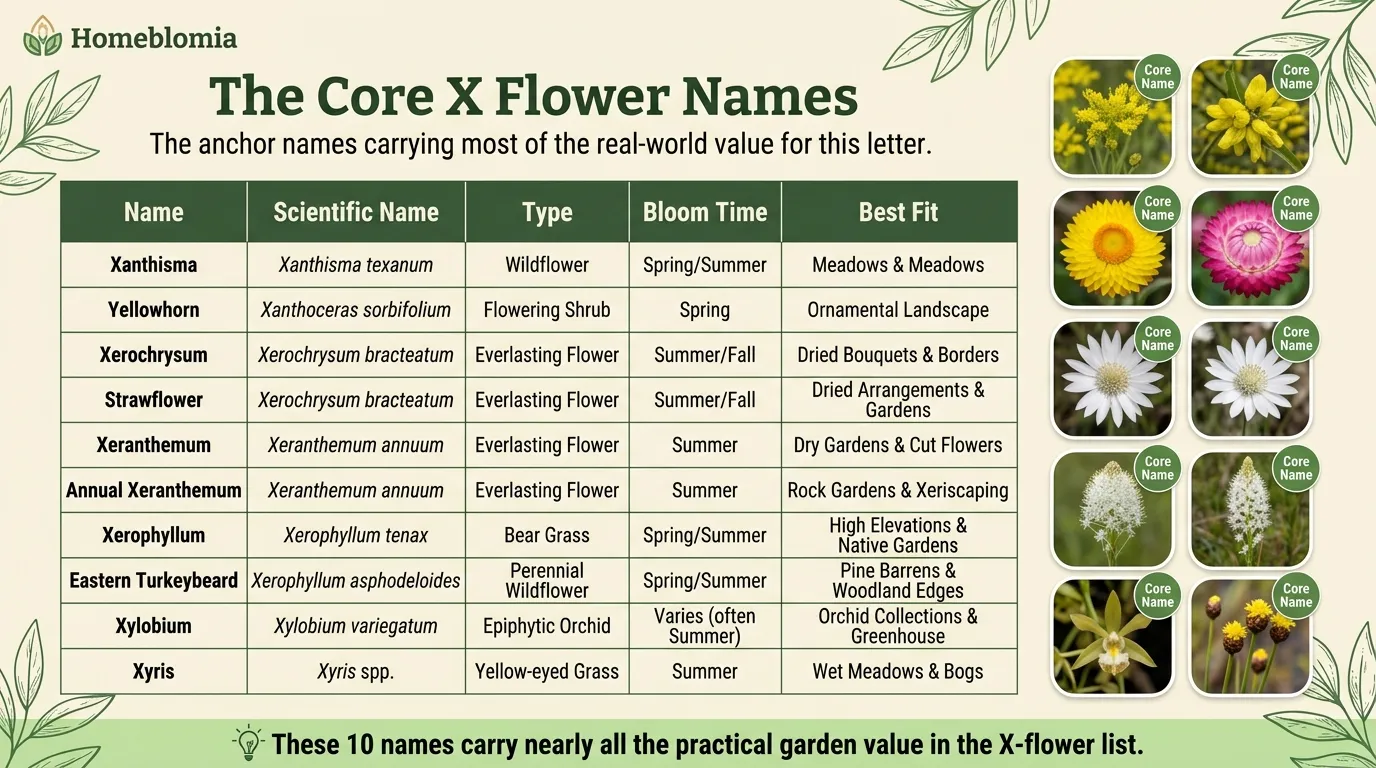
Core X Flower Names
The anchor names carrying most of the real-world value for this topic.
| # | Name | Scientific Name | Type | Alternate Name | Bloom Time | Best Growing Condition | Best Fit |
|---|---|---|---|---|---|---|---|
| 1 | Xanthisma | Xanthisma | Wildflower genus | Sleepy Daisy group | Spring–summer | Open, sunny ground | Native borders |
| 2 | Yellowhorn | Xanthoceras sorbifolium | Flowering shrub/small tree | Golden horn tree | Spring | Full sun, good drainage | Specimen planting |
| 3 | Xerochrysum | Xerochrysum | Paper daisy genus | Everlasting daisy group | Spring–fall | Full sun | Dried flowers, borders |
| 4 | Strawflower | Xerochrysum bracteatum | Flowering plant | Everlasting flower | Summer–fall | Warm, sunny beds | Bouquets, cutting |
| 5 | Xeranthemum | Xeranthemum | Everlasting flower genus | Immortelle group | Summer | Dry, sunny sites | Dried arrangements |
| 6 | Annual Xeranthemum | Xeranthemum annuum | Annual flower | Common xeranthemum | Summer | Lean, sunny soil | Dry garden color |
| 7 | Xerophyllum | Xerophyllum | Flowering genus | Turkeybeard group | Late spring–summer | Sun–part sun | Native, woodland edges |
| 8 | Eastern Turkeybeard | Xerophyllum asphodeloides | Perennial flower | Eastern turkeybeard | Late spring | Open meadows, sandy sites | Meadow planting |
| 9 | Xylobium | Xylobium | Orchid genus | Tropical xylobium orchid group | Varies by species | Warm, humid, filtered light | Collectors, greenhouses |
| 10 | Xyris | Xyris | Yellow-eyed grass genus | Yellow-eyed grass group | Summer | Wet, sunny sites | Bog gardens |
Wildflowers and Meadow Bloomers
Habitat-value species best suited to looser, naturalistic planting.
| # | Name | Scientific Name | Type | Bloom Time | Best Growing Condition | Best Fit |
|---|---|---|---|---|---|---|
| 11 | Sand Sleepy Daisy | Xanthisma arenarium | Wildflower | Spring–summer | Dry, sunny ground | Native dry beds |
| 12 | Fringeleaf Sleepy Daisy | Xanthisma blephariphyllum | Wildflower | Spring | Open sun | Compact meadow planting |
| 13 | Colorado Sleepy Daisy | Xanthisma coloradoense | Wildflower | Spring–early summer | Rocky, sunny sites | Regional native gardens |
| 14 | Slender Sleepy Daisy | Xanthisma gracile | Wildflower | Spring | Light, open soil | Fine-textured meadow planting |
| 15 | Gumweed Sleepy Daisy | Xanthisma grindelioides | Wildflower | Summer | Dry, exposed ground | Tough native mixes |
| 16 | Bare-Head Sleepy Daisy | Xanthisma gymnocephalum | Wildflower | Spring | Sunny native sites | Botanical collections |
| 17 | Two-Edged Yellow-Eyed Grass | Xyris anceps | Wetland flower | Summer | Warm, wet soil | Rain gardens |
| 18 | Short-Leaf Yellow-Eyed Grass | Xyris brevifolia | Wetland flower | Summer | Moist subtropical ground | Wet borders |
| 19 | Carolina Yellow-Eyed Grass | Xyris caroliniana | Wetland flower | Summer | Sunny marsh/bog, coastal plain | Native wetland planting |
| 20 | Bog Yellow-Eyed Grass | Xyris difformis | Wetland flower | Summer | Constant moisture | Bog gardens, pondsides |
Orchids and Tropical Bloomers
Specialist entries adding exotic range to the letter, less useful for ordinary borders.
| # | Name | Scientific Name | Type | Bloom Time | Best Growing Condition | Best Fit |
|---|---|---|---|---|---|---|
| 21 | Xylobium Bractescens | Xylobium bractescens | Orchid | Varies | Warm humidity, filtered light | Orchid collections |
| 22 | Xylobium Coelia | Xylobium coelia | Orchid | Varies | Humid greenhouse conditions | Tropical collections |
| 23 | Xylobium Colleyi | Xylobium colleyi | Orchid | Varies | Warm, protected growing areas | Specialty growers |
| 24 | Xylobium Corrugatum | Xylobium corrugatum | Orchid | Varies | Bright indirect light | Orchid houses |
| 25 | Xylobium Elatum | Xylobium elatum | Orchid | Varies | Warm, humid conditions | Tropical displays |
| 26 | Xylobium Elongatum | Xylobium elongatum | Orchid | Varies | Filtered light, airflow | Botanical collections |
| 27 | Xylobium Foveatum | Xylobium foveatum | Orchid | Varies | Stable warmth, humidity | Indoor specialty growing |
| 28 | Xylobium Leontoglossum | Xylobium leontoglossum | Orchid | Varies | Tropical greenhouse culture | Orchid enthusiasts |
| 29 | Xylobium Miliaceum | Xylobium miliaceum | Orchid | Varies | Warm, humid indoor conditions | Collector shelves |
| 30 | Xylobium Pallidiflorum | Xylobium pallidiflorum | Orchid | Varies | Bright, filtered light | Pale-flowered orchid displays |
Flowering Shrubs, Trees, and Ornamentals
Names better understood as ornamental flowering plants than classic cut flowers.
| # | Name | Scientific Name | Type | Bloom Time | Best Growing Condition | Best Fit |
|---|---|---|---|---|---|---|
| 31 | Xerochrysum Bicolor | Xerochrysum bicolor | Ornamental flower | Summer | Full sun, good drainage | Dry borders |
| 32 | Xerochrysum Hispidum | Xerochrysum hispidum | Ornamental flower | Summer | Sunny, open ground | Native-style planting |
| 33 | Xerochrysum Macranthum | Xerochrysum macranthum | Ornamental flower | Summer | Open sun | Showier perennial beds |
| 34 | Xerochrysum Neoanglicum | Xerochrysum neoanglicum | Ornamental flower | Summer | Full sun | Perennial daisy borders |
| 35 | Xerochrysum Papillosum | Xerochrysum papillosum | Ornamental flower | Summer | Well-drained sunny sites | Regional botanical interest |
| 36 | Xerochrysum Palustre | Xerochrysum palustre | Ornamental flower | Summer | Moist, open sites | Habitat-focused planting |
| 37 | Xerochrysum Subundulatum | Xerochrysum subundulatum | Ornamental flower | Summer | Sunny, upland conditions | Mountain-style beds |
| 38 | Xerochrysum Viscosum | Xerochrysum viscosum | Ornamental flower | Summer | Open sun, drainage | Drought-friendly borders |
Dry-Climate and Xeric Bloomers
Best suited to sunny, dry-garden plans and dried-flower use.
| # | Name | Scientific Name | Type | Bloom Time | Best Growing Condition | Best Fit |
|---|---|---|---|---|---|---|
| 39 | Cylindric Xeranthemum | Xeranthemum cylindraceum | Annual flower | Summer | Dry, sunny soil | Xeric beds |
| 40 | Closed Xeranthemum | Xeranthemum inapertum | Annual flower | Summer | Full sun, lean soil | Warm, dry gardens |
| 41 | Bear Grass | Xerophyllum tenax | Flowering perennial | Summer | Sunny slopes, open woods | Naturalistic planting |
| 42 | Flatstem Yellow-Eyed Grass | Xyris complanata | Wet-to-seasonally-dry flower | Summer | Warm climates with moisture | Flexible habitat planting |
| 43 | Jupicai Yellow-Eyed Grass | Xyris jupicai | Annual/biennial flower | Summer | Moist, sunny ground | Tropical wet beds |
| 44 | Drummond’s Yellow-Eyed Grass | Xyris drummondii | Wetland flower | Summer | Marshy, open ground | Habitat gardens |
| 45 | Slender Yellow-Eyed Grass | Xyris torta | Perennial flower | Summer | Moist, sandy soil | Native bog planting |
Extended Entries
The remaining names extend the topic with genuine botanical relevance, less familiar to casual gardeners.
| # | Name | Scientific Name | Type | Bloom Time | Best Growing Condition | Best Fit |
|---|---|---|---|---|---|---|
| 46 | Cape Yellow-Eyed Grass | Xyris capensis | Flowering grass-like plant | Summer | Moist, warm ground | Specialist wet beds |
| 47 | Small’s Yellow-Eyed Grass | Xyris smalliana | Wetland flower | Summer | Moist, coastal ground | Botanical collections |
| 48 | Harper’s Yellow-Eyed Grass | Xyris scabrifolia | Wetland flower | Summer | Moist, sandy Southeastern US sites | Wet habitat planting |
| 49 | Baldwin’s Yellow-Eyed Grass | Xyris baldwiniana | Perennial flower | Summer | Moist, open sites | Regional botanical interest |
| 50 | Indian Yellow-Eyed Grass | Xyris indica | Wetland flower | Summer | Tropical, wet ground | Asian and Australian plantings |
| 51 | Loose-Flowered Yellow-Eyed Grass | Xyris laxifolia | Perennial flower | Summer | Moist tropical sites | Rain garden collections |
| 52 | Acid-Swamp Yellow-Eyed Grass | Xyris serotina | Perennial flower | Summer | Acidic coastal-plain swamp | Specialty wet habitat displays |
| 53 | Elliott’s Yellow-Eyed Grass | Xyris elliottii | Wetland flower | Summer | Sunny, wet ground | Southeastern US habitat gardens |
| 54 | Mountain Yellow-Eyed Grass | Xyris montana | Perennial flower | Summer | Cool, boggy sites | North American bog gardens |
| 55 | Fan-Leaf Yellow-Eyed Grass | Xyris flabelliformis | Perennial flower | Summer | Moist, sandy coastal-plain sites | Rare botanical collections |
Best Flower Names Starting With X by Color
Purple Flowers That Start With X
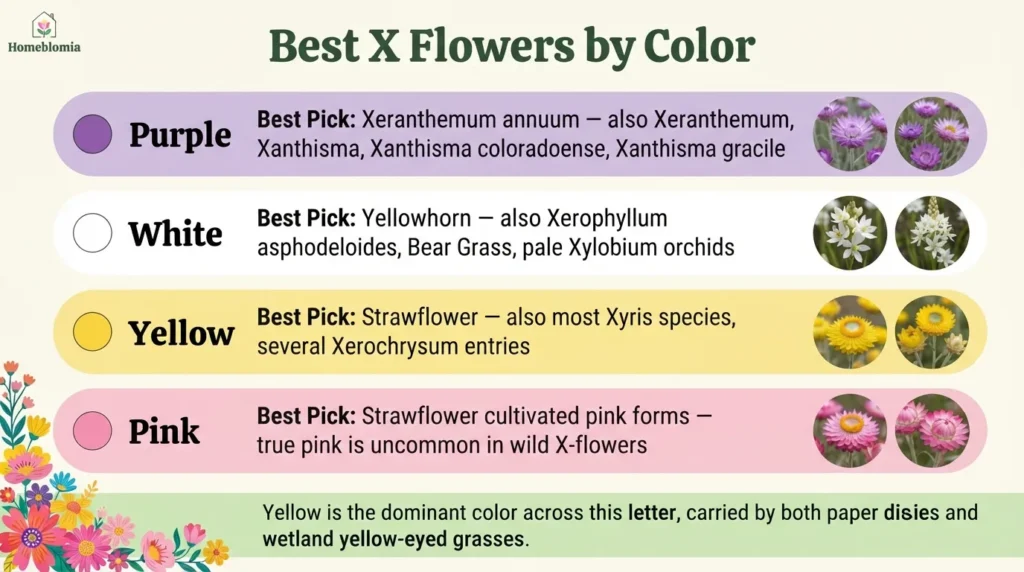
Best pick: Xeranthemum annuum. Xeranthemum annuum, Xeranthemum, Xanthisma, Xanthisma coloradoense, and Xanthisma gracile are the strongest purple-leaning options, purple is one of the more achievable colors in this letter group, carried by both everlastings and daisy-like wildflowers.
White X-Flower Names
Best pick: Yellowhorn. Yellowhorn, Xerophyllum asphodeloides, Bear Grass, and some pale-flowered Xylobium orchids round out the white and cream options, useful for contrast or a cooler palette.
Yellow X-Flower Names
Best pick: Strawflower. Strawflower, most Xyris species, and several Xerochrysum entries lead the yellow side of the list, yellow is genuinely the dominant color across both the paper daisies and the wetland yellow-eyed grasses.
Pink X-Flower Names
Best pick: Strawflower (cultivated pink forms). True pink is uncommon in wild X-flowers, but cultivated Strawflower and select Xerochrysum forms carry blush-to-dusty-pink tones.
Best X Flowers by Growing Style and Use
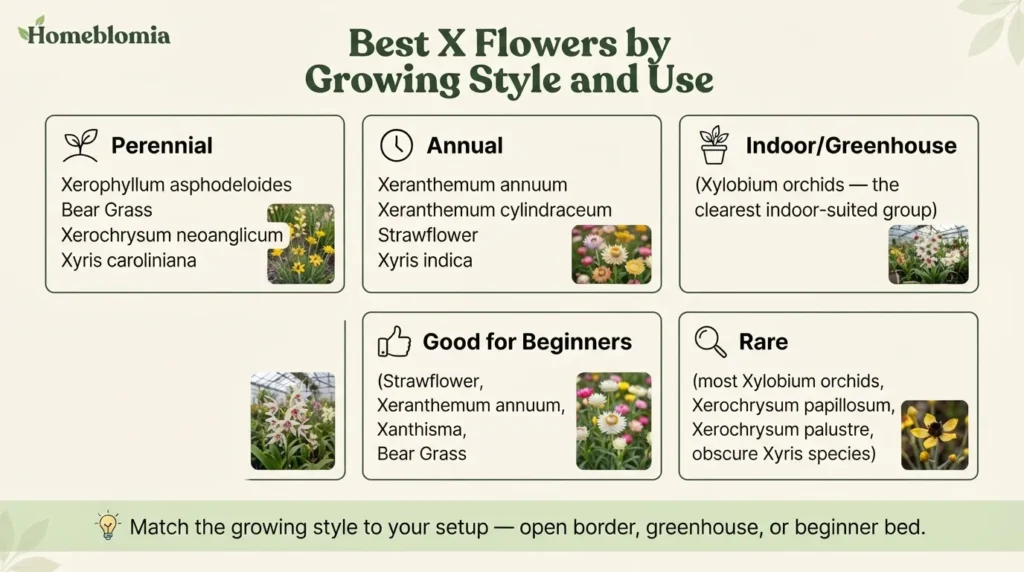
Perennial
Xerophyllum asphodeloides, Bear Grass, Xerochrysum neoanglicum, Xerochrysum viscosum, Xyris caroliniana, and Xyris montana.
Annual
Xeranthemum annuum, Xeranthemum cylindraceum, Strawflower (when grown as an annual), and Xyris indica.
Indoor/Greenhouse
Xylobium orchids, the clearest indoor-suited group in this letter, needing warmth, humidity, and filtered light.
Good for Beginners
Strawflower, Xeranthemum annuum, Xanthisma, and Bear Grass, all tolerate ordinary garden conditions without specialized care.
Rare
Most Xylobium orchids, Xerochrysum papillosum, Xerochrysum palustre, and the more obscure Xyris species, uncommon mainly because they’re not sold in general garden centers.
Symbolism and Meaning of Key X Flowers
| Flower | Common Symbolic Reading | Why It Fits |
|---|---|---|
| Strawflower | Endurance, lasting memory | Dries well and keeps its shape, a natural link to permanence |
| Xeranthemum | Calm resilience | Papery, everlasting form suits dry conditions, a quiet enduring feel |
| Yellowhorn | Renewal, spring energy | Bold spring flowering brings a fresh-start quality |
| Xylobium | Rarity, refinement | Uncommon tropical orchid group, feels curated and elegant |
| Xanthisma | Simplicity, natural beauty | Daisy-like form suits meadow symbolism over formal bouquet tradition |
What Is the Most Popular Flower That Starts With X?
Strawflower (Xerochrysum bracteatum) is the clearest answer, colorful, familiar, easy to grow, and useful both fresh and dried. Xeranthemum annuum comes next, with a long history specifically as an everlasting flower. Yellowhorn is memorable but functions more as a flowering shrub than a standard bedding pick.
Where X Flowers Grow Best
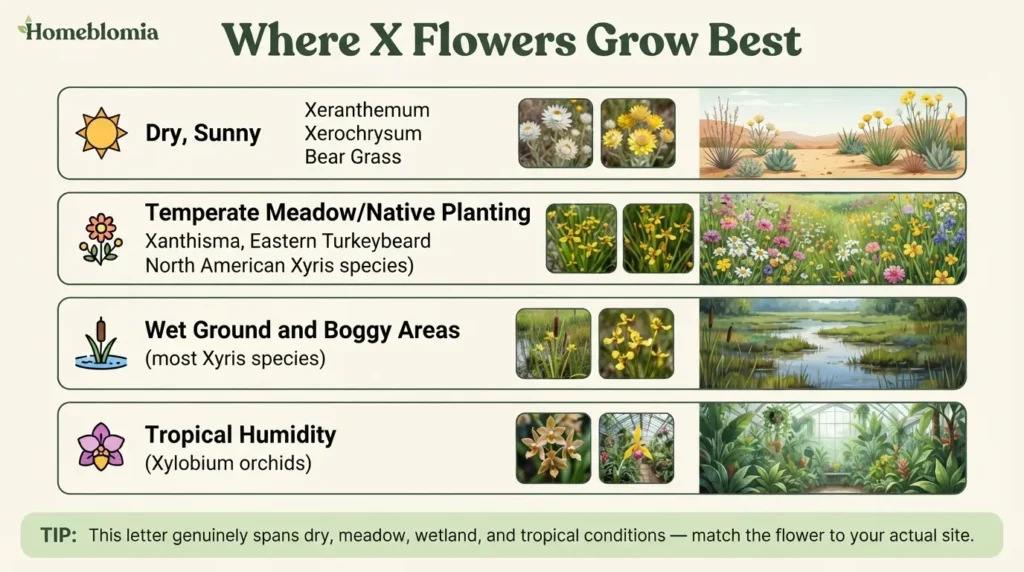
- Dry, sunny sites suit Xeranthemum, Xerochrysum, and Bear Grass, strongest where drainage is good and rich, moisture-retentive soil isn’t the main condition.
- Temperate meadow and native planting fits Xanthisma, Eastern Turkeybeard, and several North American Xyris species, working especially well in looser planting designs.
- Wet ground and boggy areas suit most Xyris species, genuinely valuable in a letter group that would otherwise lean too heavily toward dry-garden bloomers.
- Tropical humidity is where Xylobium orchids make sense, far better suited to greenhouse growing than ordinary open beds.
How to Use X Flowers in a Garden or Bouquet
For dried arrangements, Strawflower and Xeranthemum annuum are the standout choices, both hold shape and color exceptionally well after cutting. For native or pollinator planting, Xanthisma fits neatly into open, meadow-like borders. For wet corners and rain gardens, Xyris fills a genuine gap most flower lists can’t address. For greenhouse display, Xylobium adds real tropical, collector-grade variety. For a flowering specimen shrub, Yellowhorn gives the group real spring landscape presence.
Common Mistakes in X-Flower Lists
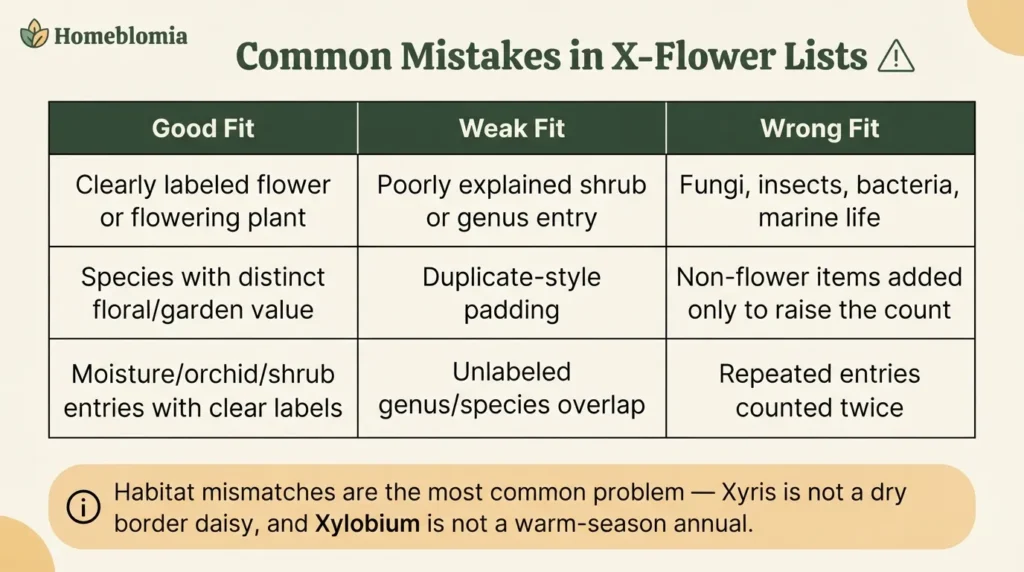
The most common mistake is forcing the count with entries that aren’t genuinely flowers. That erodes trust and usefulness fast. A second common issue is listing a genus and one of its species without any label explaining the difference between them, better practice keeps both only when the genus is widely used in naming lists and the species has a distinct identity of its own. Habitat mismatches are a third common problem: Xyris species are not dry border daisies, and Xylobium orchids are not warm-season annual bed plants. Matching each name to its real growing condition is what gives a list like this actual value.
| Good Fit | Weak Fit | Wrong Fit |
|---|---|---|
| Clearly labeled flower or flowering plant | Poorly explained shrub or genus entry | Fungi, insects, bacteria, marine life |
| Species with distinct floral/garden value | Duplicate-style padding | Non-flower items added only to raise the count |
| Moisture/orchid/shrub entries with clear labels | Unlabeled genus/species overlap | Repeated entries counted twice |
An Honesty Note on This List’s Structure
Worth being upfront about: roughly 30 of these 55 entries are individual species within just two genera — Xyris and Xylobium. That’s not padding in the sense of including non-flowers or fake names; every entry above is a real, taxonomically recognized species. But it does mean “55 X-flowers” is more accurately “about 7 genuinely distinct plant types, represented across many named species,” most of which share very similar appearance and growing needs within their genus. If you’re choosing what to actually plant, the Group 1 core names and the At-a-Glance table above will serve you better than treating all 55 as meaningfully different options.
Conclusion
Flower names starting with X are rare, but the list doesn’t have to feel like filler once it’s organized honestly. The strongest names come from everlastings, yellow-eyed grasses, wildflowers, orchids, and one flowering woody plant. For real garden value, start with Strawflower, Xeranthemum annuum, Xanthisma, Xyris difformis, and Yellowhorn. For a rarer botanical feel, move toward Xylobium and the less familiar Xyris and Xerochrysum species.
FAQ
What are flowers that start with X?
The genuine names come from Xeranthemum, Xerochrysum (including Strawflower), Xanthisma, Xylobium, Xyris, Xerophyllum, and the flowering shrub Yellowhorn.
How many flowers start with the letter X?
A small core of about 7 distinct plant types, though a species-level count across genera like Xyris and Xylobium can reach 50 or more.
What are the most common flowers that start with X?
Strawflower, Xeranthemum, Xanthisma, Yellowhorn, Xyris, and Xylobium.
Which flowers that start with X are perennials?
Xerophyllum asphodeloides, Bear Grass, Xerochrysum neoanglicum, Xyris caroliniana, and Xyris montana.
Are there indoor flowers that start with X?
Yes, Xylobium orchids, suited to warm, humid, bright filtered conditions.
Which X-flowers are good for beginners?
Strawflower, Xeranthemum annuum, Xanthisma, and Bear Grass.
What are rare flowers that start with X?
Most Xylobium orchids and the more obscure Xerochrysum and Xyris species.
Are there purple flowers that start with X?
Yes, Xeranthemum annuum and several Xanthisma species.
Are any X-flowers good for dried arrangements?
Strawflower and Xeranthemum annuum are the standouts.
What flower starting with X smells the best?
Fragrance isn’t a strong feature of this letter, most X-flowers are chosen for texture, rarity, or habitat value rather than scent.
Do any flower names starting with X have meaning or symbolism?
Yes, though gently, Strawflower with endurance, Xeranthemum with quiet resilience, Yellowhorn with spring renewal.
What’s the difference between plants and flowers starting with X?
A flower is the bloom; a flowering plant is the whole plant. Xylobium (an orchid genus) and Yellowhorn (a flowering tree) are better understood as flowering plants than simple garden flowers.