30 Flowers That Start With Q: Full Guide, Types & Care
Quick Answer: Flowers that start with Q include Queen Anne's Lace, Quaker Ladies, Queen's Cup, Queen's Tears, Queen of the Night, Quamash, Quamoclit, Quince Blossoms, Queen's Wreath, and Qantuta. A fuller list also includes flowering trees, ornamental grasses, desert shrubs, and rarities like Queen of the Andes.
Q is one of the least common starting letters in flower naming, but the group holds more genuine variety than its size suggests, true wildflowers, flowering vines, shrubs, trees, bromeliads, orchids, a night-blooming cactus, and even a rare giant of the Andes. That variety matters practically: a meadow plant like Queen Anne’s Lace doesn’t need the same care as a tropical vine like Queen’s Wreath or an indoor bromeliad like Queen’s Tears.
Popular Flower Names Starting With Q
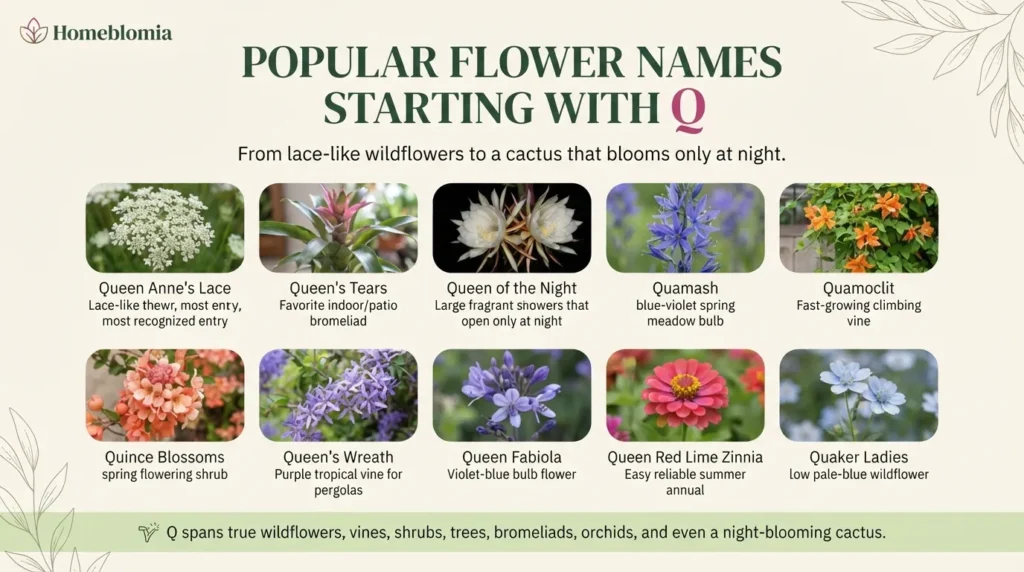
The most familiar Q-flowers across gardens, wildflower references, and container guides include Queen Anne’s Lace, Queen’s Tears, Queen of the Night, Quamash, Quamoclit, Quince Blossoms, Queen’s Wreath, Queen Fabiola, Queen Red Lime Zinnia, and Quaker Ladies. Queen Anne’s Lace is probably the single most recognized entry, known for its lace-like white flower clusters. Queen’s Tears is a favorite for indoor and patio containers. Queen of the Night is known for large, fragrant flowers that open only at night. Quamoclit is valued as a fast-growing climbing flower, and Queen Red Lime Zinnia is one of the easiest choices for reliable summer color.
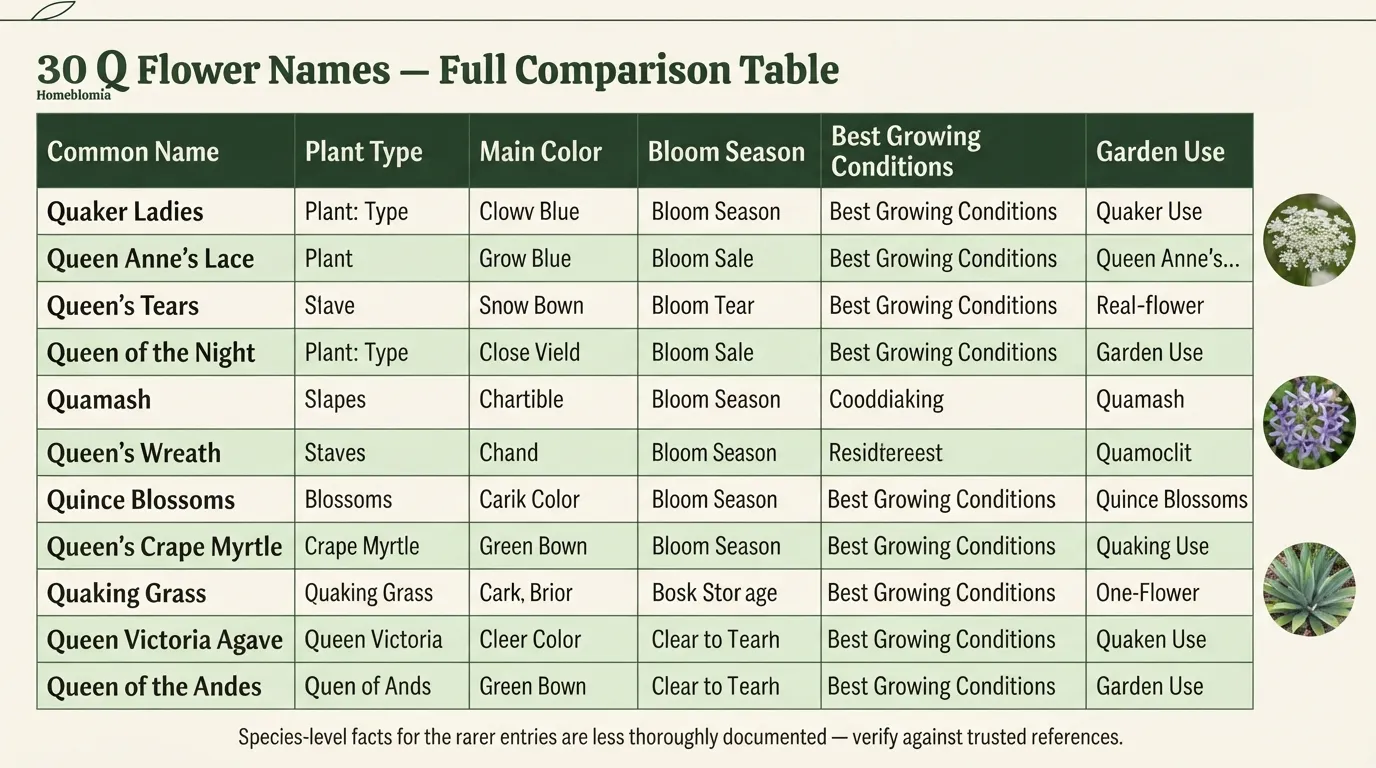
30 Q Flower Names Full Comparison Table
| Common Name | Scientific Name | Plant Type | Main Color | Bloom Season | Best Growing Conditions | Garden Use |
|---|---|---|---|---|---|---|
| Quaker Ladies | Houstonia caerulea | Low wildflower | Pale blue, white, yellow center | Spring–early summer | Full sun–part shade, moist/sandy soil | Rock gardens, native beds |
| Queen Anne’s Lace | Daucus carota | Biennial wildflower | White | Midsummer–fall | Full sun, well-drained soil | Pollinator/cottage gardens |
| Queen’s Cup | Clintonia uniflora | Woodland perennial | White | Late spring–early summer | Moist woodland soil, cool shade | Shade/woodland gardens |
| Queen’s Tears | Billbergia nutans | Bromeliad | Pink, green, purple, yellow | Winter–spring | Bright indirect light, sharp drainage | Containers, indoor display |
| Queen of the Night | Epiphyllum oxypetalum | Night-blooming cactus | White | Late spring–summer | Bright filtered light, cactus mix | Containers, patios |
| Quamash | Camassia quamash | Bulb perennial | Blue, violet | Late spring–early summer | Full sun–part sun, moist spring soil | Meadow gardens, borders |
| Quamoclit | Ipomoea quamoclit | Annual vine | Red, pink, white | Summer–fall | Full sun, climbing support | Trellises, hummingbird gardens |
| Queen’s Wreath | Petrea volubilis | Woody vine | Purple, lavender | Spring–summer (warm climates) | Full sun, fertile well-drained soil | Pergolas, tropical landscapes |
| Quince Blossoms | Chaenomeles spp. | Flowering shrub | Pink, red, orange, white | Late winter–early spring | Full sun–part sun, well-drained loam | Hedges, cottage gardens |
| Queen of the Prairie | Filipendula rubra | Herbaceous perennial | Pink | Summer | Moist soil, sun–part shade | Rain gardens, pond edges |
| Queen of the Meadow | Filipendula ulmaria | Herbaceous perennial | Creamy white | Summer | Moist–wet soil, part sun | Wet meadows, streamside |
| Queen Lily Ginger | Curcuma petiolata | Tropical perennial | Pink bracts, yellow flowers | Summer–early fall | Part shade, rich moist soil | Containers, tropical beds |
| Queen of Sheba Orchid | Thelymitra variegata | Terrestrial orchid | Purple, pink, yellow, white | Late winter–spring (native habitat) | Specialized habitat only | Educational/conservation reference |
| Queen’s Crape Myrtle | Lagerstroemia speciosa | Flowering tree | Pink, purple | Summer | Full sun, warm climate | Shade tree, street planting |
| Queen Fabiola | Triteleia laxa | Bulb perennial | Violet-blue | Late spring–early summer | Full sun, well-drained soil | Borders, cut flowers |
| Queen Red Lime Zinnia | Zinnia elegans cultivar | Annual flower | Lime, rose, burgundy | Summer–fall | Full sun, warm soil | Cut flower beds, borders |
| Queen’s Crown | Dicliptera suberecta | Perennial | Coral, orange-red | Summer–fall | Full sun–part sun | Pollinator beds, containers |
| Qantuta | Cantua buxifolia | Flowering shrub | Red, pink, yellow | Spring–summer | Sun–light shade, cool mountain conditions | Ornamental/cultural gardens |
| Quesnelia | Quesnelia spp. | Bromeliad | Red, pink, blue, purple | Varies by species | Bright filtered light, humidity | Tropical containers |
| Quisqualis | Combretum indicum | Climbing vine | White, pink, red | Warm season | Full sun, frost-free climate | Fences, fragrance gardens |
| Quaking Grass | Briza media | Ornamental flowering grass | Green fading to gold | Late spring–summer | Full sun, well-drained soil | Borders, dried arrangements |
| Queen Victoria Agave | Agave victoriae-reginae | Succulent (monocarpic bloomer) | Cream-yellow | Once at maturity (years) | Full sun, sharp drainage | Rock gardens, containers |
| Queen of the Andes | Puya raimondii | Giant bromeliad relative | Green-white | Once at maturity, after decades | High-altitude, well-drained soil | Botanical/specialist collections |
| Quandong | Santalum acuminatum | Flowering/fruiting native tree | Cream | Spring–summer | Full sun, well-drained soil (native to Australia) | Native gardens, orchards |
| Queensland Firewheel Tree | Stenocarpus sinuatus | Flowering tree | Red-orange | Summer | Full sun, warm climate | Specimen tree, warm landscapes |
| Queensland Bluebell | Wahlenbergia gracilis | Wildflower | Blue-violet | Spring–summer | Full sun, well-drained soil | Native/meadow planting |
| Queen Palm | Syagrus romanzoffiana | Flowering palm | Cream | Summer | Full sun, warm frost-free climate | Specimen/landscape tree |
| Quinoa | Chenopodium quinoa | Flowering crop plant | Green, red, gold (seed heads) | Summer | Full sun, well-drained soil | Educational/edible gardens |
| Quailbush | Atriplex lentiformis | Desert flowering shrub | Greenish, inconspicuous | Summer | Full sun, dry alkaline soil | Xeric/desert landscaping |
| Quinine Bush | Garrya fremontii | Flowering shrub (catkins) | Greenish-gray | Late winter–spring | Sun–part shade, well-drained soil | Native/dry shrub borders |
Types of Flowers That Start With Q
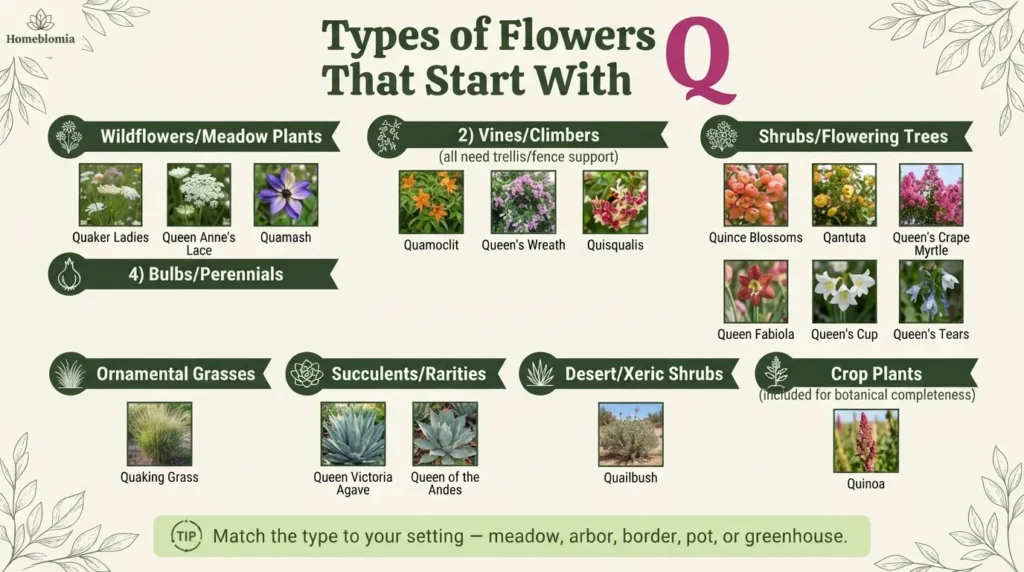
- Wildflowers/meadow plants: Quaker Ladies, Queen Anne’s Lace, Quamash, Queen of the Prairie, Queen of the Meadow, Queensland Bluebell.
- Vines/climbers: Quamoclit, Queen’s Wreath, Quisqualis, all need a trellis, fence, or arbor.
- Shrubs/flowering trees: Quince Blossoms, Qantuta, Queen’s Crape Myrtle, Queensland Firewheel Tree, Quinine Bush, Quandong, Queen Palm.
- Bulbs/perennials: Queen Fabiola, Quamash, Queen’s Cup, Queen’s Tears, Queen Lily Ginger, Queen of the Night, Quesnelia.
- Ornamental grasses: Quaking Grass.
- Succulents/rarities: Queen Victoria Agave, Queen of the Andes.
- Desert/xeric shrubs: Quailbush.
- Crop plants included for botanical completeness: Quinoa.
Purple Flowers That Start With Q
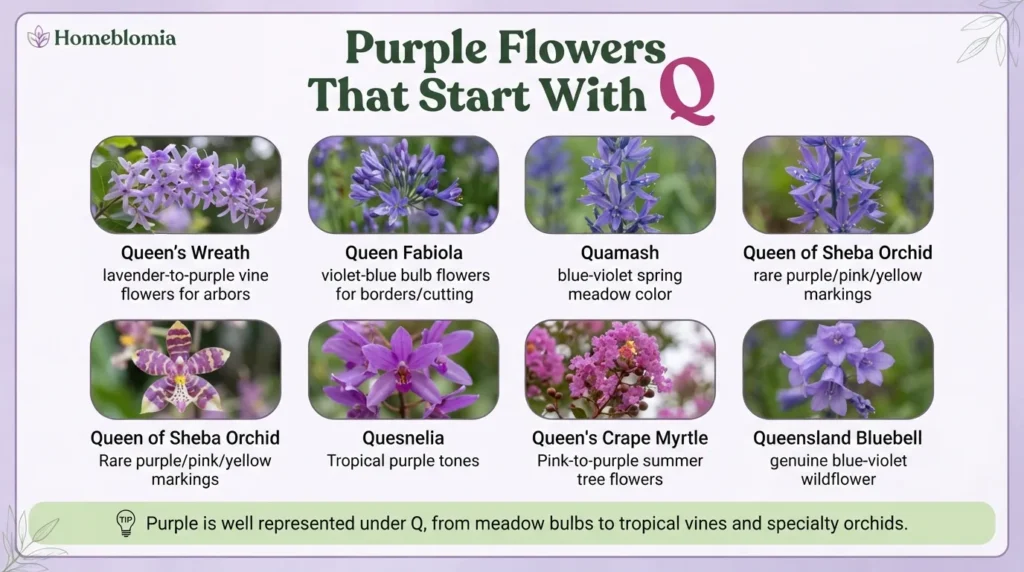
Strong purple choices include Queen’s Wreath (lavender-to-purple vine flowers for arbors), Queen Fabiola (violet-blue bulb flowers for borders and cutting), Quamash (blue-violet spring meadow color), Queen of Sheba Orchid (rare purple, pink, and yellow markings), Quesnelia (tropical purple tones depending on species), Queen’s Crape Myrtle (pink-to-purple summer tree flowers), and Queensland Bluebell (a genuine blue-violet wildflower addition to this letter group).
For more violet and purple bloom ideas, see Flowers That Start With V.
Rare Flowers That Start With Q
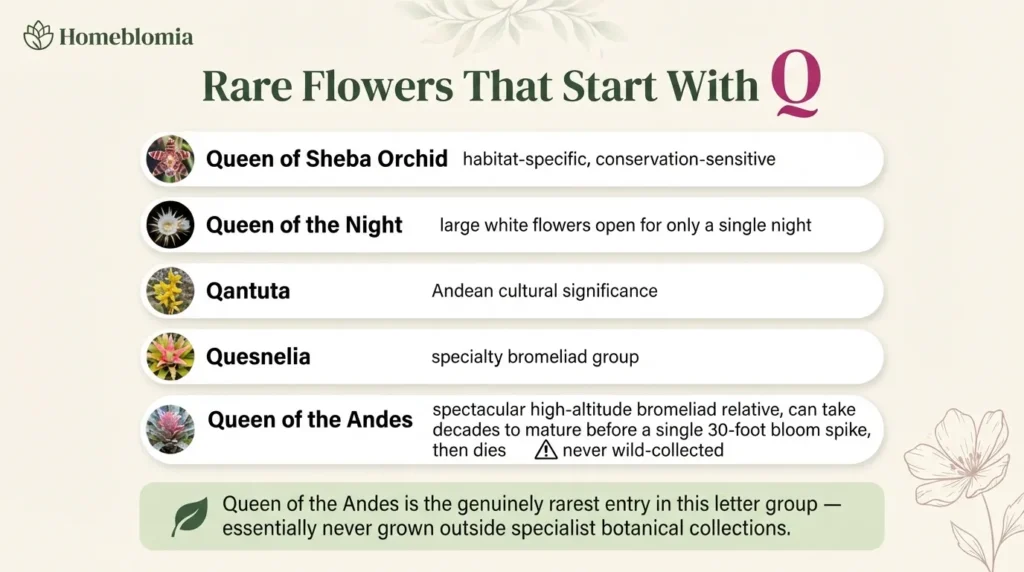
Queen of Sheba Orchid is among the most special entries, habitat-specific and conservation-sensitive. Queen of the Night feels rare because its large white flowers open for only a single night. Qantuta carries Andean cultural significance. Quesnelia is a specialty bromeliad group. Quisqualis is easy in warm climates but impractical for cold gardens without protection.
The genuinely rarest entry on this expanded list is Queen of the Andes (Puya raimondii), a spectacular bromeliad relative native to high-altitude Peru and Bolivia that can take decades to mature before sending up a flower spike over 30 feet tall, blooming once, then dying. It’s essentially never grown outside specialist botanical collections and should be admired through those channels only, never wild-collected.
Container Flowers With Q
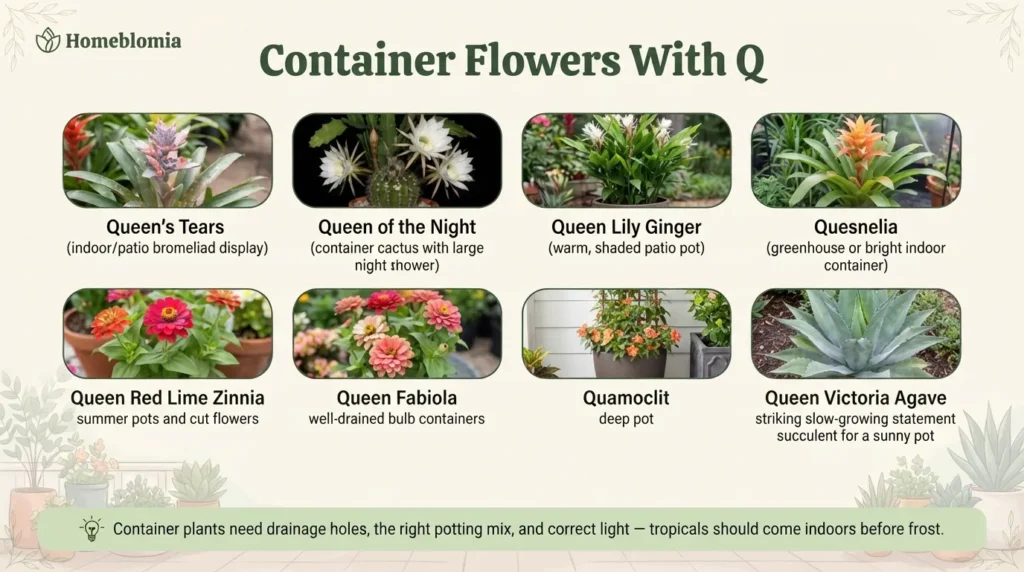
Good choices for container growing include Queen’s Tears (indoor/patio bromeliad display), Queen of the Night (container cactus with large night flowers), Queen Lily Ginger (warm, shaded patio pot), Quesnelia (greenhouse or bright indoor container), Queen Red Lime Zinnia (summer pots and cut flowers), Queen Fabiola (well-drained bulb containers), Quamoclit (deep pot with a small trellis), and Queen Victoria Agave (a striking, slow-growing statement succulent for a sunny pot).
Container plants need drainage holes, an appropriate potting mix, and correct light. Tropical entries should stay away from cold windows and come indoors before frost; sun-loving annuals need strong light, while bromeliads and the night-blooming cactus prefer bright filtered light.
Indoor Flowers With Q
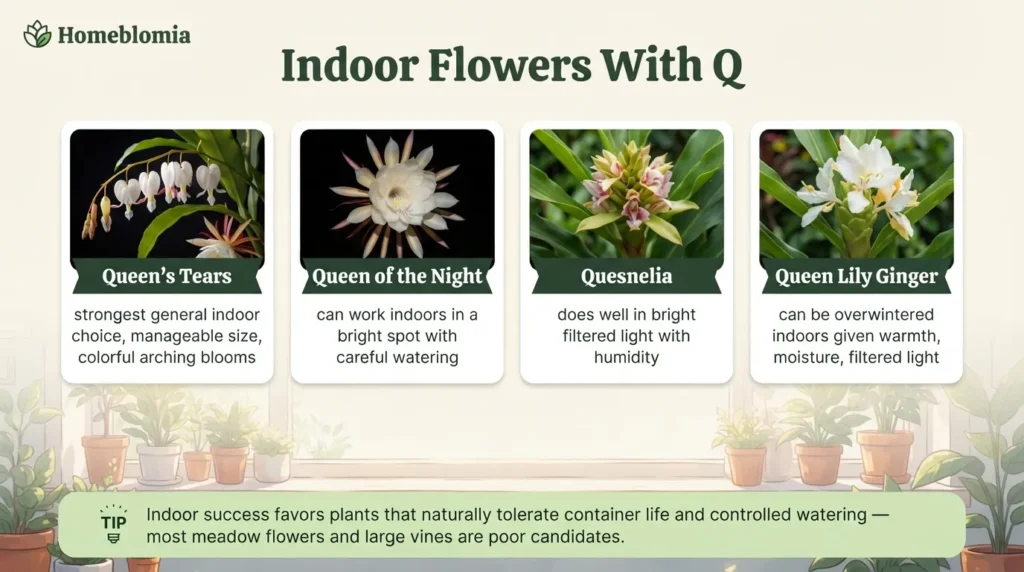
Queen’s Tears is the strongest general indoor choice, manageable size, colorful arching blooms. Queen of the Night can also work indoors in a bright spot with careful watering. Quesnelia does well in bright filtered light with humidity and an airy mix. Queen Lily Ginger can be overwintered indoors given warmth, moisture, and filtered light. Most meadow flowers and large vines are poor indoor candidates, indoor success favors plants that naturally tolerate container life and controlled watering.
Best Q Flowers for Home Gardens
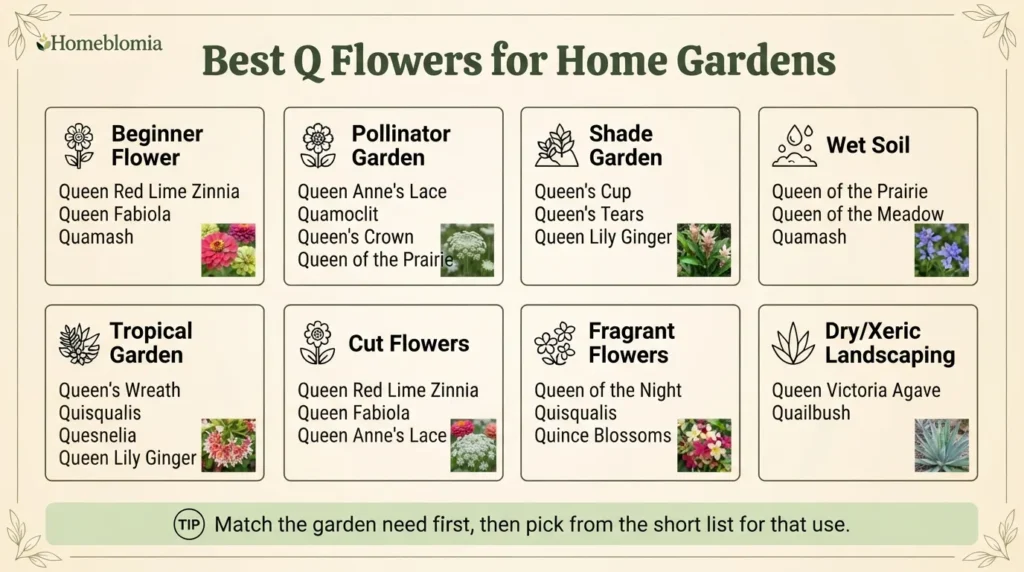
| Garden Need | Best Q-Flower Choices |
|---|---|
| Beginner flower | Queen Red Lime Zinnia, Queen Fabiola, Quamash |
| Pollinator garden | Queen Anne’s Lace, Quamoclit, Queen’s Crown, Queen of the Prairie |
| Shade garden | Queen’s Cup, Queen’s Tears, Queen Lily Ginger |
| Wet soil | Queen of the Prairie, Queen of the Meadow, Quamash |
| Tropical garden | Queen’s Wreath, Quisqualis, Quesnelia, Queen Lily Ginger |
| Cut flowers | Queen Red Lime Zinnia, Queen Fabiola, Queen Anne’s Lace |
| Fragrant flowers | Queen of the Night, Quisqualis, Quince Blossoms |
| Dry/xeric landscaping | Queen Victoria Agave, Quailbush |
| Native/Australian gardens | Quandong, Queensland Firewheel Tree, Queensland Bluebell |
Which Q Flowers Smell the Best?
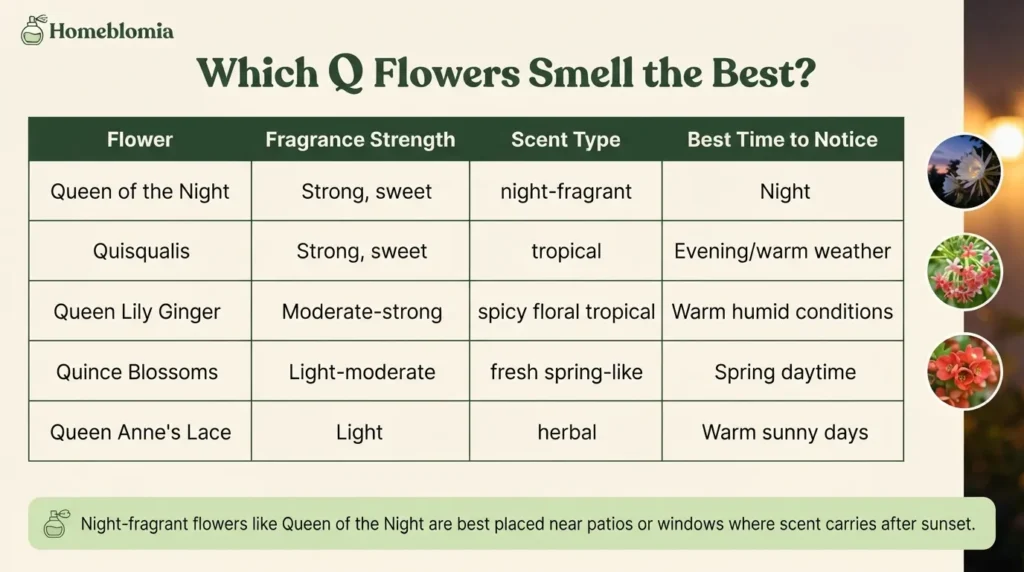
| Flower | Fragrance Strength | Scent Type | Best Time to Notice |
|---|---|---|---|
| Queen of the Night | Strong | Sweet, night-fragrant | Night |
| Quisqualis | Strong | Sweet, tropical | Evening, warm weather |
| Queen Lily Ginger | Moderate–strong | Spicy, floral, tropical | Warm humid conditions |
| Quince Blossoms | Light–moderate | Fresh, spring-like | Spring daytime |
| Queen Anne’s Lace | Light | Green, herbal | Warm sunny days |
Fragrance is strongest on healthy, well-watered plants in the right light. Night-fragrant flowers like Queen of the Night are best placed near patios or windows where the scent carries after sunset.
Tropical vs. Temperate Q Flowers
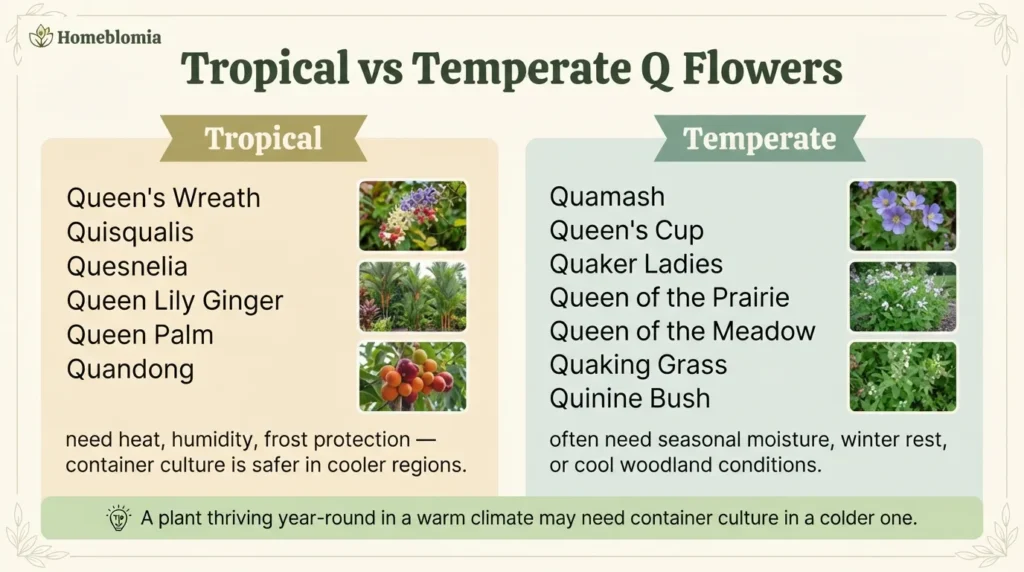
- Tropical: Queen’s Wreath, Quisqualis, Quesnelia, Queen Lily Ginger, Queen Palm, Quandong, all need heat, humidity, and frost protection; container culture is safer in cooler regions.
- Temperate: Quamash, Queen’s Cup, Quaker Ladies, Queen of the Prairie, Queen of the Meadow, Quaking Grass, Quinine Bush, these often need seasonal moisture, winter rest, or cool woodland conditions.
- Warm-season annuals: Quamoclit, Queen Red Lime Zinnia.
- Indoor-friendly: Queen’s Tears, Queen of the Night, Quesnelia.
- High-altitude specialist: Queen of the Andes, needs cool, high-elevation conditions essentially impossible to replicate outside its native range or a specialist botanical collection.
A plant that grows year-round in a warm climate may need container culture in a colder one, especially true for bromeliads, tropical vines, ginger relatives, and night-blooming cacti.
Meaning and Symbolism of Flowers Starting With Q
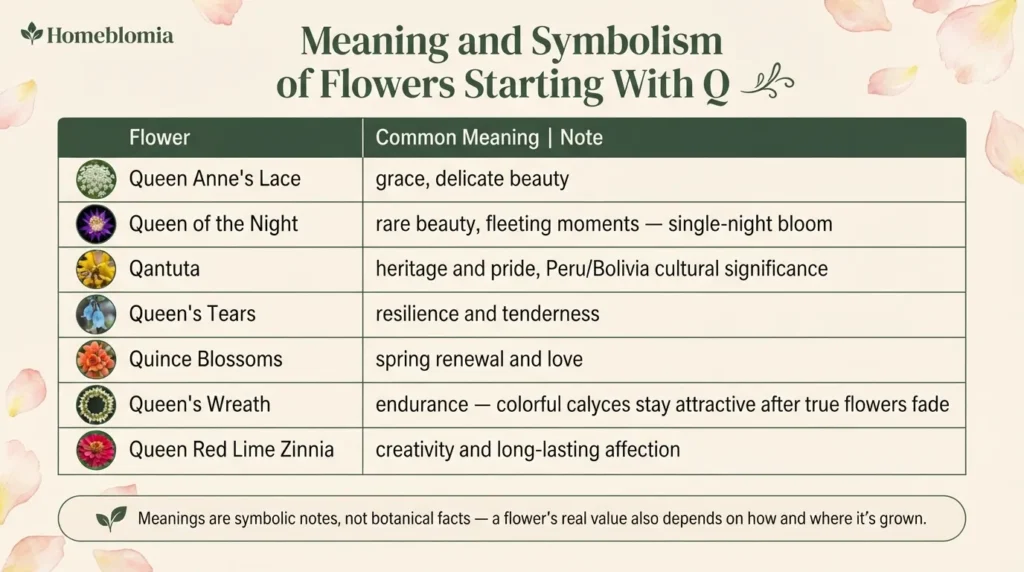
Queen Anne’s Lace is often linked with grace and delicate beauty. Queen of the Night suggests rare beauty and fleeting moments, given its single-night bloom. Qantuta carries heritage and pride from its cultural significance in Peru and Bolivia. Queen’s Tears can suggest resilience and tenderness. Quince Blossoms are often tied to spring renewal and love. Queen’s Wreath suggests endurance, since its colorful calyces stay attractive after the true flowers fade. Queen’s Cup feels simple and woodland-rooted. Queen Red Lime Zinnia can suggest creativity and long-lasting affection.
Meanings should be treated as symbolic notes, not botanical facts, a flower’s real value also depends on how and where it’s grown.
For the letter before or after this one, see Flowers That Start With P or continue to Flowers That Start With R.
How Many Flowers Start With the Letter Q?
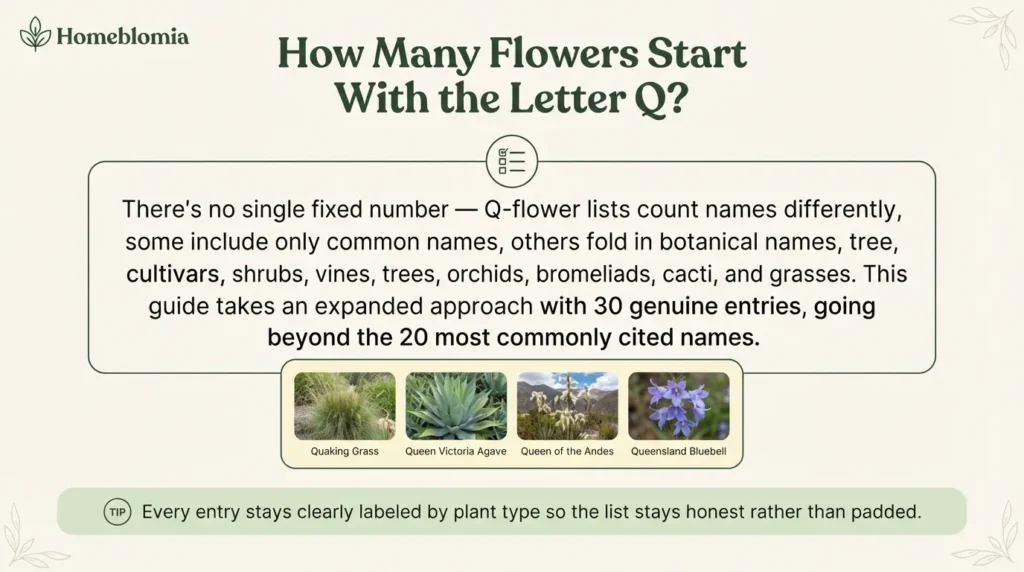
There’s no single fixed number, since Q-flower lists count names differently, some include only common flower names, others fold in botanical names, cultivars, flowering shrubs, vines, trees, orchids, bromeliads, cacti, and ornamental grasses. This guide takes an expanded approach with 30 genuine entries, going beyond the 20 most commonly cited names to include real additions like Quaking Grass, Queen Victoria Agave, Queen of the Andes, and several Australian natives, while still keeping every entry clearly labeled by plant type so the list stays honest rather than padded with weak fits.
Edible Plants vs. Flowers That Start With Q
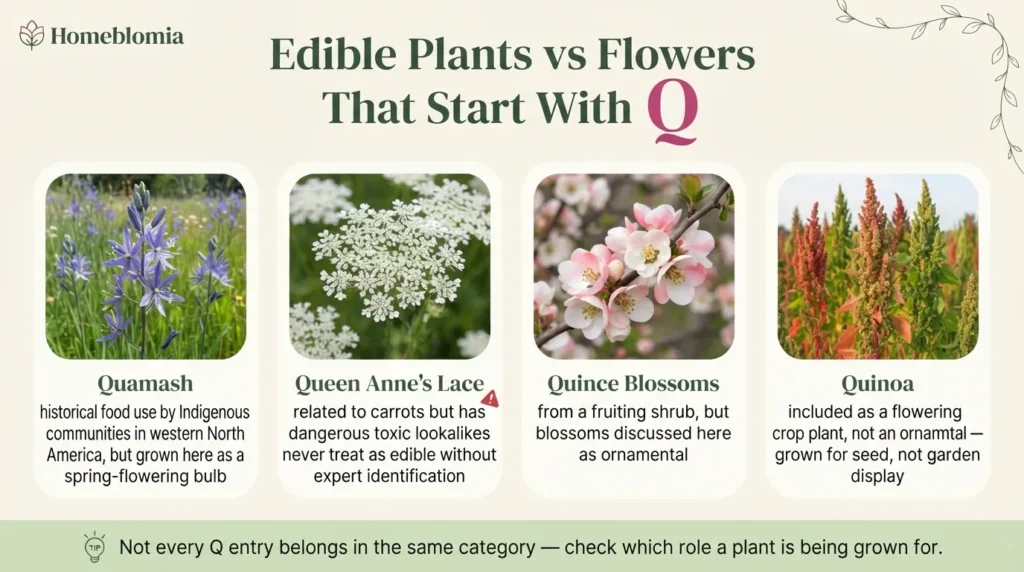
Not every Q entry belongs in the same category. Quamash has historical food use by Indigenous communities in western North America, but it’s grown here as a spring-flowering bulb. Queen Anne’s Lace is related to carrots but has dangerous toxic lookalikes and should never be treated as edible without expert identification. Quince Blossoms come from a fruiting shrub, but the blossoms themselves are discussed here as ornamental flowers. Quinoa is included specifically as a flowering crop plant, not an ornamental recommendation, it’s grown for seed, not garden display.
Safety and Regional Notes
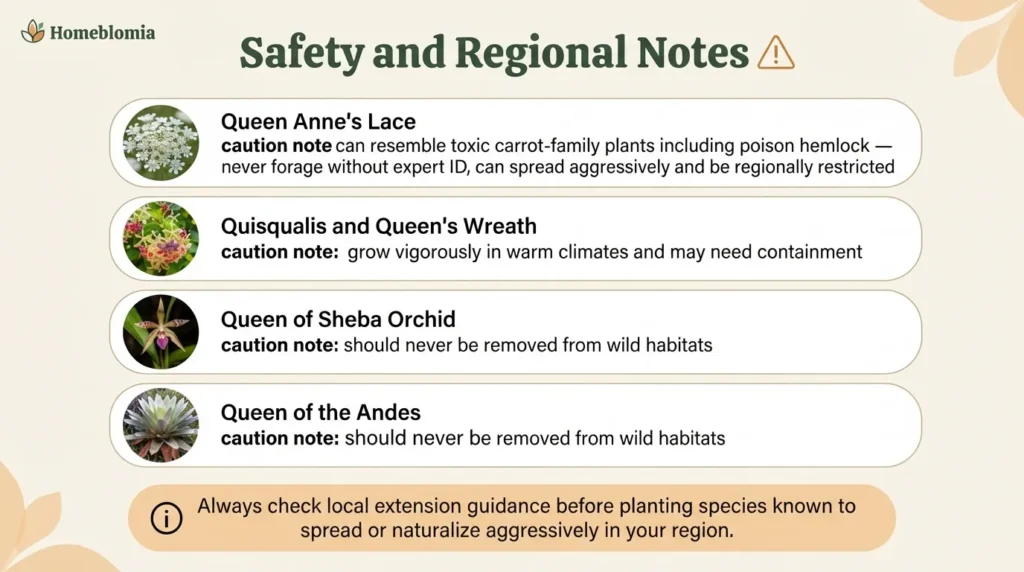
Queen Anne’s Lace can resemble toxic plants in the carrot family (including poison hemlock), it should never be used for food, medicine, or foraging without confirmed expert identification, and it can spread aggressively enough to be restricted in some regions. Tropical vines like Quisqualis and Queen’s Wreath can grow vigorously in warm climates and may need containment. Rare orchids and native plants, Queen of Sheba Orchid and Queen of the Andes especially, should never be removed from wild habitats. Always check local extension guidance before planting species known to spread or naturalize aggressively in your specific region.
Conclusion
Q-flower names are less common than most letters, but they cover a genuinely useful mix of wildflowers, vines, shrubs, trees, bromeliads, cacti, orchids, grasses, and even a giant Andean rarity. For easy color, Queen Red Lime Zinnia and Queen Fabiola are strong choices. For fragrance, Queen of the Night and Quisqualis stand out. For shade, Queen’s Cup and Queen’s Tears fit best. For tropical style, Queen’s Wreath, Quesnelia, and Queen Lily Ginger bring the strongest look. For genuine rarity, Queen of the Andes is unmatched in this letter group.
FAQ
What is the most popular flower that starts with Q?
Queen Anne’s Lace is the most widely recognized name, while Queen’s Tears is likely the most commonly grown as an actual houseplant.
What are common flowers that start with Q?
Queen Anne’s Lace, Queen’s Tears, Quince Blossoms, Quamash, and Quamoclit are among the most frequently referenced.
Which flowers that start with Q are perennials?
Queen’s Cup, Queen of the Prairie, Queen of the Meadow, Quamash, Queen Fabiola, and Queen’s Crown are all true perennials.
Are there indoor flowers that start with Q?
Yes, Queen’s Tears, Queen of the Night, and Quesnelia all adapt well to indoor or bright container growing.
Which Q-flowers are good for beginners?
Queen Red Lime Zinnia, Queen Fabiola, and Quamash are all forgiving, straightforward choices.
What are rare flowers that start with Q?
Queen of Sheba Orchid and Queen of the Andes are the two genuine rarities on this list, both conservation-sensitive or nearly impossible to cultivate outside specialist settings.
What purple flowers start with Q?
Queen’s Wreath, Queen Fabiola, Quamash, Queen of Sheba Orchid, and Queensland Bluebell are the strongest purple options.
Are all Q-flowers true flowers?
No, several entries (Quinoa, Queen Palm, Quinine Bush) are better understood as flowering plants, a crop, or a flowering shrub/tree included for botanical completeness rather than ornamental bedding flowers.
Can Q-flowers grow in containers?
Yes, Queen’s Tears, Queen of the Night, Queen Lily Ginger, Quesnelia, Queen Red Lime Zinnia, Queen Fabiola, and Queen Victoria Agave all suit container growing.
References
- USDA — PLANTS Database
- Missouri Botanical Garden — Plant Finder
- Royal Horticultural Society — RHS Plant Finder
- Royal Botanic Gardens, Kew — Plants of the World Online