85+ Flowers That Start With D: Complete Guide & Care
Quick Answer: Best spring choices: Daffodil, Dutch Iris, Dicentra, Dutchman's Breeches Best summer choices: Dahlia, Daylily, Dianthus, Drummond Phlox Best purple choices: Delphinium, Dutch Iris, Drumstick Allium, Douglas Aster Best yellow choices: Daffodil, Dandelion, Desert Marigold, Dahlberg Daisy Best for pots: Dianthus, Dwarf Dahlia, Dahlberg Daisy, Desert Rose Best for bees: Dandelion, Daisy types, Douglas Aster, open-centered Dahlia Best fragrant choices: Dianthus, Daphne, fragrant Daffodil forms, Dog Rose Best unusual choices: Dragon Arum, Dutchman's Breeches, Disa Orchid, Desert Five-Spot
Flowers starting with D include familiar garden blooms, wildflowers, orchids, bulbs, vines, flowering shrubs, small trees, and genuinely unusual plants with memorable blossoms. The best-known names, Daffodil, Dahlia, Daisy, Daylily, Delphinium, Dianthus, Digitalis, Dicentra, Dandelion, and Dutch Iris, are joined here by 75 more entries, including a run of desert wildflowers and specialty orchids most guides skip.
Full Alphabetical List of Flowers That Start With D
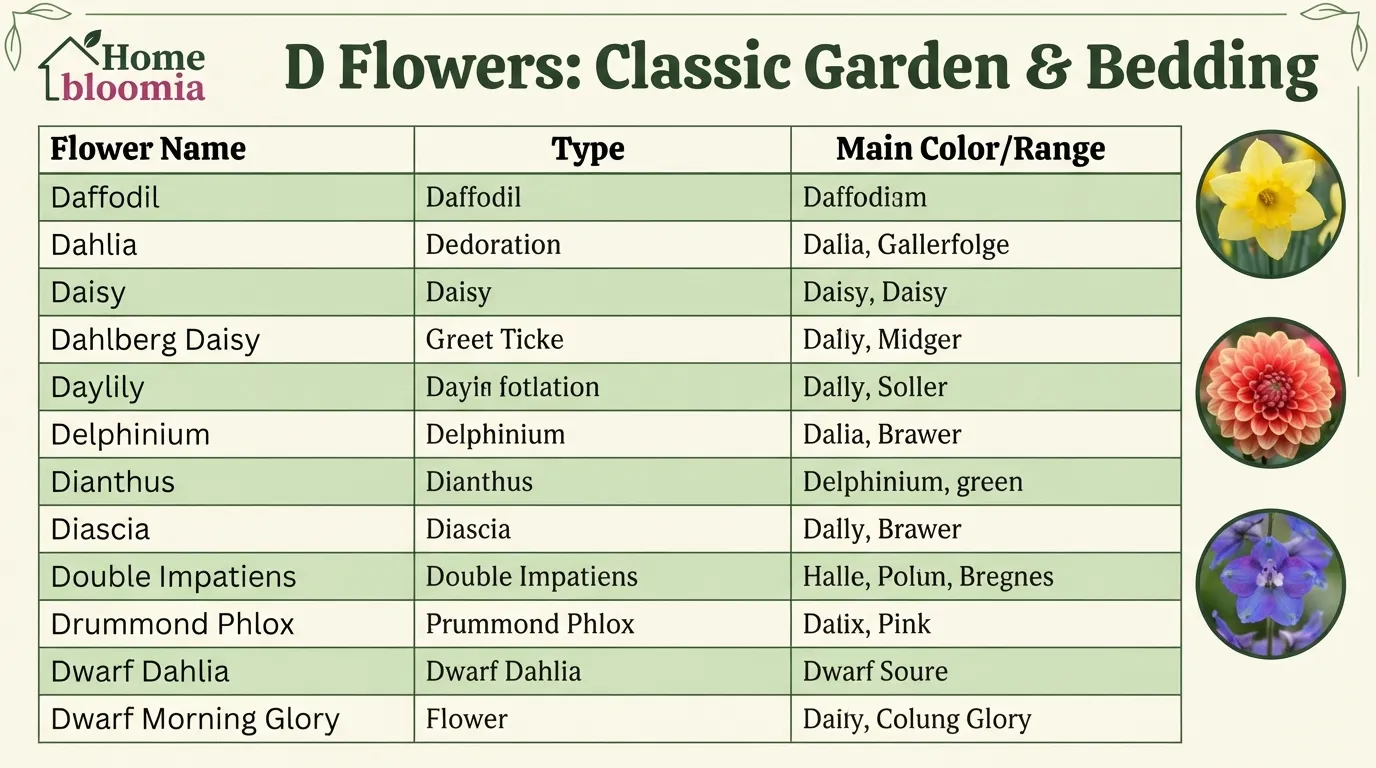
| # | Flower Name | Type | Main Color/Range |
| 1 | Daffodil | Bulb flower | Yellow, white, orange |
| 2 | Dahlia | Tuberous flower | Many colors |
| 3 | Daisy | Annual/perennial flower | White, yellow, pink |
| 4 | Dahlberg Daisy | Annual flower | Yellow |
| 5 | Dalmatian Bellflower | Perennial flower | Purple, blue |
| 6 | Dame’s Rocket | Biennial/short-lived perennial | Purple, pink, white |
| 7 | Dandelion | Wildflower | Yellow |
| 8 | Datura | Caution flower | White, purple, yellow |
| 9 | Daylily | Perennial flower | Yellow, orange, red, pink |
| 10 | Dead Nettle | Flowering ground cover | Purple, pink, white |
| 11 | Delosperma | Succulent bloomer | Pink, purple, yellow, orange |
| 12 | Delphinium | Perennial flower | Blue, purple, pink, white |
| 13 | Dendrobium Orchid | Orchid | White, pink, purple, yellow |
| 14 | Deptford Pink | Wildflower | Pink |
| 15 | Desert Beardtongue | Desert wildflower | Pink, purple |
| 16 | Desert Bluebell | Desert wildflower | Blue |
| 17 | Desert Chicory | Desert wildflower | White, pale pink |
| 18 | Desert Dandelion | Desert wildflower | Yellow |
| 19 | Desert Five-Spot | Desert wildflower | Pink, purple-marked |
| 20 | Desert Four O’Clock | Desert wildflower | Pink, purple |
| 21 | Desert Globemallow | Desert wildflower | Orange, apricot |
| 22 | Desert Lily | Desert wildflower | White |
| 23 | Desert Lupine | Desert wildflower | Purple, blue |
| 24 | Desert Marigold | Desert wildflower | Yellow |
| 25 | Desert Paintbrush | Desert wildflower | Red, orange |
| 26 | Desert Primrose | Desert wildflower | White, yellow, pink |
| 27 | Desert Rose | Succulent flowering plant | Pink, red, white |
| 28 | Desert Sand Verbena | Desert wildflower | Pink, purple |
| 29 | Desert Sunflower | Desert wildflower | Yellow |
| 30 | Desert Tobacco | Desert wildflower | White, pale green |
| 31 | Desert Willow | Flowering tree | Pink, lavender, white |
| 32 | Desert Zinnia | Desert wildflower | White, yellow |
| 33 | Devil’s Bit Scabious | Wildflower | Purple, blue |
| 34 | Devil’s Claw | Flowering plant | Pink, purple, white |
| 35 | Devil in a Bush | Annual flower | Blue, white |
| 36 | Dianella | Flowering perennial | Blue, purple |
| 37 | Dianthus | Annual/perennial flower | Pink, red, white, purple |
| 38 | Diascia | Bedding flower | Pink, coral, orange |
| 39 | Dichondra | Flowering ground cover | Greenish, yellow, white |
| 40 | Dicentra | Perennial flower | Pink, white, red |
| 41 | Dietes | Iris-like flower | White, yellow, purple |
| 42 | Digitalis | Biennial/perennial flower | Pink, purple, white, yellow |
| 43 | Dipladenia | Flowering vine | Pink, red, white |
| 44 | Disa Orchid | Orchid | Red, pink, orange |
| 45 | Dittany | Herbaceous flower | Pink, purple, white |
| 46 | Dog Rose | Flowering rose | Pink, white |
| 47 | Dogwood Blossom | Flowering tree | White, pink |
| 48 | Double Impatiens | Bedding flower | Pink, red, white, orange |
| 49 | Douglas Aster | Wildflower perennial | Purple |
| 50 | Drummond Phlox | Annual flower | Red, pink, purple, white |
| 51 | Drumstick Allium | Bulb flower | Burgundy, purple |
| 52 | Drumstick Primrose | Perennial flower | Purple, pink, white |
| 53 | Dutch Iris | Bulb flower | Blue, purple, white, yellow |
| 54 | Dutchman’s Breeches | Woodland flower | White, yellow |
| 55 | Dutchman’s Pipe | Flowering vine | Green, purple, brown |
| 56 | Dwarf Columbine | Garden flower | Blue, purple, yellow, red |
| 57 | Dwarf Crested Iris | Woodland flower | Blue, violet, white |
| 58 | Dwarf Dahlia | Garden form | Many colors |
| 59 | Dwarf Iris | Bulb flower | Blue, purple, yellow, white |
| 60 | Dwarf Morning Glory | Bedding flower | Blue, white, pink |
| 61 | Donkey Orchid | Orchid | Yellow, brown, purple, white |
| 62 | Dyer’s Chamomile | Herbaceous flower | Yellow |
| 63 | Daphne | Flowering shrub | Pink, white |
| 64 | Deutzia | Flowering shrub | White, pink |
| 65 | Dragon Arum | Caution flower | Purple, maroon |
| 66 | Dragon Tree | Flowering tree/houseplant | Greenish-white, cream |
| 67 | Dragon’s Breath Celosia | Bedding flower | Red |
| 68 | Daboecia | Flowering shrub | Pink, purple, white |
| 69 | Dactylorhiza Orchid | Orchid | Purple, pink |
| 70 | Dalea | Prairie flower | Purple, pink, white |
| 71 | Dasiphora | Flowering shrub | Yellow, white, pink |
| 72 | Deinanthe | Shade flower | White, lavender |
| 73 | Delonix | Flowering tree | Red, orange |
| 74 | Dentaria | Woodland flower | White, pink |
| 75 | Didiscus | Annual flower | Blue, lavender, white |
| 76 | Dimorphotheca | Daisy-type flower | Orange, yellow, white |
| 77 | Disporum | Woodland flower | White, yellow, greenish |
| 78 | Doronicum | Perennial flower | Yellow |
| 79 | Draba | Rock garden flower | Yellow, white |
| 80 | Duranta | Flowering shrub | Purple, blue, white |
| 81 | Diervilla | Flowering shrub | Yellow |
| 82 | Dampiera | Wildflower/perennial | Blue |
| 83 | Darlingtonia | Carnivorous wetland perennial | Green, purple-veined (cobra-lily flower) |
| 84 | Dyckia | Terrestrial bromeliad | Orange, yellow |
| 85 | Dorotheanthus | Annual succulent flower | Pink, yellow, orange |
How This 85-Flower List Was Curated
The 85 count includes strict flower names and broader flowering plants where the bloom is a major part of the plant’s garden value, keeping classic flowers like Daffodil, Dahlia, Daisy, Daylily, Delphinium, and Dianthus in the same guide as clearly labeled shrubs, trees, vines, orchids, and succulent bloomers.
Garden forms such as Dwarf Dahlia, Dwarf Iris, Dwarf Morning Glory, and Double Impatiens are included only when widely used as recognizable flowering forms, not confused with separate species. Dichondra is included as a flowering ground cover but is grown more for foliage than showy bloom. Dragon Tree is included only as a broader flowering plant, not a typical flower choice. Dittany is handled carefully since the name can refer to more than one aromatic plant group. Among this guide’s additions, Darlingtonia (the cobra lily pitcher plant) deserves the same honesty — its flower is real but unusual, and the plant is grown mainly for its carnivorous pitcher structure rather than the bloom itself.
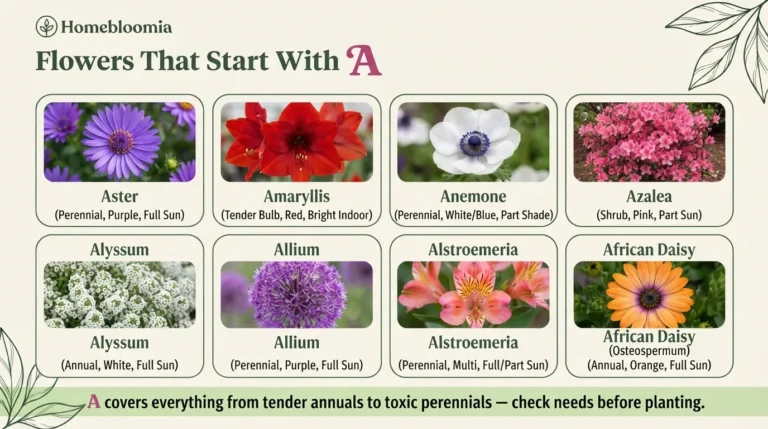
For another broad alphabet guide with common flowers, wildflowers, and flowering plants, see Flowers That Start With A.
Common Flowers That Start With D
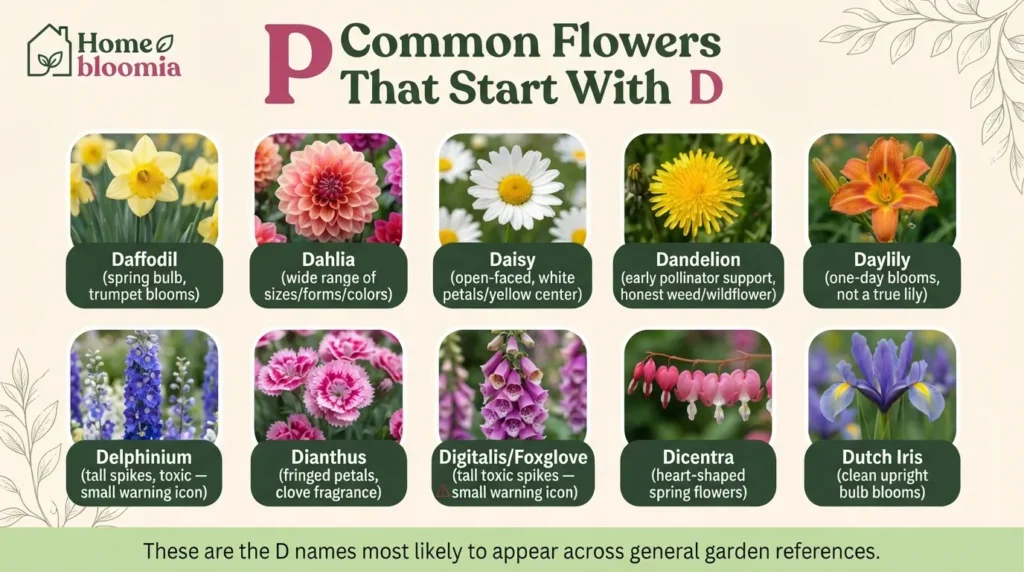
Daffodil is one of the clearest D-flower names — a spring bulb with trumpet-shaped blooms in yellow, white, cream, and orange. Most garden daffodils prefer well-drained soil and full sun to part shade, blooming early before many perennials fill out. After flowering, foliage should be left to fade naturally so the bulb stores energy for next season.
Dahlia is known for its wide range of flower sizes, forms, and colors. It’s a higher-care flower than Daffodil or Daylily — large types may need staking, feeding, steady watering, and winter storage in colder regions. Especially useful in cutting gardens and summer-to-fall borders.
Daisy is a familiar name for several open-faced flowers with a central disc and surrounding petals. The classic look is white petals around a yellow center. Because the name covers many plants, botanical naming helps when choosing a specific type.
Dandelion is often treated as a lawn weed, but it’s still a genuine flowering plant, supporting early-season pollinators when other flowers are limited. It belongs in a complete D-flower list but should be described honestly as a wildflower that can also behave as a weed.
Daylily produces arching foliage and trumpet-shaped flowers that open one at a time — each bloom usually lasts one day, though mature clumps produce many buds across the flowering period. Despite the name, it’s not a true lily.
Delphinium brings tall flower spikes in blue, purple, white, pink, and lavender, performing best in full sun with rich, well-drained soil and some wind protection. Because plant parts can be toxic, it should be placed carefully around pets or grazing animals.
Dianthus is valued for fringed petals, compact growth, and a light clove-like fragrance in many types — one of the better D-flowers for small spaces, front borders, rock gardens, and containers.
Digitalis (foxglove) has tall spikes lined with tubular flowers, adding height and strong vertical form to cottage and woodland gardens, but the plant is toxic and must be placed with care.
Dicentra is best known for heart-shaped spring flowers hanging from arching stems, suiting woodland beds and cool borders with spring moisture; it may fade back later in the season.
Dutch Iris is a bulb flower with clean, upright blooms in blue, purple, white, and yellow markings, flowering in late spring and working well in cutting beds and formal borders.
Dendrobium Orchid is one of the best indoor D-flower names — the clearest orchid answer in this group, fitting better as a bright indoor or sheltered display plant than a standard outdoor border flower.
Desert Rose is a succulent flowering plant with a swollen base and showy blooms, popular in pots and warm-climate gardens; the sap deserves caution around pets and children.
Daphne is a fragrant flowering shrub known for pink or white blooms, often in late winter or spring — grown for scent as much as appearance, though several species have toxic plant parts.
Dogwood Blossom is a flowering tree or shrub group valued for spring bracts that look like large petals, working as a small focal tree or woodland-edge plant.
Drummond Phlox is an annual flower with bright clusters, useful for bedding, containers, and seasonal color blocks.
Drumstick Allium produces narrow stems topped with egg-shaped burgundy-purple flower heads, adding contrast as an accent in mixed borders — deserving caution around pets that may chew bulbs or leaves.
Douglas Aster is a purple late-season flower that supports pollinators as many summer flowers fade, fitting meadow-style beds and naturalistic planting. Gardeners comparing familiar flower names may also find Flowers That Start With B useful for classic bloom choices.
Other D Flowers Worth Knowing
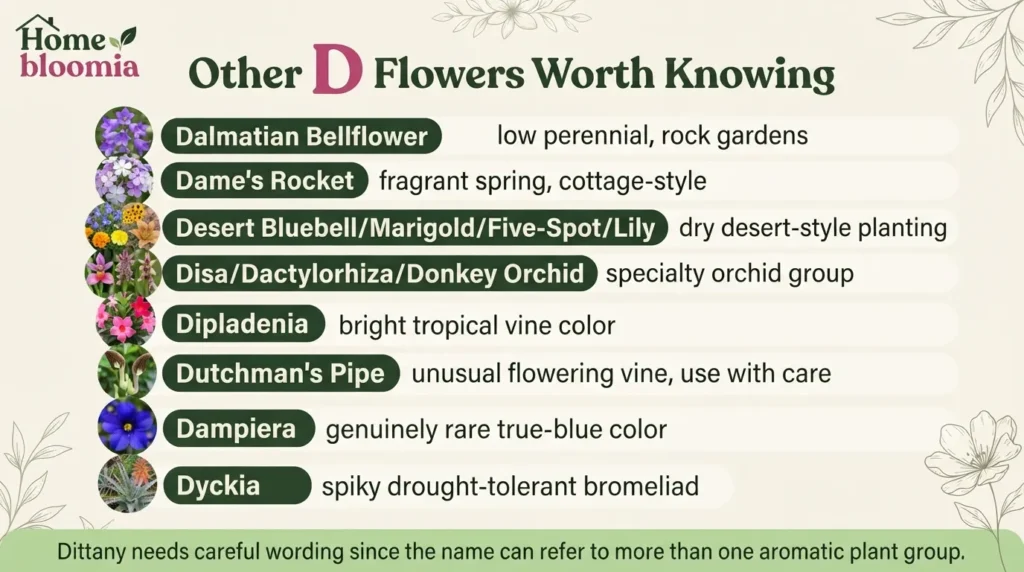
Dalmatian Bellflower is a low perennial with purple-blue blooms for rock gardens and edging. Dame’s Rocket has fragrant spring flowers fitting cottage-style or naturalized areas. Desert Bluebell, Desert Marigold, Desert Five-Spot, Desert Lily, Desert Sand Verbena, Desert Paintbrush, and Desert Globemallow are useful in dry or desert-style planting where softer flowers struggle. Disa Orchid, Dactylorhiza Orchid, and Donkey Orchid belong to the specialty orchid group — botanical interest, not ordinary beginner bedding plants. Dipladenia and Dutchman’s Pipe are flowering vines; Dipladenia gives bright tropical color in containers, while Dutchman’s Pipe is more unusual and should be used with care. Dittany needs careful wording since the name can refer to different plants depending on usage.
Among this guide’s additions, Dampiera brings a genuinely rare true-blue color to the letter, and Dyckia adds a spiky, drought-tolerant bromeliad option rarely covered in general D-flower guides.
For the letter before or after this one, see Flowers That Start With C or continue to Flowers That Start With E.
Types of D Flowers by Growth Habit and Garden Use
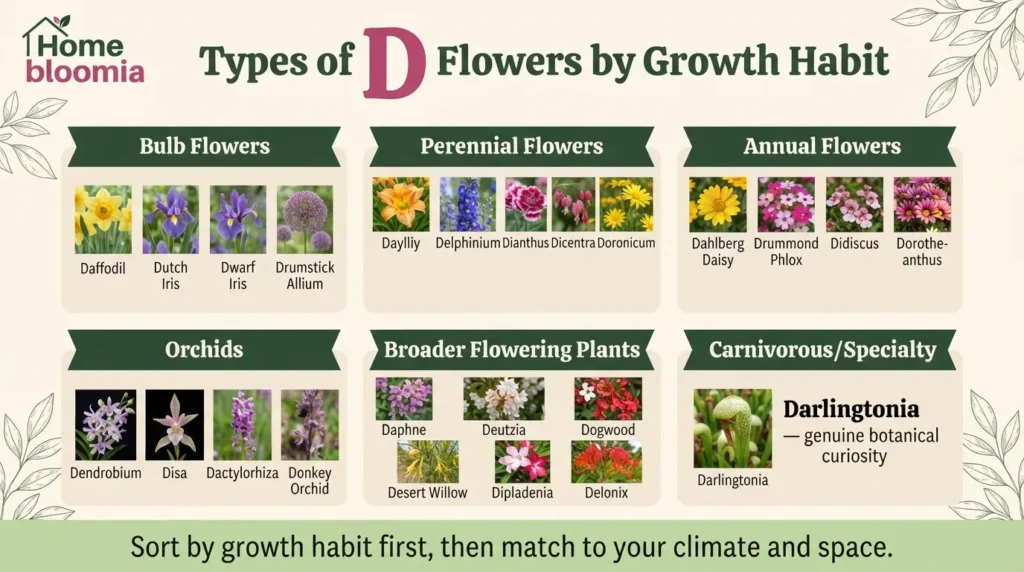
Bulb flowers: Daffodil, Dutch Iris, Dwarf Iris, Drumstick Allium — useful for seasonal bloom and clean structure.
Perennial flowers: Daylily, Delphinium, Dianthus, Dicentra, Doronicum, Douglas Aster, Delosperma — better for long-term garden value.
Annual flowers: Dahlberg Daisy, Drummond Phlox, Didiscus, Diascia, Double Impatiens, Dwarf Morning Glory, Dorotheanthus — helpful for quick color, containers, and bedding.
Orchids: Dendrobium, Disa, Dactylorhiza, Donkey Orchid — more connected to specialty growing or indoor display than ordinary border planting.
Broader flowering plants: Daphne, Deutzia, Dogwood, Desert Willow, Dipladenia, Delonix, Duranta, Diervilla, should be labeled as shrubs, trees, or vines.
Carnivorous/specialty: Darlingtonia — a genuine botanical curiosity, not a conventional garden flower.
Perennials That Start With D
Good perennial choices include Daylily, Delphinium, Dianthus, Dicentra, Dalmatian Bellflower, Douglas Aster, Delosperma, Dutch Iris, Dwarf Iris, Dwarf Crested Iris, Drumstick Allium, Doronicum, Disporum, and Deinanthe.
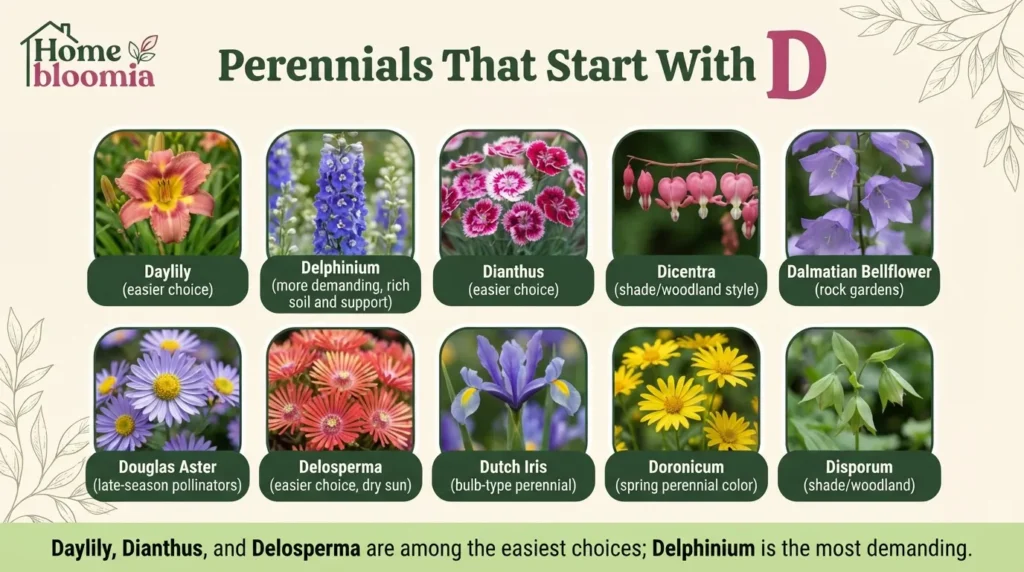
Daylily, Dianthus, and Delosperma are among the easier choices. Delphinium is more demanding, often needing rich soil, cooler conditions, and support. Dicentra, Disporum, Dentaria, and Dutchman’s Breeches are better for shade or woodland-style planting.
Annual Flowers That Start With D
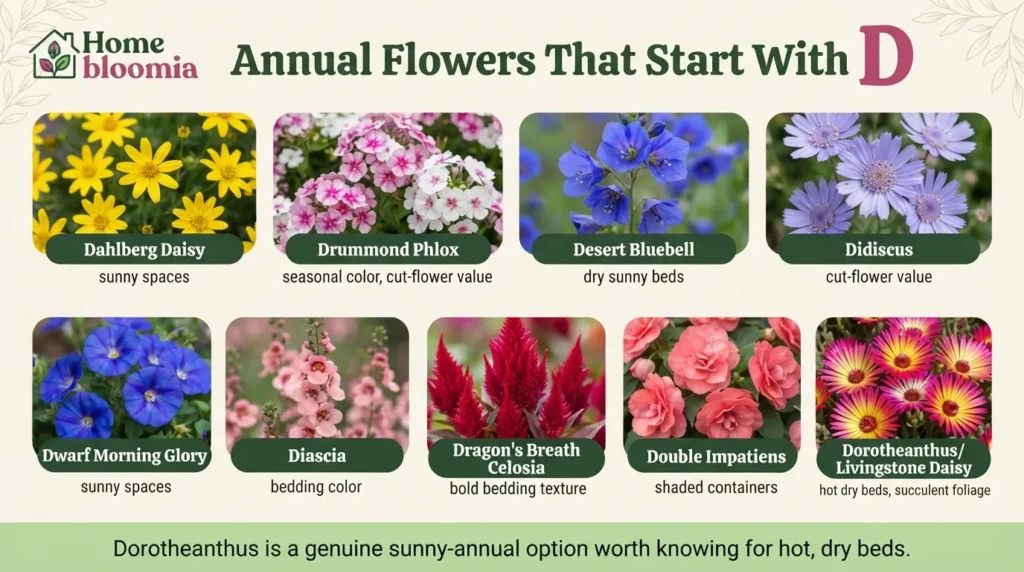
Dahlberg Daisy, Drummond Phlox, Desert Bluebell, Didiscus, Dwarf Morning Glory, Diascia, Dragon’s Breath Celosia, and Double Impatiens all fit annual or perennial growing use. Dahlberg Daisy and Dwarf Morning Glory suit sunny spaces; Double Impatiens is better for shaded containers; Drummond Phlox and Didiscus are useful when seasonal color and cut-flower value matter. Dorotheanthus (Livingstone Daisy), one of this guide’s additions, is a genuine sunny-annual option worth knowing — its succulent foliage and bright daisy blooms suit hot, dry beds particularly well.
Beginner-Friendly Choices
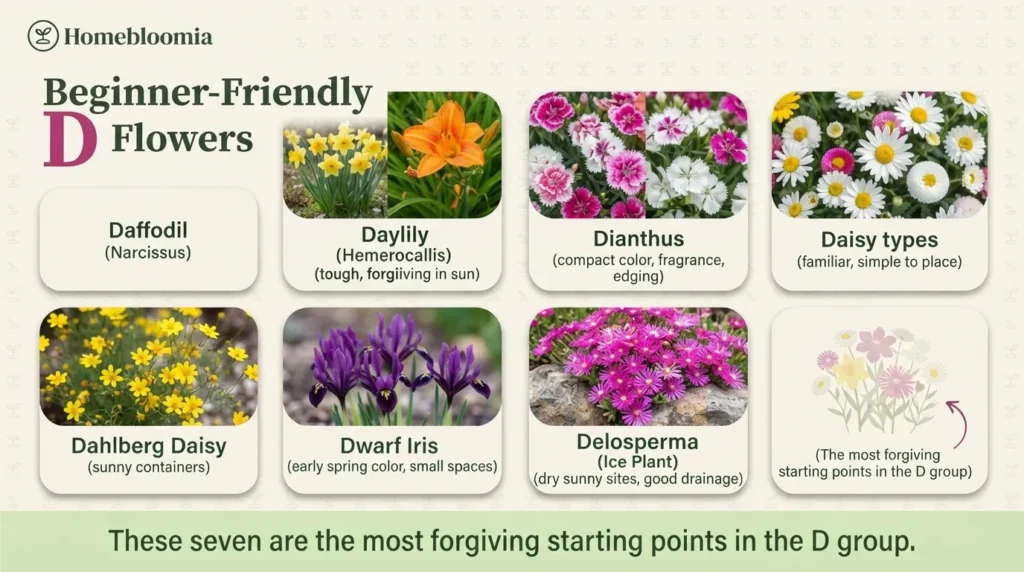
Daffodil is one of the easiest spring choices, planted as a bulb, returning for years in suitable conditions. Daylily is tough and forgiving in many sunny gardens. Dianthus works well for compact color, fragrance, and edging. Daisy types are familiar and simple to place. Dahlberg Daisy is useful for sunny containers. Dwarf Iris gives early spring color in small spaces. Delosperma is a good beginner choice for dry, sunny sites with good drainage.
Color Filters
Purple Flowers That Start With D
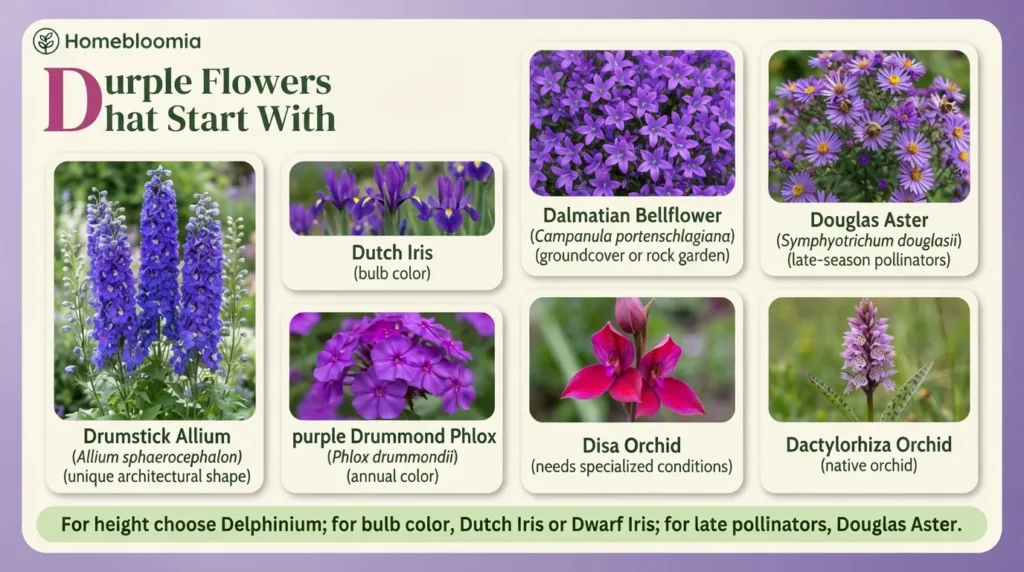
Delphinium is the strongest quick answer, with tall blue-purple spikes. Dutch Iris, Dalmatian Bellflower, Douglas Aster, Drumstick Allium, purple Drummond Phlox, Disa Orchid, Dactylorhiza Orchid, Dwarf Iris, and some Dianthus forms also fit. For height, choose Delphinium; for bulb color, Dutch Iris or Dwarf Iris; for late-season pollinators, Douglas Aster.
Yellow Flowers That Start With D
Daffodil, Dandelion, Desert Marigold, Dahlberg Daisy, Dyer’s Chamomile, Doronicum, Desert Sunflower, Desert Dandelion, and yellow forms of Dwarf Iris. Daffodil is the best-known spring choice; Desert Marigolds and Desert Sunflowers work better in dry-climate planting.
White Flowers That Start With D
Daisy, white Daffodil forms, white Dicentra forms, Deutzia, Daphne, Dogwood Blossom, Dendrobium Orchid, Dutchman’s Breeches, and Double Impatiens. Deutzia and Dogwood belong to broader flowering plant groups, while Daisy, Daffodil, Dicentra, and Dutchman’s Breeches are closer to classic flower intent.
Blue Flowers That Start With D
Delphinium, Dutch Iris, Desert Bluebell, Dwarf Iris, Didiscus, Dwarf Morning Glory, and some Dactylorhiza Orchid forms. Dampiera, one of this guide’s additions, is a genuinely useful addition to this color group — true blue is rare, and Dampiera delivers it reliably.
Pink, Red, and Orange D Flowers
Pink and red: Dahlia, Dianthus, Desert Rose, Dipladenia, Disa Orchid, Double Impatiens, Dog Rose, and some Drummond Phlox forms. Orange: orange Dahlias, orange Daylilies, Desert Globemallow, Desert Paintbrush, Diascia, Double Impatiens, Delonix, and Dimorphotheca.
Indoor and Container-Friendly Choices
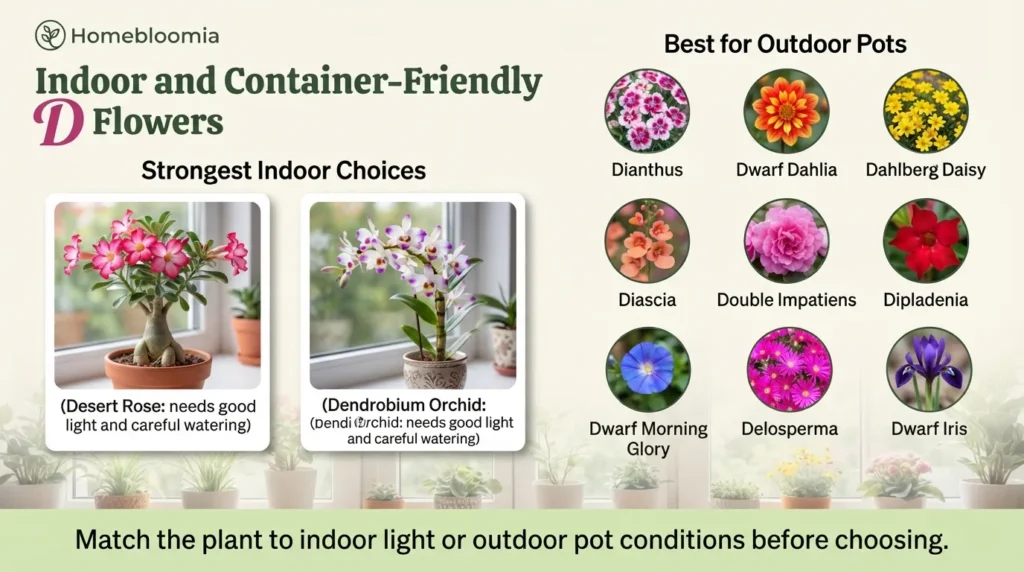
Desert Rose and Dendrobium Orchid are the strongest indoor or bright indoor choices, both need good light and careful watering. For outdoor pots: Dianthus, Dwarf Dahlia, Dahlberg Daisy, Diascia, Double Impatiens, Dipladenia, Dwarf Morning Glory, Delosperma, and Dwarf Iris.
Best D Flowers for Pots and Small Spaces
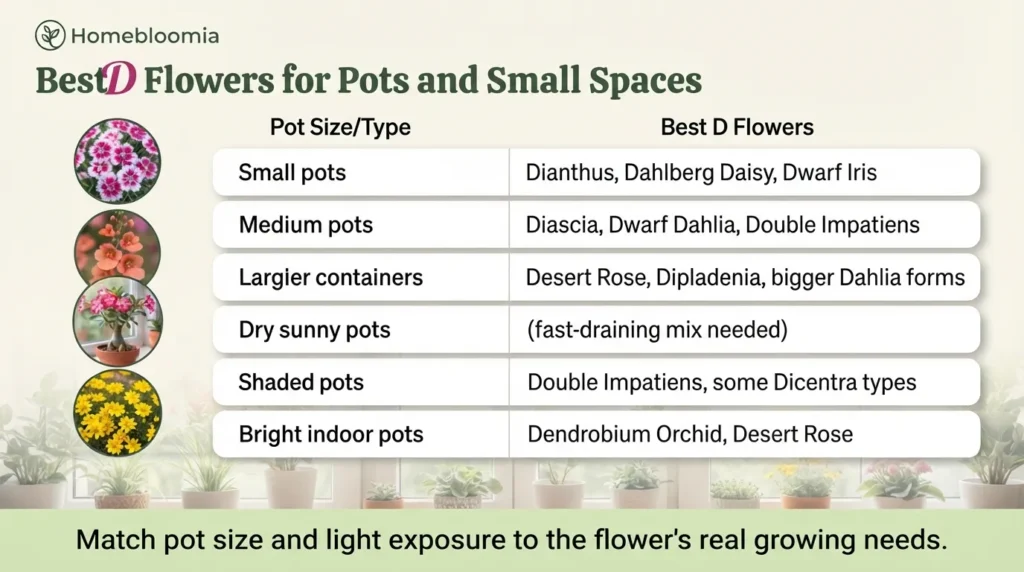
Small pots suit Dianthus, Dahlberg Daisy, and Dwarf Iris. Medium pots work for Diascia, Dwarf Dahlia, and Double Impatiens. Larger containers suit Desert Rose, Dipladenia, and bigger Dahlia forms. Dry sunny pots need a fast-draining mix; shaded pots suit Double Impatiens and some Dicentra types; bright indoor pots are better reserved for Dendrobium Orchid and Desert Rose.
Fragrance, Pollinators, and Use in the Garden
Fragrant D Flowers
Dianthus is one of the best simple answers, many varieties have a light clove-like fragrance, compact enough for pots and path edges. Daphne is highly fragrant but fits better as a shrub. Fragrant Daffodil varieties, Dog Rose, and Datura can also carry scent, though Datura deserves caution as a toxic plant.
Pollinator-Friendly and Meadow Picks
Good choices include Dandelion, Daisy types, Douglas Aster, open-centered Dahlia, Dianthus, Delphinium, Desert Marigold, Desert Sand Verbena, and Drumstick Allium. Dandelion and Daffodil appear early; Dianthus and Drumstick Allium support spring to early summer; Douglas Aster extends color and pollinator value later.
Cut Flower and Bouquet Favorites
Dahlia is one of the strongest D-flowers for bouquets, size, color, and a clear focal point. Delphinium adds height; Dutch Iris brings a cleaner, narrower form. Dianthus is useful for smaller, fragrant details; Drumstick Allium works as a textural accent; Dendrobium Orchid suits more polished or specialty bouquet work.
Flower Meanings and Symbolism for D Flowers
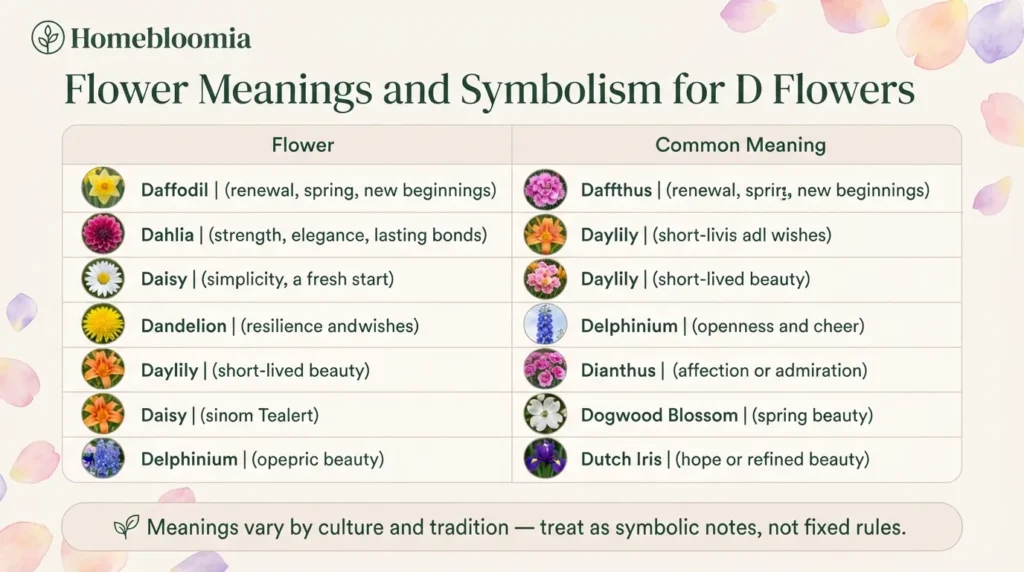
Daffodil is often linked with renewal, spring, and new beginnings. Dahlia is associated with strength, elegance, and lasting bonds. Daisy suggests simplicity and a fresh start. Dandelion is linked with resilience and wishes. Daylilies can suggest short-lived beauty since each bloom is brief. Delphinium is tied to openness and cheer. Dianthus can suggest affection or admiration. Dogwood Blossom is commonly linked with spring beauty, while Dutch Iris can suggest hope or refined beauty.
Growing Requirements for D Flowers
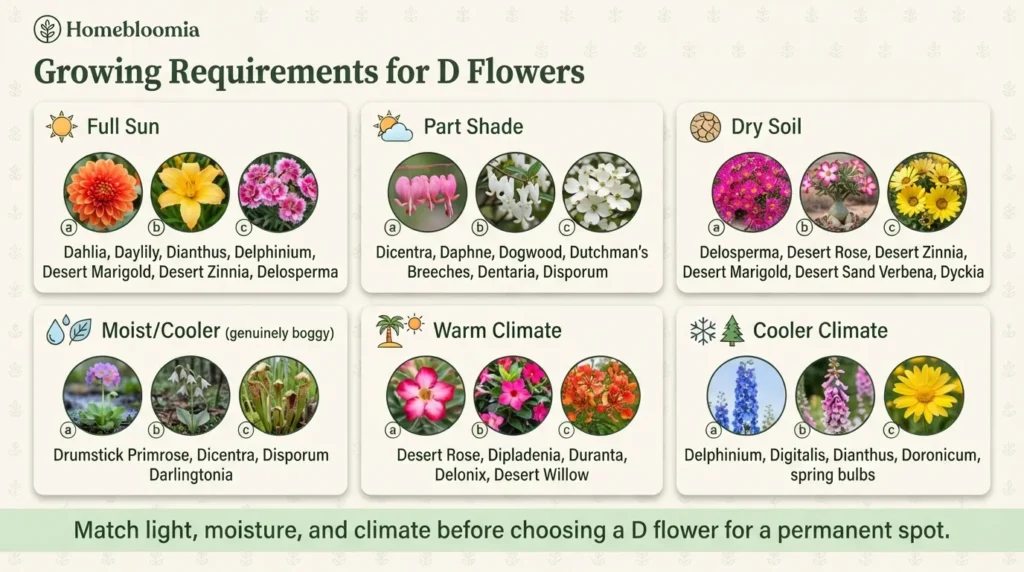
Full sun: Dahlia, Daylily, Dianthus, Delphinium, Desert Marigold, Desert Zinnia, Delosperma. Part shade: Dicentra, Daphne, Dogwood, Dutchman’s Breeches, Dentaria, Disporum. Dry soil: Delosperma, Desert Rose, Desert Zinnia, Desert Marigold, Desert Sand Verbena, Desert Globemallow, Dyckia. Moist/cooler: Drumstick Primrose, Dicentra, Disporum, some iris types, Darlingtonia (genuinely boggy, not just “moist”). Warm climate: Desert Rose, Dipladenia, Duranta, Delonix, Desert Willow. Cooler climate: Delphinium, Digitalis, Dianthus, Doronicum, many spring bulbs.
Water and Pond Flower Picks
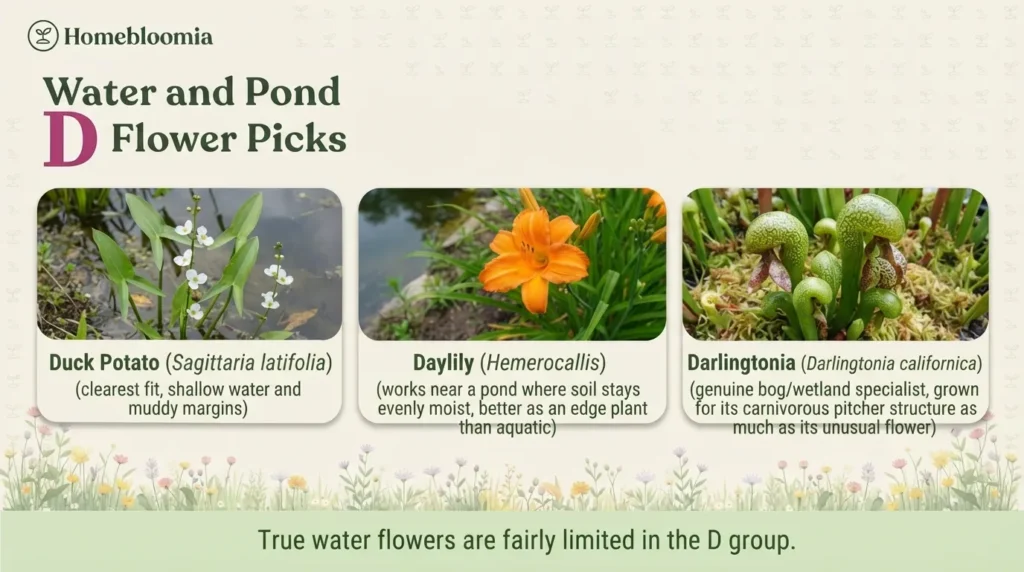
True water flowers are fairly limited in the D group. Duck Potato is the clearest fit, naturally suiting shallow water and muddy margins. Daylily can work near a pond where soil stays evenly moist, though it’s better treated as an edge plant than an aquatic flower. Darlingtonia, one of this guide’s additions, belongs in the same conversation, it’s a genuine bog/wetland specialist, though grown for its carnivorous pitcher structure as much as its unusual flower.
Broader D Bloomers, Caution Notes, and Common Mix-Ups
Strict flower names include Daffodil, Dahlia, Daisy, Dianthus, Daylily, Delphinium, Digitalis, Dicentra, and Dutch Iris. Wildflowers include Dandelion, Desert Bluebell, Desert Marigold, Desert Lily, Douglas Aster, and Desert Sand Verbena. Orchids include Dendrobium, Disa, Dactylorhiza, and Donkey Orchid. Broader bloomers include Daphne, Deutzia, Dogwood, Desert Willow, Delonix, Dipladenia, Dutchman’s Pipe, Duranta, and Diervilla.
Toxic or Caution-Worthy Entries
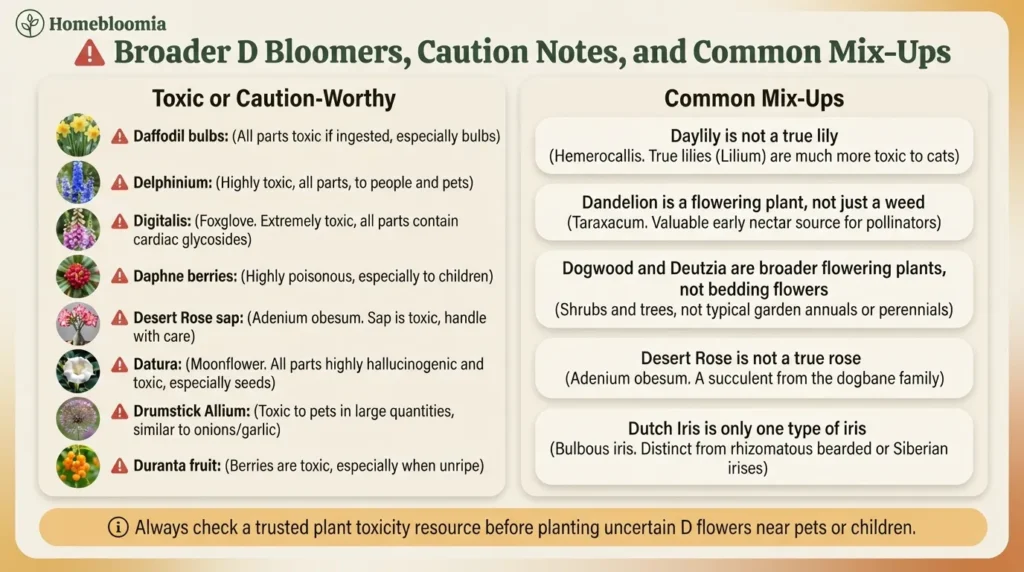
Daffodil, Delphinium, Digitalis, Daphne, Desert Rose, Datura, Dragon Arum, Dutchman’s Pipe, Drumstick Allium, and Duranta all deserve caution. Daffodil bulbs can be harmful if eaten. Digitalis and Delphinium are toxic plants. Daphne berries and plant parts can be unsafe. Desert Rose has toxic sap. Datura should be avoided in casual family gardens since the whole plant is toxic. Alliums can be risky for pets if bulbs or leaves are eaten. Duranta fruit deserves caution.
Common Mix-Ups
Daylily is not a true lily, despite the name. Daisy can refer to several different plants, so botanical names help. Dandelion is often called a weed but is still a flowering plant. Dogwood and Deutzia are broader flowering plants rather than standard bedding flowers. Desert Rose is not a true rose. Dutch Iris is only one type of iris. Dittany needs careful wording since the name can refer to more than one aromatic plant group. Dichondra is grown more for foliage than flowers.
Conclusion
D-named flowers cover much more than a short alphabet list, bulbs, perennials, annuals, orchids, wildflowers, desert bloomers, flowering shrubs, small trees, vines, succulents, and container plants. The strongest familiar choices are Daffodil, Dahlia, Daisy, Daylily, Delphinium, Dianthus, Dutch Iris, and Digitalis. For pots, compact options like Dianthus, Dwarf Dahlia, Dahlberg Daisy, Diascia, and Desert Rose are more practical. For pollinators, open-centered flowers like Daisy types, Dandelion, Douglas Aster, and simple Dahlias are more useful.
FAQ
How many flowers start with the letter D?
This guide covers 85 genuinely distinct entries.
What are the most popular flowers that start with D?
Daffodil, Dahlia, Daisy, Daylily, and Delphinium are the most widely recognized.
What flower starts with D and is purple?
Delphinium, Dutch Iris, Dalmatian Bellflower, and Douglas Aster.
What yellow flowers start with D?
Daffodil, Dandelion, Desert Marigold, and Dahlberg Daisy.
Which D flowers are perennials?
Daylily, Delphinium, Dianthus, Dicentra, Douglas Aster, and Delosperma.
Which D flowers are annuals?
Dahlberg Daisy, Drummond Phlox, Diascia, Double Impatiens, and Dorotheanthus.
Which D flowers are best for beginners?
Daffodil, Daylily, Dianthus, and Dahlberg Daisy.
Which D flowers grow well in pots?
Dianthus, Dwarf Dahlia, Dahlberg Daisy, Diascia, and Double Impatiens.
Are there indoor flowers that start with D?
Yes, Desert Rose and Dendrobium Orchid are the strongest choices.
What orchid starts with D?
Dendrobium, Disa, Dactylorhiza, and Donkey Orchid are all real orchid genera or common names starting with D.
What flower starting with D lasts only one day?
Daylily, each individual bloom lasts about a day, though plants produce many buds over the season.
Which D flowers are best for bees?
Dandelion, Daisy types, Douglas Aster, and open-centered Dahlia.
Are Daisies, Dogwood, and Dandelions all counted as flowers?
Yes, though they belong to different categories, Daisy and Dandelion are true herbaceous flowers, while Dogwood is a flowering tree included for its showy spring bracts.
Are any D flowers toxic to pets?
Yes, Daffodil, Delphinium, Digitalis, Daphne, Desert Rose, and Datura all require caution.
Can shrubs and trees be included in D flower lists?
Yes, when clearly labeled, Daphne, Deutzia, Dogwood, Desert Willow, and Delonix are all genuine flowering shrubs or trees included for their bloom value.
References
- Royal Horticultural Society — Plant Search
- Missouri Botanical Garden — Plant Finder
- NC State Extension — Plant Toolbox
- USDA — PLANTS Database
- American Daffodil Society, American Daylily Society (general reference for Daffodil/Daylily cultivar and care detail)
- ASPCA Animal Poison Control — Toxic and Non-Toxic Plants List