50+ Flowers That Start With W: Names, Full Guide & Photos
Quick Answer: Flowers That Start With W span true garden perennials, wildflowers, flowering shrubs, aquatic plants, and climbing vines. The most recognized names are Wisteria, Water Lily, Weigela, Wallflower, Witch Hazel, and Wishbone Flower. Beyond these, the letter covers woodland spring flowers (Wake Robin, Wood Anemone, White Trillium), pond and wetland blooms (Water Hyacinth, Water Lotus, Water Iris), and winter-flowering shrubs (Winter Jasmine, Wintersweet, Winter Aconite) — giving W flowers meaningful presence across nearly every season and growing condition
The letter W covers unusually wide ground: fragrant spring shrubs, dramatic climbing vines, quiet woodland perennials, and a full set of pond and wetland blooms. Wisteria, Water Lily, and Wallflower are the names most people already know, beyond those, the list opens into wildflowers, winter-blooming shrubs, and a handful of genuine rarities like Waratah and Waling-waling.
Flower Names Starting With W: At a Glance
| Category | Example Flowers | Main Colors | Typical Bloom Season |
|---|---|---|---|
| Common garden flowers | Wallflower, Weigela, Wishbone Flower | Yellow, pink, purple, mixed | Spring–summer |
| Wildflowers | Wild Bergamot, Wild Columbine, Wild Geranium | Pink, red, lavender, blue | Spring–summer |
| Perennials | Water Lily, White Trillium, Wood Anemone | White, pink, blue, yellow | Spring–summer |
| Annuals | Wishbone Flower, Wax Begonia | Pink, white, violet, blue | Summer–frost |
| Aquatic/wetland | Water Lily, Water Hyacinth, Water Violet | White, blue, violet, mixed | Spring–summer |
| Rare/less familiar | Waling-Waling, Waratah, Woadwaxen | Purple, red, yellow | Varies |
| Purple-toned | Wisteria, Wild Indigo, Water Hyacinth | Purple, violet, blue | Spring–summer |
| Winter bloomers | Winter Aconite, Winter Jasmine, Wintersweet, Witch Hazel | Yellow, cream, orange | Winter–early spring |
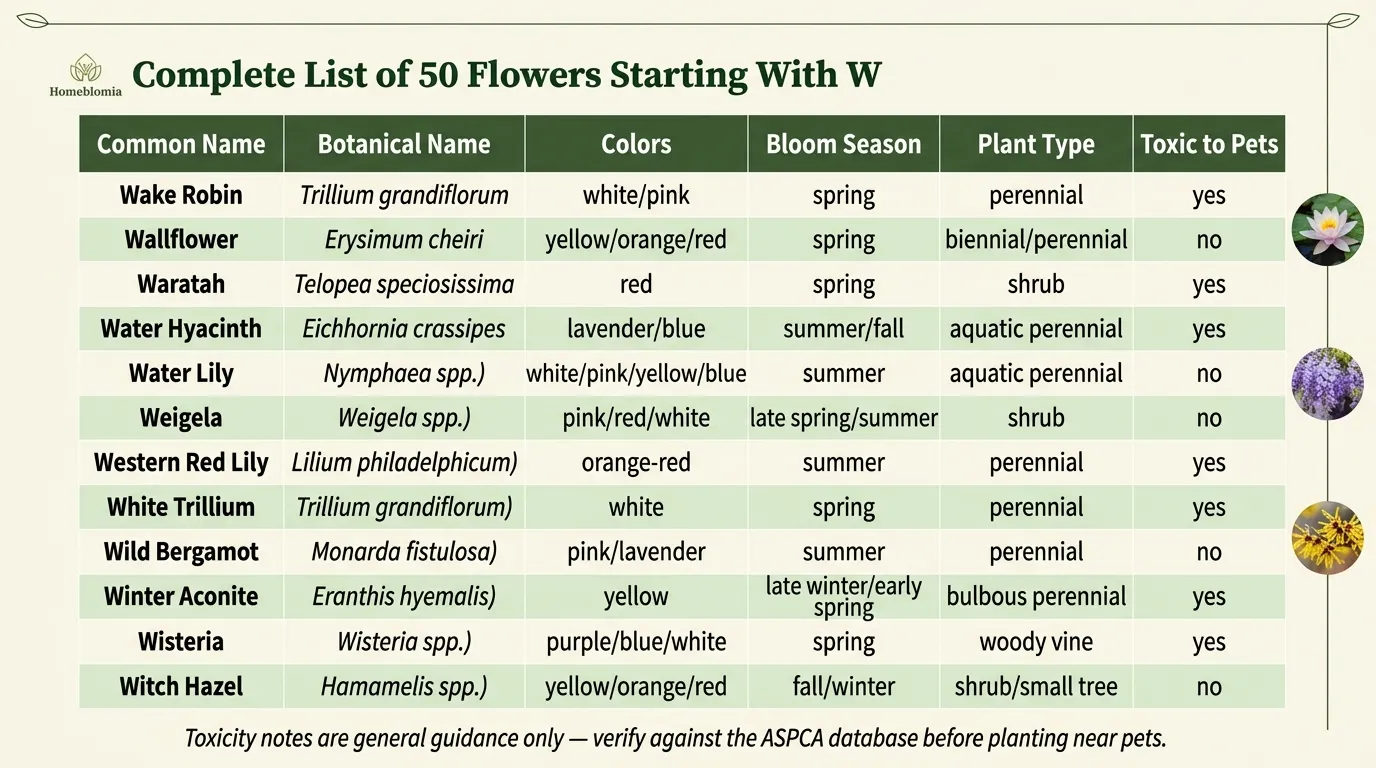
Complete List of 50 Flowers Starting With Letter W Full Comparison Table
| # | Common Name | Botanical Name | Colors | Bloom Season | Plant Type | Toxic to Pets |
|---|---|---|---|---|---|---|
| 1 | Wake Robin | Trillium erectum | Maroon, red, purple | Spring | Woodland perennial | No |
| 2 | Wallflower | Erysimum spp. | Yellow, orange, red, purple | Spring | Perennial/biennial | No |
| 3 | Wandflower | Dierama spp. | Pink, mauve, white | Summer | Perennial | No |
| 4 | Waratah | Telopea spp. | Red, pink, cream | Spring | Shrub | No |
| 5 | Water Avens | Geum rivale | Pink, cream, purple | Spring–summer | Moisture-loving perennial | No |
| 6 | Water Hyacinth | Pontederia crassipes | Lavender, violet | Summer | Aquatic plant | Mildly, GI irritant |
| 7 | Water Iris | Iris laevigata | Blue, violet, white | Late spring–summer | Aquatic perennial | Mildly, GI/skin irritant |
| 8 | Water Lily | Nymphaea spp. | White, pink, yellow, blue | Summer | Aquatic perennial | No |
| 9 | Water Lotus | Nelumbo nucifera | Pink, white | Summer | Aquatic perennial | No |
| 10 | Water Violet | Hottonia palustris | Pale lilac, white | Spring–early summer | Aquatic perennial | No |
| 11 | Watsonia | Watsonia spp. | Pink, orange, red, white | Spring–summer | Corm perennial | No |
| 12 | Wax Begonia | Begonia × semperflorens-cultorum | White, pink, red | Summer–frost | Annual bedding | Yes — mildly toxic |
| 13 | Waxflower | Chamelaucium uncinatum | Pink, white, purple | Spring | Shrub | No |
| 14 | Wedelia | Sphagneticola trilobata | Yellow | Warm season | Groundcover perennial | No |
| 15 | Weigela | Weigela spp. | Pink, red, white | Spring–early summer | Shrub | No |
| 16 | Western Red Lily | Lilium philadelphicum | Orange-red | Summer | Perennial | Yes — lilies highly toxic to cats |
| 17 | Western Wallflower | Erysimum capitatum | Yellow, orange | Spring–summer | Wildflower | No |
| 18 | Whirling Butterflies | Oenothera lindheimeri | White, pink | Summer–fall | Perennial | No |
| 19 | White Campion | Silene latifolia | White | Late spring–summer | Wildflower | No |
| 20 | White Snakeroot | Ageratina altissima | White | Late summer–fall | Perennial | Yes — toxic, historically dangerous in livestock |
| 21 | White Trillium | Trillium grandiflorum | White | Spring | Woodland perennial | No |
| 22 | White Wood Aster | Eurybia divaricata | White | Late summer–fall | Woodland perennial | No |
| 23 | Wild Bergamot | Monarda fistulosa | Lavender, pink | Summer | Perennial | No |
| 24 | Wild Columbine | Aquilegia canadensis | Red, yellow | Spring | Wildflower perennial | No |
| 25 | Wild Geranium | Geranium maculatum | Pink, lavender | Spring–early summer | Perennial | No |
| 26 | Wild Indigo | Baptisia spp. | Blue, purple, yellow | Late spring | Perennial | No |
| 27 | Wild Petunia | Ruellia humilis | Lavender, violet | Summer | Perennial | No |
| 28 | Wild Phlox | Phlox divaricata | Blue, lavender, white | Spring | Perennial | No |
| 29 | Wild Rose | Rosa spp. | Pink, white | Spring–summer | Shrub | No |
| 30 | Wild Senna | Senna hebecarpa | Yellow | Summer | Perennial | No |
| 31 | Wild Sunflower | Helianthus spp. | Yellow | Summer–fall | Perennial/annual | No |
| 32 | Willowherb | Epilobium spp. | Pink, purple | Summer | Wildflower | No |
| 33 | Windflower | Anemone spp. | White, pink, blue, purple | Spring | Perennial | Yes — mildly toxic |
| 34 | Wine Cup | Callirhoe involucrata | Magenta, purple | Late spring–summer | Perennial | No |
| 35 | Winged Monkey Flower | Mimulus alatus | Purple, pink | Summer | Moist-soil wildflower | No |
| 36 | Winter Aconite | Eranthis hyemalis | Yellow | Late winter–early spring | Bulbous perennial | Yes — toxic |
| 37 | Winter Jasmine | Jasminum nudiflorum | Yellow | Winter–early spring | Shrub | No |
| 38 | Wintersweet | Chimonanthus praecox | Yellow, cream | Winter | Shrub | Mildly, seeds toxic |
| 39 | Wishbone Flower | Torenia fournieri | Blue, violet, pink, white | Summer–frost | Annual | No |
| 40 | Wisteria | Wisteria spp. | Purple, white, pink | Spring | Flowering vine | Yes — seeds/pods toxic |
| 41 | Witch Hazel | Hamamelis spp. | Yellow, orange, red | Winter–early spring | Shrub | No |
| 42 | Woadwaxen | Genista tinctoria | Yellow | Summer | Shrub-like perennial | No |
| 43 | Wood Anemone | Anemonoides nemorosa | White, pale pink | Spring | Woodland perennial | Yes — mildly toxic |
| 44 | Wood Sorrel | Oxalis acetosella | White, pale pink | Spring | Woodland perennial | Yes — toxic in quantity |
| 45 | Wood Violet | Viola odorata | Violet, purple, white | Spring | Perennial | No |
| 46 | Woodland Sunflower | Helianthus divaricatus | Yellow | Summer–fall | Perennial | No |
| 47 | Woodruff | Galium odoratum | White | Spring | Groundcover perennial | No |
| 48 | Woolly Yarrow | Achillea tomentosa | Yellow | Summer | Perennial | No |
| 49 | Wreath Flower | Stephanotis floribunda | White | Summer | Flowering vine | Yes — mildly toxic |
| 50 | Waling-Waling | Vanda sanderiana | Pink, rose, purple | Warm-season cycles | Orchid | No |
Toxicity notes are general guidance only, verify against the ASPCA database (linked in References) before planting near pets.
Popular Flower Names Starting With W
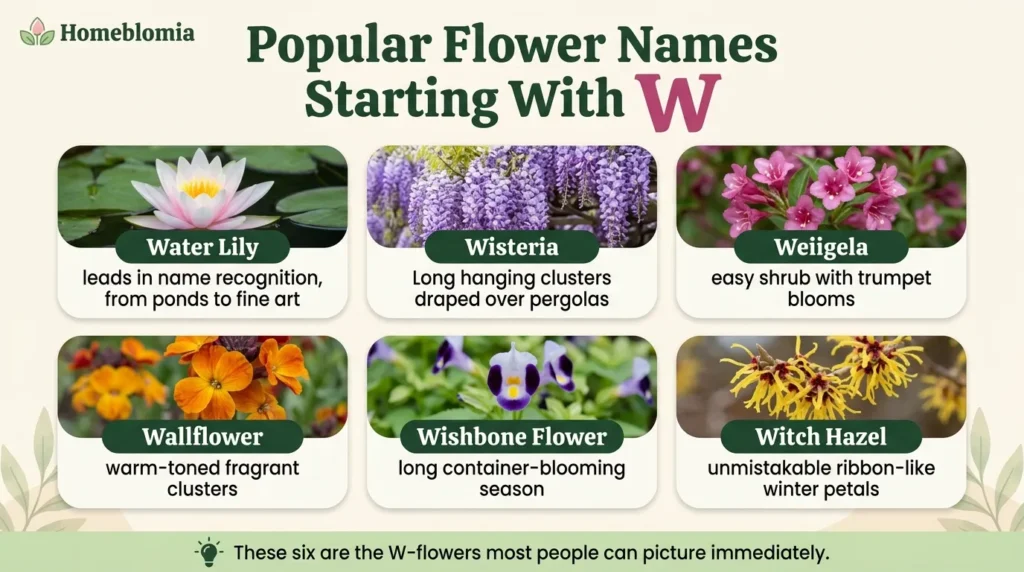
Water Lily leads the group in name recognition, it appears everywhere from backyard ponds to fine art, making it probably the single most universally known W-flower. Wisteria is a close second, instantly recognizable for its long, hanging flower clusters draped over pergolas and arbors each spring. Weigela, Wallflower, Wishbone Flower, and Witch Hazel round out the flowers most people can picture immediately, each tied to a distinct visual: Weigela’s trumpet blooms on an easy shrub, Wallflower’s warm-toned clusters, Wishbone Flower’s long container season, and Witch Hazel’s unmistakable ribbon-like winter petals.
Common Flowers That Start With W
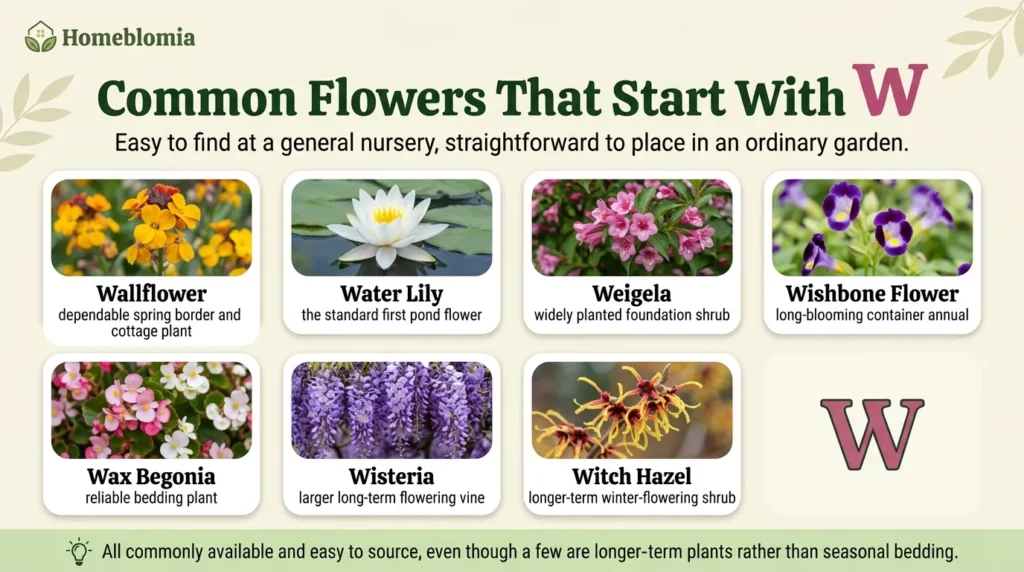
“Common” here means easy to find at a general nursery and straightforward to place in an ordinary home garden. Wallflower is a dependable spring border and cottage-garden plant. Water Lily is the standard pond flower almost anyone with a water feature will consider first. Weigela is a widely planted foundation shrub, and Wishbone Flower is a reliable, long-blooming container and bedding annual. Wax Begonia, Wisteria, and Witch Hazel also belong in this common tier, all are readily available and commonly grown, even though Wisteria and Witch Hazel are larger, longer-term plants rather than seasonal bedding.
Rare Flowers That Start With W
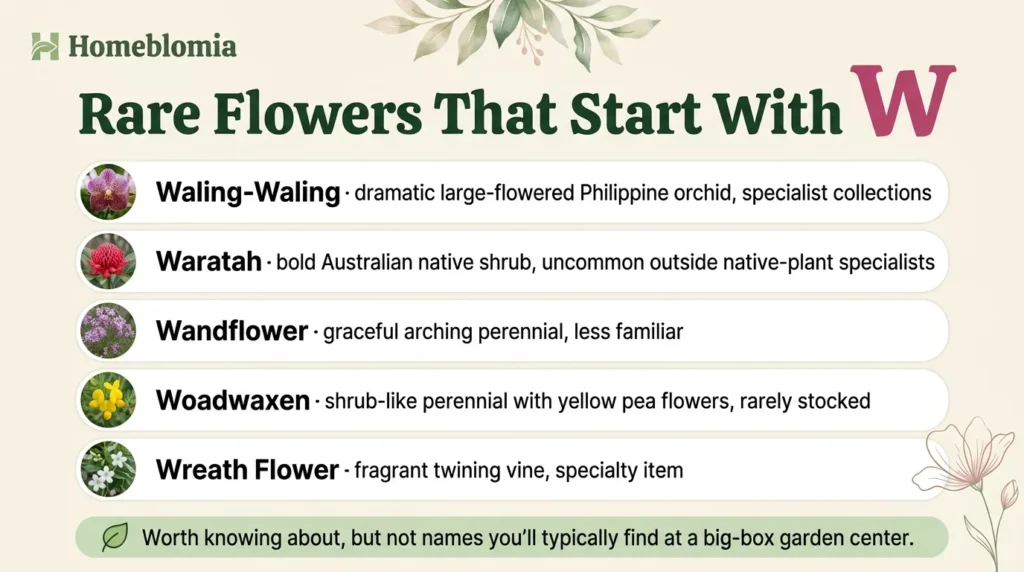
A smaller set of W names is genuinely less common, either because the plant is regional, needs specific conditions, or simply isn’t stocked at typical garden centers. Waling-Waling is a dramatic, large-flowered orchid native to the Philippines, more likely found in a specialist orchid collection than a general nursery. Waratah, an Australian native shrub with bold, rounded flower heads, is similarly uncommon outside native-plant specialists or particular climate zones. Wandflower, Woadwaxen, and Wreath Flower also fall into this less-familiar tier, worth knowing about, but not names you’ll typically find at a big-box garden center.
Types of Flowers That Start With W
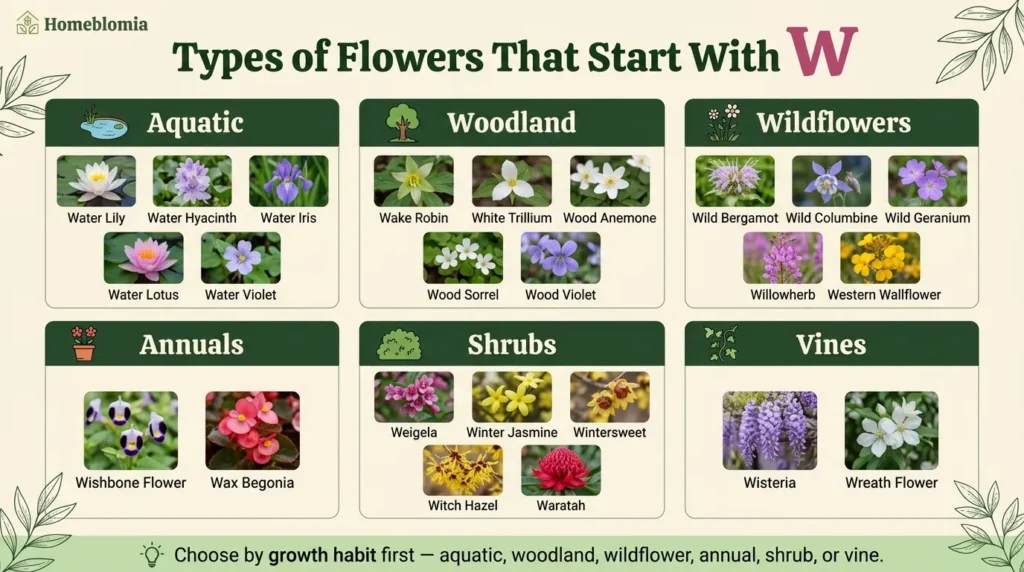
- Aquatic: Water Lily, Water Hyacinth, Water Iris, Water Lotus, Water Violet
- Woodland: Wake Robin, White Trillium, Wood Anemone, Wood Sorrel, Wood Violet
- Wildflowers: Wild Bergamot, Wild Columbine, Wild Geranium, Willowherb, Western Wallflower
- Annuals: Wishbone Flower, Wax Begonia
- Shrubs: Weigela, Winter Jasmine, Wintersweet, Witch Hazel, Waratah
- Vines: Wisteria, Wreath Flower
Plants vs. Flowers That Start With W
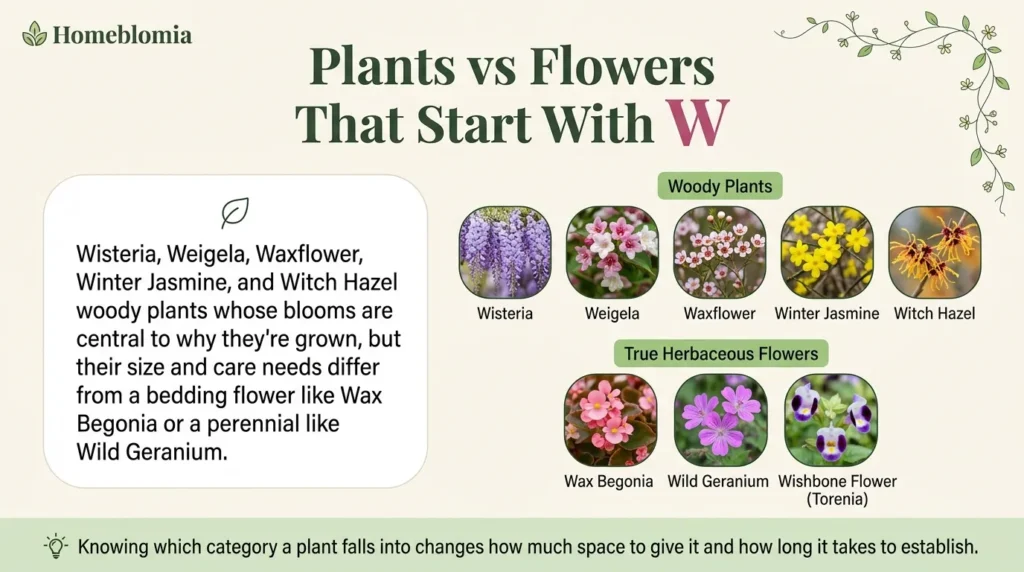
Some W entries are flowering shrubs or vines rather than true herbaceous flowers, and it’s worth keeping that distinction clear rather than treating every entry identically. Wisteria, Weigela, Waxflower, Winter Jasmine, and Witch Hazel are all woody plants, their blooms are central to why they’re grown, which earns them a place on this list, but their size, care needs, and landscape role are different from a bedding flower like Wax Begonia or a perennial like Wild Geranium. Knowing which category a plant falls into changes how much space to give it and how long it takes to establish.
For the letter before or after this one, see Flowers That Start With V or continue to Flowers That Start With X.
Perennials That Start With W
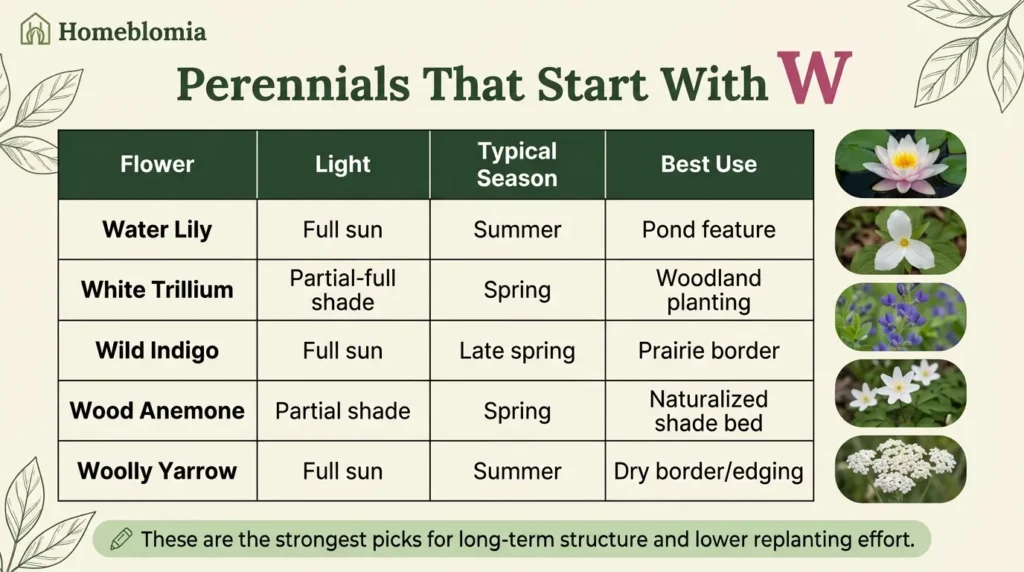
Water Lily, White Trillium, Wood Anemone, Wild Bergamot, Wild Indigo, and Wild Geranium are all reliable perennials that return year after year in the right conditions. These are the strongest picks for long-term structure and lower replanting effort, Water Lily for a pond feature, White Trillium and Wood Anemone for shaded woodland beds, and Wild Bergamot and Wild Indigo for sunny pollinator borders.
| Flower | Light | Typical Season | Best Use |
|---|---|---|---|
| Water Lily | Full sun | Summer | Pond feature |
| White Trillium | Partial–full shade | Spring | Woodland planting |
| Wild Indigo | Full sun | Late spring | Prairie border |
| Wood Anemone | Partial shade | Spring | Naturalized shade bed |
| Woolly Yarrow | Full sun | Summer | Dry border/edging |
Annual Flowers That Start With W
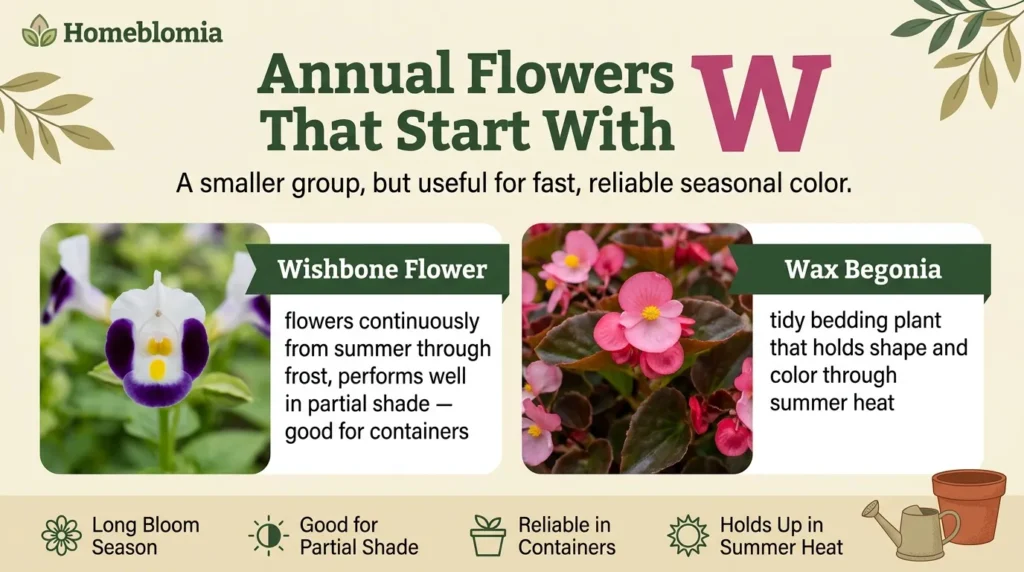
The annual group is smaller but still useful. Wishbone Flower is the clearest example, it flowers continuously from summer through frost and performs especially well in partial shade, which makes it a good fit for containers or beds that don’t get full sun all day. Wax Begonia is grown much the same way, as a dependable seasonal bedding plant that holds its shape and color through summer heat.
Purple Flowers That Start With W
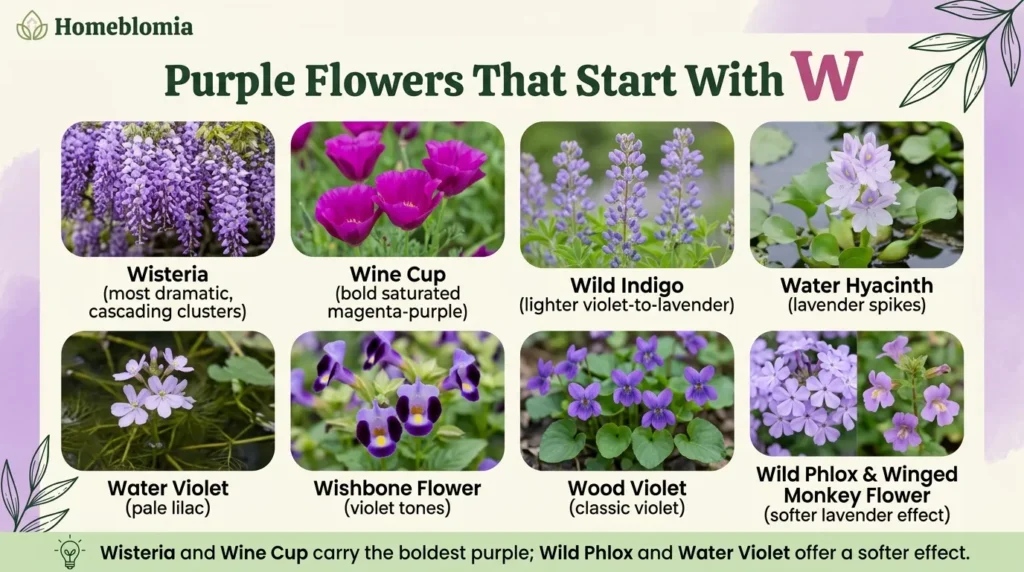
Purple and violet tones are well represented under W. Wisteria is the most dramatic, producing long, cascading clusters that create one of the most striking spring displays of any flowering plant. Wild Indigo, Water Hyacinth, Water Violet, Wishbone Flower, and Wood Violet all add lighter violet-to-lavender tones. For a softer effect, Wild Phlox and Winged Monkey Flower work well; for a bolder, saturated purple, Wine Cup and Wisteria carry the most visual weight from a distance.
Wildflowers That Begin With the Letter W
The wildflower group gives this letter a genuinely natural, unmanicured character. Wild Bergamot is especially valuable for pollinators and produces reliable summer color. Wild Columbine brings nodding red-and-yellow spring flowers well-suited to woodland edges. Wild Geranium and Wild Phlox both fit loose, naturalized plantings with a soft, informal look, while White Campion, Willowherb, and Western Wallflower round out the group with additional texture and color range.
Aquatic and Wetland Flowers That Begin With W
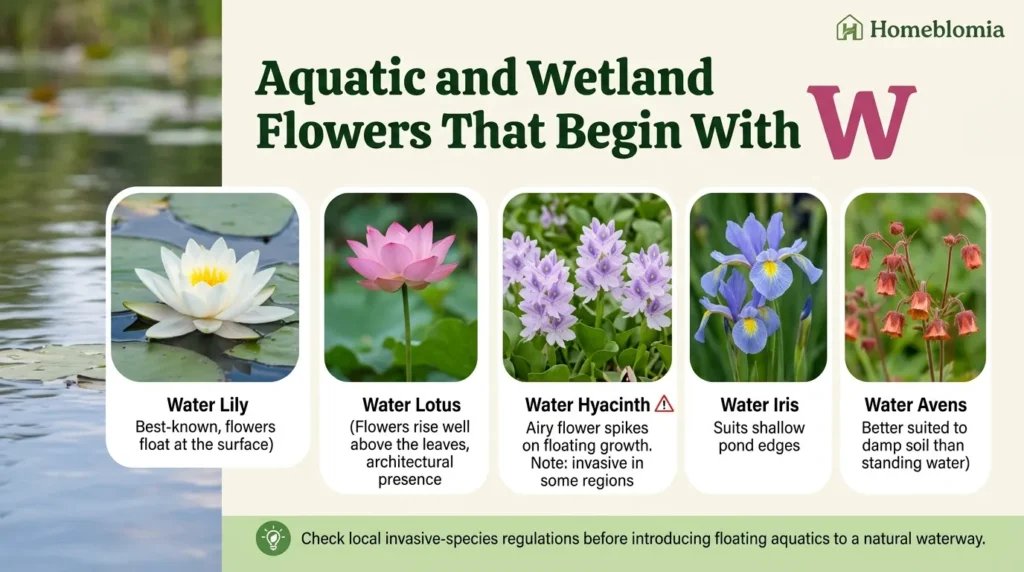
Water Lily is the best-known aquatic W-flower, but it has real company. Water Lotus produces flowers that rise well above the leaves rather than floating flat on the surface, giving it a more upright, architectural presence than a typical water lily. Water Hyacinth carries airy flower spikes on floating growth, note that it’s classified as invasive in some regions and warm-climate waterways, so check local regulations before introducing it to any pond connected to natural water systems. Water Iris and Water Violet suit shallow pond edges rather than deep open water, and Water Avens is better suited to consistently damp soil than true standing water.
Woodland and Shade-Friendly W Flowers
This is one of the strongest categories under W. Wake Robin and White Trillium are classic early-spring woodland natives, both well-suited to humus-rich, undisturbed shade. Wood Anemone opens even earlier and spreads into a natural-looking carpet under deciduous trees. Wood Sorrel stays low and delicate, while White Wood Aster extends white color later into the season, after most spring woodland flowers have finished. Wood Violet adds fragrance to the shade garden, a rarer trait among woodland flowers.
Shrubs, Vines, and Structural Bloomers
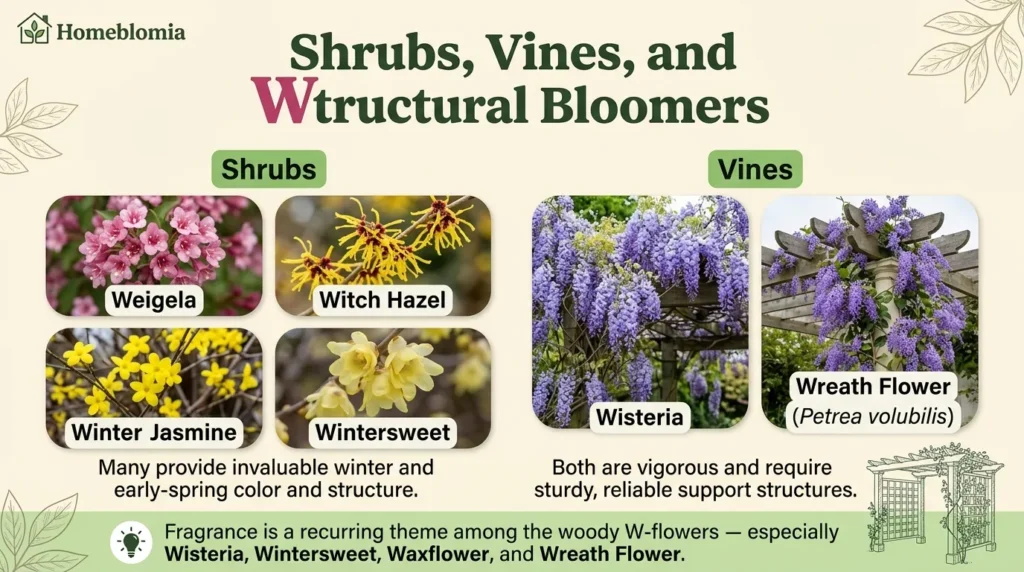
Weigela is a low-fuss, reliable flowering shrub for spring color. Witch Hazel, Winter Jasmine, and Wintersweet are especially valuable because they flower in winter or very early spring, when almost nothing else in the garden is blooming. Wisteria and Wreath Flower represent the vining side of this group, both need sturdy support (a pergola, trellis, or strong wall structure) and reward that investment with dramatic seasonal display. Fragrance is a recurring theme among the woody W-flowers, especially Wisteria, Wintersweet, Waxflower, and Wreath Flower.
Best W Flowers by Color
| Color | Standout Examples |
|---|---|
| White | White Trillium, White Campion, Wood Anemone, Woodruff |
| Yellow | Winter Aconite, Witch Hazel, Winter Jasmine, Woadwaxen |
| Pink | Weigela, Wild Rose, Wandflower, Water Avens |
| Purple/blue | Wisteria, Wild Indigo, Water Hyacinth, Wood Violet |
| Red/warm tones | Waratah, Western Red Lily, Wallflower, some Wax Begonia cultivars |
Best W Flowers by Bloom Season
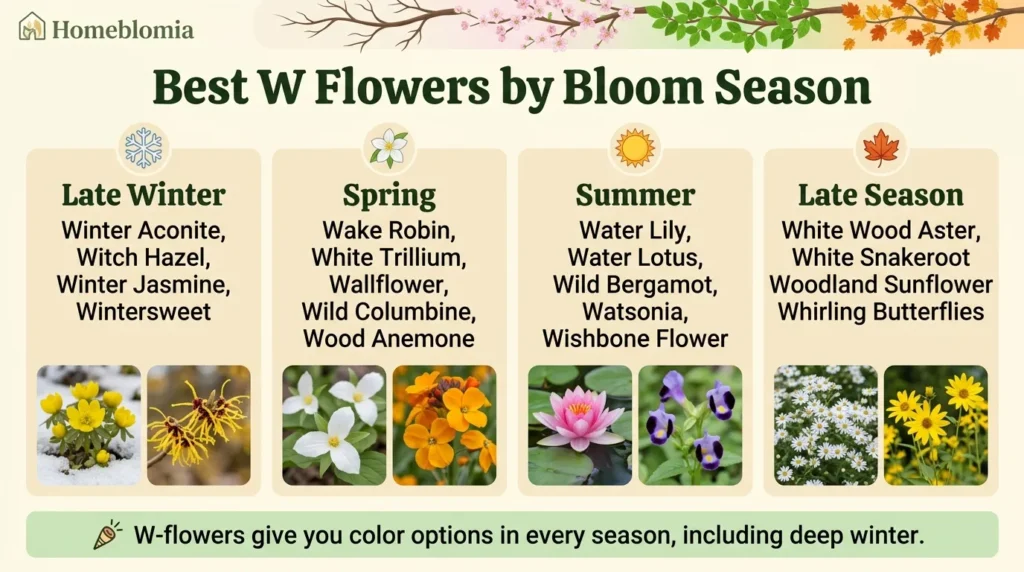
| Season | Good Choices |
|---|---|
| Late winter | Winter Aconite, Witch Hazel, Winter Jasmine, Wintersweet |
| Spring | Wake Robin, White Trillium, Wallflower, Wild Columbine, Wood Anemone |
| Summer | Water Lily, Water Lotus, Wild Bergamot, Watsonia, Wishbone Flower |
| Late season | White Wood Aster, White Snakeroot, Woodland Sunflower, Whirling Butterflies |
Best Picks for Different Garden Uses
| Garden Use | Best Choices |
|---|---|
| Ponds | Water Lily, Water Lotus, Water Iris |
| Shade | White Trillium, Wood Anemone, Wood Violet |
| Pollinators | Wild Bergamot, Wild Indigo, Western Wallflower |
| Fragrance | Wallflower, Wintersweet, Wood Violet |
| Containers | Wishbone Flower, Wax Begonia |
| Climbers | Wisteria, Wreath Flower |
| Cut flower interest | Waxflower, Watsonia, Waratah |
| Low-maintenance, sunny | Woolly Yarrow, Wallflower, Woadwaxen |
Quick Comparison
| Flower | Habit | Bloom Season | Light | Moisture | Best Use |
|---|---|---|---|---|---|
| Wallflower | Low border perennial/biennial | Spring | Full sun | Moderate | Bedding, borders |
| Water Lily | Aquatic perennial | Summer | Full sun | Water | Pond display |
| Waxflower | Flowering shrub | Spring | Full sun | Moderate | Floral detail, shrub borders |
| Weigela | Shrub | Spring–early summer | Full sun–light shade | Moderate | Foundation planting |
| White Trillium | Woodland perennial | Spring | Shade | Even moisture | Woodland gardens |
| Wild Indigo | Upright perennial | Late spring | Full sun | Moderate | Prairie-style planting |
| Windflower | Herbaceous perennial | Spring | Full sun–partial shade | Moderate | Spring color |
| Winter Aconite | Bulbous perennial | Late winter | Sun–partial shade | Moderate | Early seasonal interest |
| Wishbone Flower | Annual | Summer–frost | Partial shade | Even moisture | Containers, bedding |
| Wisteria | Flowering vine | Spring | Full sun | Moderate | Pergolas, supports |
| Witch Hazel | Shrub | Winter–early spring | Sun–partial shade | Moderate | Winter bloom |
| Wood Anemone | Woodland perennial | Spring | Partial shade | Even moisture | Naturalized shade planting |
Visual Identification Tips
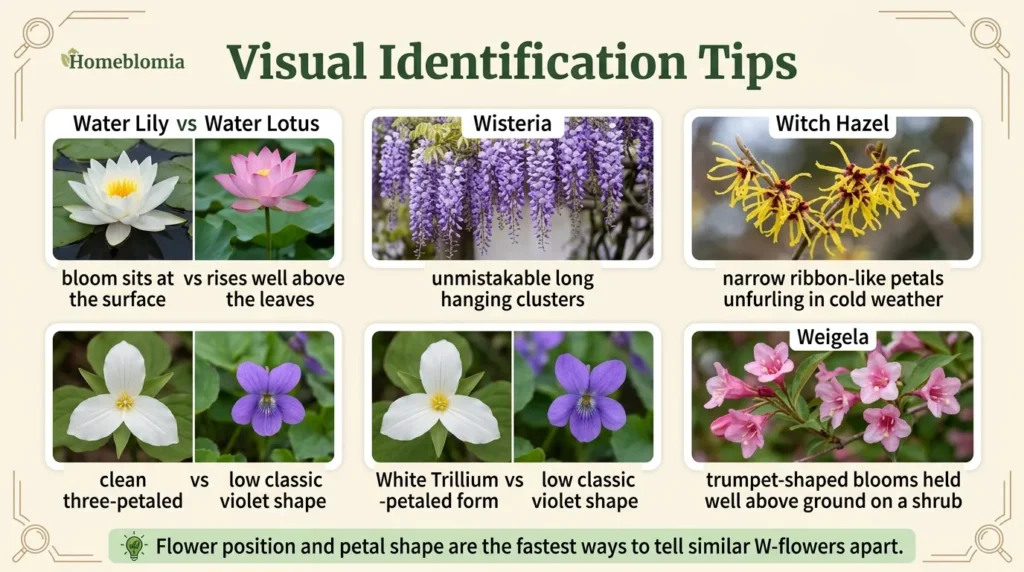
Water Lily and Water Lotus are both aquatic, but flower position is the fastest way to tell them apart: water lily blooms sit at or near the surface, while lotus flowers rise well above the leaves on tall stems. Wisteria is unmistakable once you’ve seen its long, hanging flower clusters. Witch Hazel has narrow, ribbon-like petals that unfurl in cold weather, unlike almost anything else blooming at that time of year. White Trillium shows a clean, three-petaled form typical of the genus, while Wood Violet stays low with small, classic violet-shaped flowers, and Weigela carries its trumpet-shaped blooms on a shrub, well above ground level, distinguishing it at a glance from lower perennials.
Short Descriptions for All 50 Flowers
- Wake Robin — A deep maroon-red woodland trillium that opens in early spring shade, thriving in humus-rich, undisturbed soil.
- Wallflower — Warm-colored flower clusters with a light, sweet fragrance, well-suited to spring borders and cottage planting.
- Wandflower — A graceful perennial with arching stems and hanging bell-shaped flowers that bring movement to sunny borders.
- Waratah — An Australian native shrub with bold, rounded flower heads, best used as a single dramatic focal point.
- Water Avens — A damp-soil perennial with nodding pink or cream flowers, well-suited to streamside planting.
- Water Hyacinth — A floating aquatic plant with upright lavender spikes; check regional invasiveness rules before planting.
- Water Iris — A pond-edge iris with clear blue-to-violet blooms, suited to shallow water and wet margins.
- Water Lily — The classic pond flower, with broad floating leaves and surface-level blooms through summer.
- Water Lotus — Upright, above-water blooms give it a more architectural presence than a typical water lily.
- Water Violet — A delicate aquatic perennial with pale, starry flowers and a finer texture than larger pond blooms.
- Watsonia — A corm-grown plant with upright flower spikes and sword-like foliage, useful for vertical color in warm borders.
- Wax Begonia — A tidy, glossy-leaved bedding plant with long-lasting blooms, dependable in containers and formal beds.
- Waxflower — A shrub with small, waxy flowers that hold up especially well in cut arrangements.
- Wedelia — A spreading, warm-climate groundcover with bright yellow, daisy-like flowers.
- Weigela — A reliable spring-flowering shrub with trumpet-shaped blooms, common in foundation planting.
- Western Red Lily — A striking upward-facing lily in orange-red, bolder than many softer meadow flowers.
- Western Wallflower — A wildflower relative of common wallflower, with bright yellow-orange clustered blooms.
- Whirling Butterflies — A loose, airy perennial whose flowers appear to flutter above wiry stems.
- White Campion — A simple, clean white wildflower suited to meadow-style or informal planting.
- White Snakeroot — A late-season perennial with cloudy white flower clusters that softens borders into fall.
- White Trillium — A classic three-petaled woodland flower and one of the most recognizable spring shade plants.
- White Wood Aster — A fine-textured woodland perennial extending white color later into the season than most shade flowers.
- Wild Bergamot — A pollinator-magnet perennial with tufted lavender-pink blooms, strong in sunny or prairie-style beds.
- Wild Columbine — A spring wildflower with nodding red-and-yellow flowers, light and airy at woodland edges.
- Wild Geranium — A soft, mounded perennial with open pink-to-lavender flowers, useful for natural-looking spring beds.
- Wild Indigo — An upright, structural perennial with spike-like blue, purple, or yellow flowers.
- Wild Petunia — A low-to-medium perennial with soft, trumpet-shaped summer flowers.
- Wild Phlox — A fragrant spring perennial with loose clusters, well-suited to woodland edges.
- Wild Rose — A simple, open-flowered rose with a natural, unformal character, suited to hedgerow planting.
- Wild Senna — A taller perennial with loose yellow blooms and an airy habit.
- Wild Sunflower — A more naturalistic daisy-form sunflower than typical garden cultivars.
- Willowherb — A tall wildflower with upright pink-to-purple bloom spikes, meadow-like in character.
- Windflower — An anemone-type flower with soft, open petals in a range of spring colors.
- Wine Cup — A trailing perennial with bold, cup-shaped magenta flowers, good for sunny slopes and edging.
- Winged Monkey Flower — A moist-soil wildflower with tubular, snapdragon-like blooms.
- Winter Aconite — A very early bulb with bright yellow flowers close to the ground, blooming before most gardens wake up.
- Winter Jasmine — A shrub with clear yellow flowers on bare stems, bringing brightness to cold months.
- Wintersweet — Grown as much for its sweet winter fragrance as for its pale flowers.
- Wishbone Flower — A long-blooming annual with tubular flowers, especially strong in containers and partial shade.
- Wisteria — A vigorous flowering vine with hanging clusters, creating one of the most dramatic spring vine displays available.
- Witch Hazel — A winter-flowering shrub with unmistakable narrow, ribbon-like petals.
- Woadwaxen — A shrubby perennial with yellow pea-type flowers, suited to sunny, dry ground.
- Wood Anemone — A small, early spring woodland flower that naturalizes into a soft carpet under deciduous trees.
- Wood Sorrel — A delicate, low-growing woodland plant with fine flowers and clover-like foliage.
- Wood Violet — A fragrant, low-growing violet well-suited to shade, with a familiar classic form.
- Woodland Sunflower — A shade-tolerant Helianthus species, extending yellow color into lighter-shaded spots.
- Woodruff — A low groundcover with tiny white flowers, useful for softening shade-bed edges.
- Woolly Yarrow — A mat-forming, gray-green perennial with yellow clusters, suited to dry, sunny edging.
- Wreath Flower — A twining, fragrant vine with white waxy blooms, valued for its perfume.
- Waling-Waling — A large, dramatic orchid native to the Philippines, with showy pink-to-purple flowers.
Safety, Toxicity & Notes
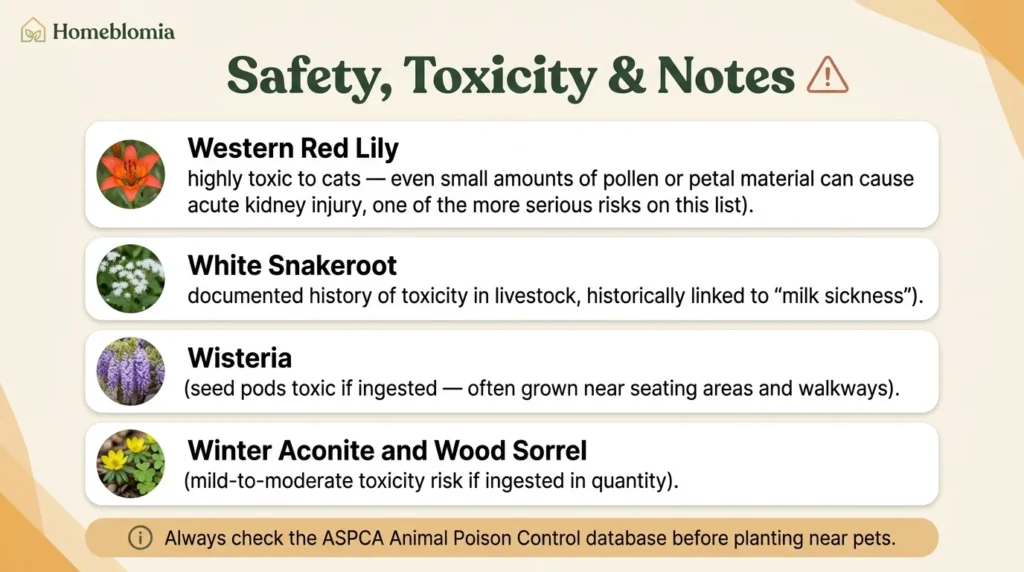
A handful of W-flowers deserve specific caution:
- Western Red Lily, like true lilies generally, is highly toxic to cats, even small amounts of pollen or petal material can cause acute kidney injury. This is one of the more serious plant-toxicity risks on this list.
- White Snakeroot has a well-documented history of toxicity in livestock (historically linked to “milk sickness” in the 19th century US) and should be handled with care around grazing animals.
- Wisteria seed pods are toxic if ingested, a detail worth knowing given how often the vine is grown near seating areas and walkways.
- Winter Aconite and Wood Sorrel carry mild-to-moderate toxicity risk if ingested in quantity.
References
- ASPCA Animal Poison Control — Toxic and Non-Toxic Plants List
- USDA — PLANTS Database
- Missouri Botanical Garden — Plant Finder
- Royal Horticultural Society — RHS Plant Finder
- NC State Extension — Plant Toolbox