60+ Flowers That Start With Y: Names, Care Guide & Photos
Quick answer: the strongest true Y-flower names are Yarrow, Yucca, Yellow Jessamine, Yellow Archangel, and Yellow Wild Indigo. Beyond those, "Y flowers" commonly expands to include any yellow-colored bloom — yellow rose, yellow tulip, yellow daffodil, yellow dahlia, and dozens more.
Y is one of the trickiest letters to build an honest flower list around. There are only a handful of flowers that start with Y, yarrow, yucca, yellow jessamine, yellow archangel. Everything past that point comes from a second, much larger category: flowers whose color happens to be yellow, which lets “yellow rose,” “yellow tulip,” or “yellow dahlia” count as Y-names in the broader sense most flower guides use.
Rather than blur those two groups together, this guide keeps them separate and labeled the whole way through, a small set of true Y-named flowers first, then a much larger set of yellow-named garden flowers, then a short list of rare or specialist Y entries. That structure makes the page more honest and more useful than a single unsorted list of 60-plus names.
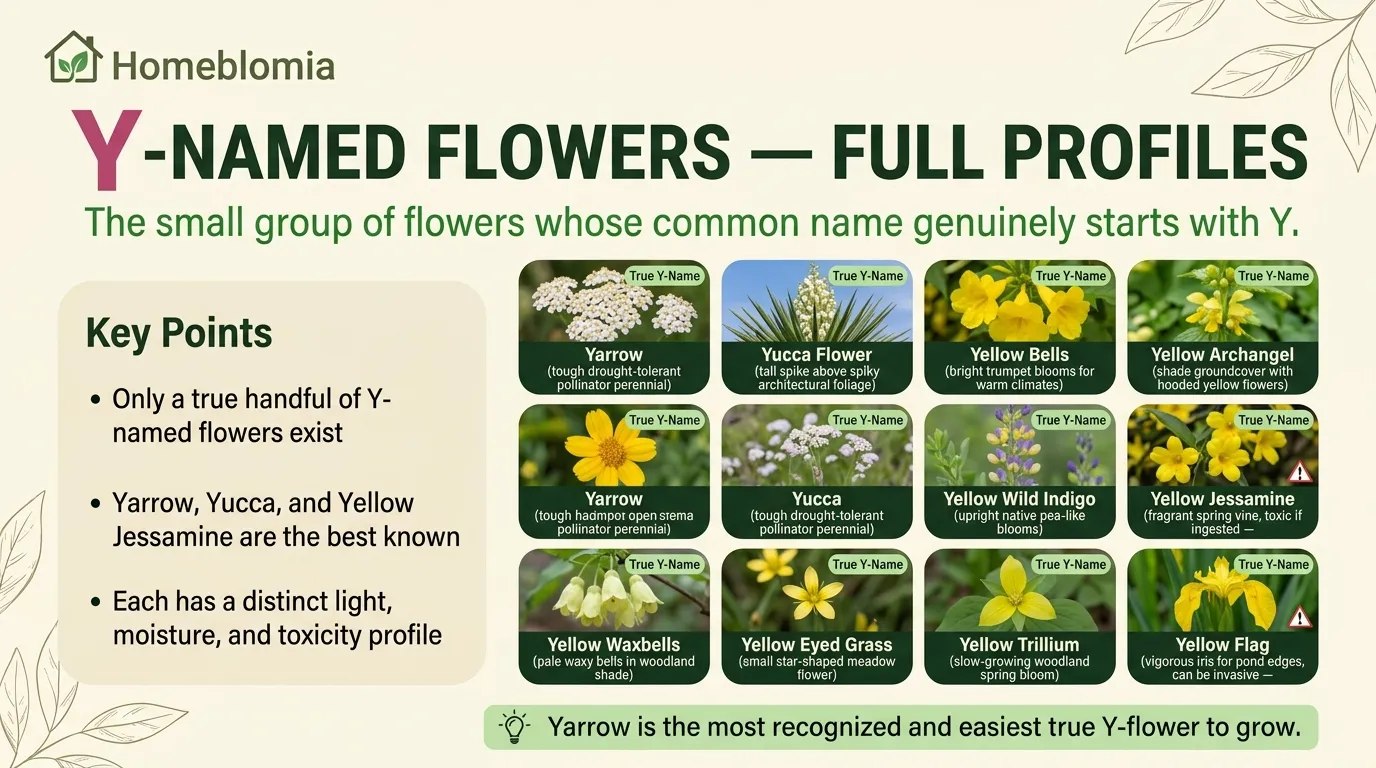
Y-Named Flowers Full Profiles
Yarrow (Achillea millefolium)
The strongest, most recognizable true Y-flower. A tough, drought-tolerant perennial with flat clusters of small flowers in white, yellow, pink, red, or purple depending on cultivar. It thrives in full sun and lean soil, self-seeds moderately, and is a reliable pollinator plant. It’s genuinely one of the easiest perennials to grow, tolerating neglect better than most border flowers.
Yucca Flower (Yucca spp.)
Yucca is better known for its bold, spiky foliage than its bloom, but mature plants send up a tall flower spike of white to cream, bell-shaped blooms, usually in summer. It’s extremely drought-tolerant and suited to xeric or dry landscape design, adding strong architectural structure even when not in flower.
Yellow Bells (Tecoma stans)
A flowering shrub with bright yellow, trumpet-shaped blooms, common in warm climates like the American Southwest and parts of the tropics. It flowers over a long season in full sun and heat, and is not reliably hardy in colder climates.
Yellow Archangel (Lamium galeobdolon)
A shade-tolerant groundcover with yellow, hooded flowers and often variegated silver-green foliage. It spreads readily in part shade, which makes it useful as a groundcover but something to plant with intention, since it can spread beyond its intended area in favorable conditions.
Yellow Wild Indigo (Baptisia sphaerocarpa)
A native perennial with an upright habit and clear yellow, pea-like flowers in late spring. It’s long-lived, deep-rooted (making it drought-tolerant once established), and well-suited to native and pollinator-focused plantings.
Yellow Jessamine (Gelsemium sempervirens)
A fragrant flowering vine with bright yellow, trumpet-shaped blooms in early spring, commonly grown on fences and trellises in the Southeastern United States. Note: all parts of the plant are toxic if ingested, a detail worth knowing given how often it’s grown near porches and walkways.
Yellow Waxbells (Kirengeshoma palmata)
A refined woodland perennial with soft, pale yellow, waxy bell-shaped flowers in late summer. It prefers part shade and consistently moist soil, making it a good fit for shaded borders rather than sunny beds.
Yellow Eyed Grass (Sisyrinchium spp.)
A grass-like perennial with small, star-shaped yellow flowers, best suited to naturalistic or meadow-style plantings rather than formal borders.
Yellow Trillium (Trillium luteum)
A spring-blooming woodland perennial with pale yellow, upright flowers above mottled foliage. It’s slow-growing and best suited to shaded, native-plant gardens rather than general bedding use.
Yellow Flag (Iris pseudacorus)
A vigorous, moisture-loving iris with bright yellow blooms, well-suited to pond edges and consistently wet soil. Note: it can be aggressive and, in some regions, is considered invasive in wetland habitats, check regional guidance before planting near natural waterways.
Yellow-Named Flowers Expanded Reference Table
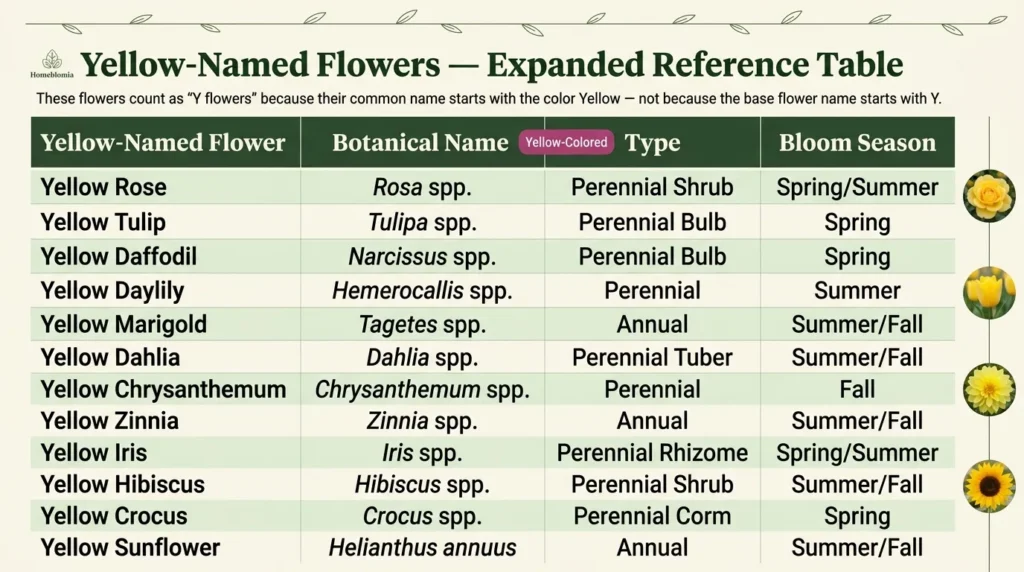
These flowers are commonly included in broader “Y flower” lists because their common name begins with the color “Yellow,” even though the base flower (rose, tulip, daisy, etc.) is covered under its own letter elsewhere on this site. Full care details for each base flower type are covered on their respective letter pages, this table exists to answer the “does X count as a Y flower” question directly.
| Yellow-Named Flower | Botanical Name | Type | Bloom Season |
|---|---|---|---|
| Yellow Rose | Rosa spp. | Shrub | Repeat bloomer |
| Yellow Tulip | Tulipa spp. | Bulb | Spring |
| Yellow Daffodil | Narcissus spp. | Bulb | Spring |
| Yellow Daylily | Hemerocallis spp. | Perennial | Summer |
| Yellow Marigold | Tagetes spp. | Annual | Summer–fall |
| Yellow Dahlia | Dahlia spp. | Tuberous | Late summer–fall |
| Yellow Chrysanthemum | Chrysanthemum spp. | Perennial/seasonal | Fall |
| Yellow Zinnia | Zinnia spp. | Annual | Summer |
| Yellow Iris | Iris spp. | Perennial | Spring–summer |
| Yellow Hibiscus | Hibiscus spp. | Shrub | Summer |
| Yellow Crocus | Crocus spp. | Bulb | Early spring |
| Yellow Freesia | Freesia spp. | Bulb | Spring |
| Yellow Coreopsis | Coreopsis spp. | Perennial | Summer |
| Yellow Snapdragon | Antirrhinum majus | Annual | Spring–summer |
| Yellow Columbine | Aquilegia spp. | Perennial | Spring |
| Yellow Camellia | Camellia spp. | Shrub | Winter–spring |
| Yellow Hyacinth | Hyacinthus orientalis | Bulb | Spring |
| Yellow Water Lily | Nymphaea spp. | Aquatic | Summer |
| Yellow Cosmos | Cosmos sulphureus | Annual | Summer–fall |
| Yellow Lupine | Lupinus spp. | Annual/perennial | Spring–summer |
| Yellow Petunia | Petunia spp. | Annual | Spring–frost |
| Yellow Lantana | Lantana camara | Shrub/bedding | Summer–fall |
| Yellow Begonia | Begonia spp. | Annual/tuberous | Spring–fall |
| Yellow Aster | Aster and related genera | Perennial | Fall |
| Yellow Alyssum | Aurinia saxatilis | Perennial | Spring |
| Yellow Canna | Canna spp. | Tropical perennial | Summer |
| Yellow Delphinium | Delphinium spp. | Perennial | Summer |
| Yellow Gerbera | Gerbera jamesonii | Perennial/seasonal | Varies |
| Yellow Hollyhock | Alcea rosea | Biennial/perennial | Summer |
| Yellow Sunflower | Helianthus annuus | Annual | Summer–fall |
Rare and Collector Y-Flowers
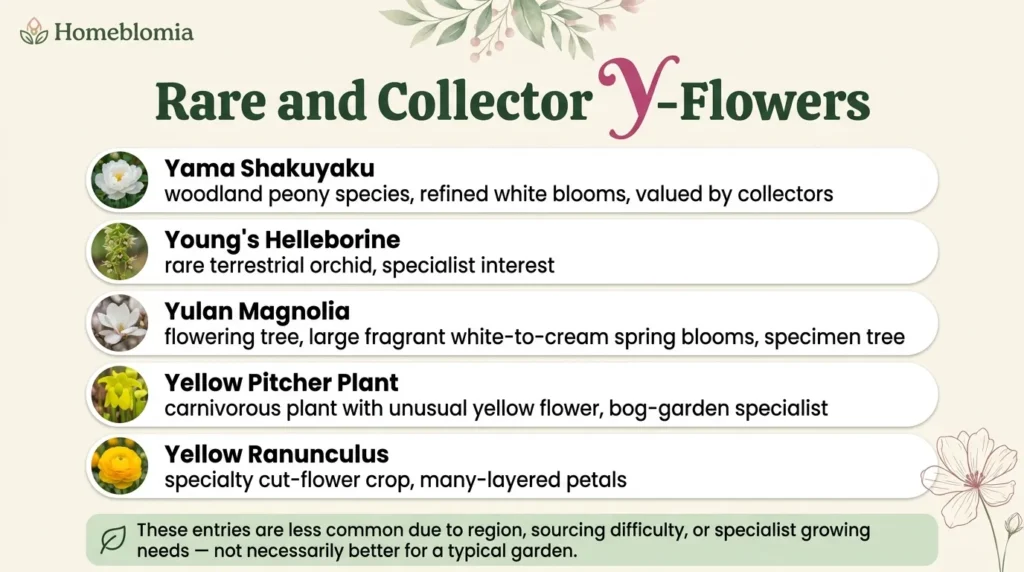
These entries are genuinely less common, either because they’re region-specific, harder to source commercially, or simply less discussed in everyday gardening content.
- Yama Shakuyaku (Paeonia japonica) — a woodland peony species valued by collectors for its refined white blooms, less common than typical garden peonies.
- Young’s Helleborine (Epipactis youngiana) — a rare terrestrial orchid, primarily of interest to specialist growers and orchid collectors rather than general gardeners.
- Yulan Magnolia (Magnolia denudata) — technically a flowering tree rather than a border flower, with large, fragrant white to cream blooms in early spring, valued as a specimen tree.
- Yellow Pitcher Plant (Sarracenia flava) — a carnivorous plant with an unusual yellow flower, grown by specialist and bog-garden collectors rather than in typical borders.
- Yellow Ranunculus (Ranunculus asiaticus, yellow cultivars) — grown as a specialty cut flower crop, valued for its many-layered petals.
Types of Flowers That Start With Y
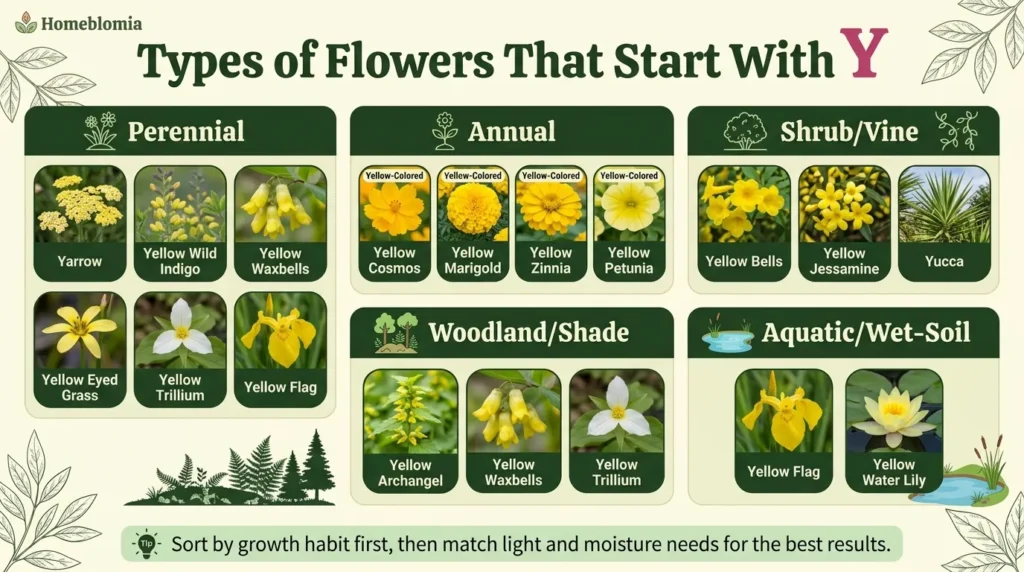
Perennial
Yarrow, Yellow Wild Indigo, Yellow Waxbells, Yellow Eyed Grass, Yellow Trillium, Yellow Flag.
Annual
Many yellow-named entries in Group 2 (Yellow Cosmos, Yellow Marigold, Yellow Zinnia, Yellow Petunia).
Shrub/Vine
Yellow Bells, Yellow Jessamine (vine), Yucca (technically a woody perennial, often grouped with shrubs for landscape purposes).
Woodland/Shade
Yellow Archangel, Yellow Waxbells, Yellow Trillium.
Aquatic/Wet-Soil
Yellow Flag, Yellow Water Lily, Yellow Lotus.
For the letter before or after this one, see Flowers That Start With X or continue to Flowers That Start With Z.
Color Note
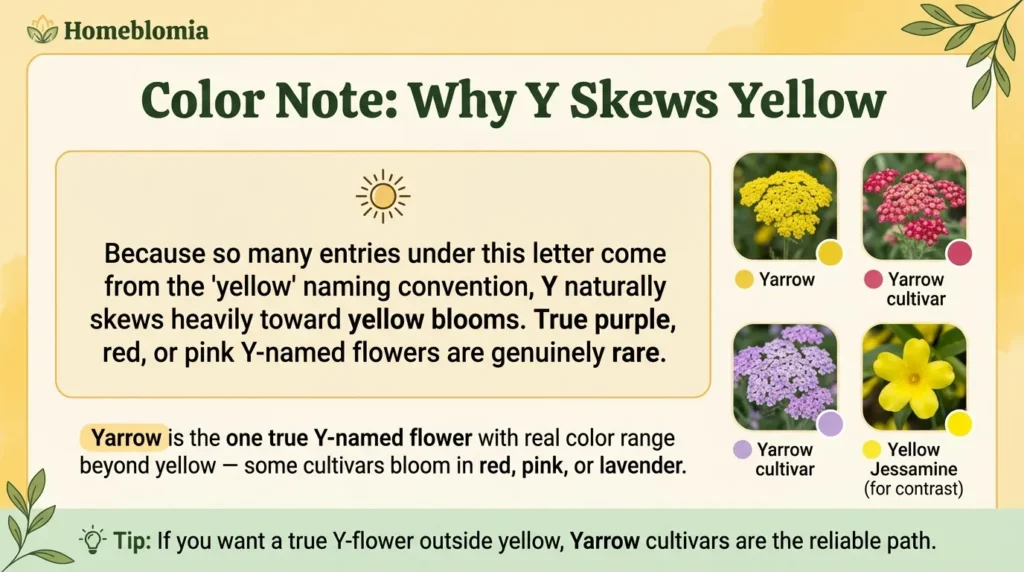
Because so many entries in this letter come from the “yellow” naming convention, the letter Y naturally skews heavily toward yellow blooms. True purple, red, or pink Y-flowers are genuinely rare, Yarrow is really the only true Y-named flower with meaningful color range beyond yellow, since some cultivars bloom in red, pink, or lavender tones.
Safety & Toxicity Notes
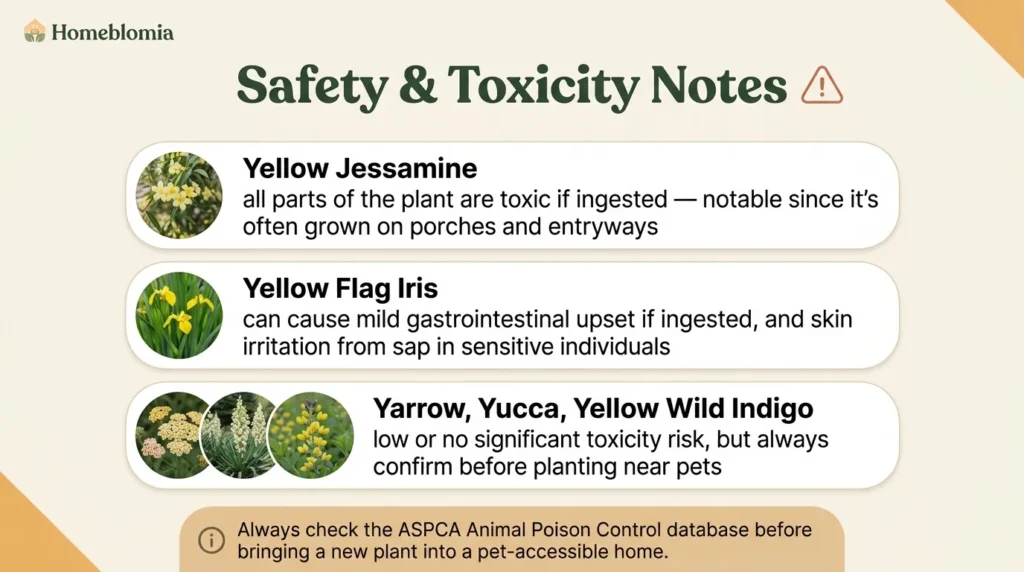
- Yellow Jessamine is toxic if ingested, all parts of the plant contain toxic alkaloids. This matters because it’s frequently grown on porches, fences, and entryways where pets and children have access.
- Yellow Flag Iris, like many true irises, can cause mild gastrointestinal upset if ingested and can also cause skin irritation from the sap in sensitive individuals.
- Most other true Y-named entries (Yarrow, Yucca, Yellow Wild Indigo) carry low or no significant toxicity risk, but always confirm against the ASPCA database below before planting near pets.
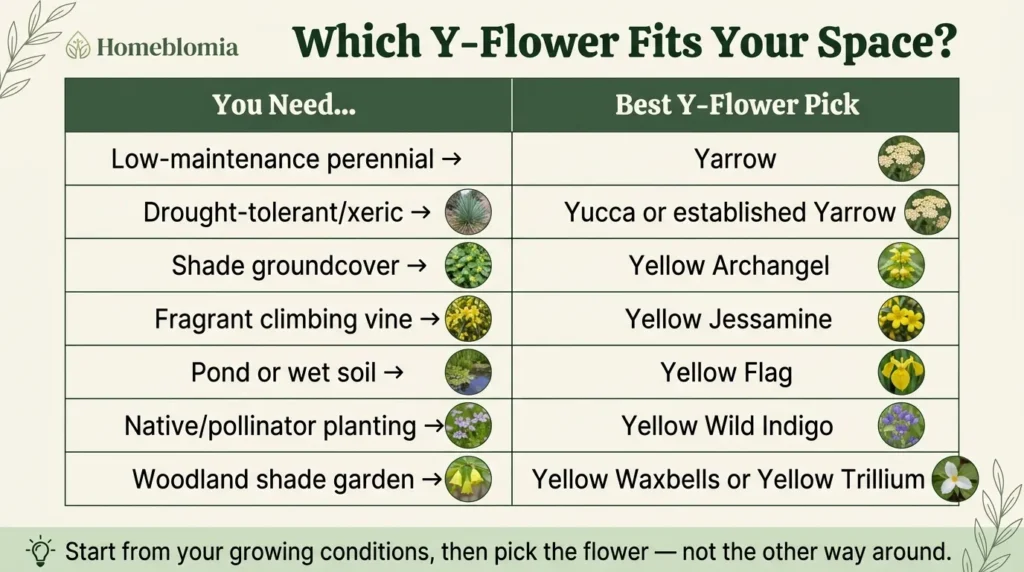
Decision Helper: Which Y-Flower Fits Your Space?
| You need… | Best Y-flower pick |
|---|---|
| Low-maintenance perennial | Yarrow |
| Drought-tolerant/xeric | Yucca or established Yarrow |
| Shade groundcover | Yellow Archangel |
| Fragrant climbing vine | Yellow Jessamine |
| Pond or wet soil | Yellow Flag |
| Native/pollinator planting | Yellow Wild Indigo |
| Woodland shade garden | Yellow Waxbells or Yellow Trillium |
FAQ
How many flowers start with the letter Y?
Only a small handful of flowers have a true common name starting with Y, roughly 10-12, led by Yarrow, Yucca, Yellow Jessamine, and Yellow Archangel. If yellow-colored cultivars of other flowers are included, the list can expand to 50 or more, though those entries are more accurately “yellow flowers” than “Y-named flowers.”
What is the most popular flower that starts with Y?
Yarrow is the most widely recognized and grown true Y-flower, valued for its ease of care and pollinator value.
Which flowers that start with Y are perennials?
Yarrow, Yellow Wild Indigo, Yellow Waxbells, Yellow Eyed Grass, Yellow Trillium, and Yellow Flag are all true perennials.
Are there indoor flowers that start with Y?
True Y-named indoor options are limited, Yucca is the most common indoor plant in this group, though it rarely flowers indoors. Yellow-flowering orchids (technically covered under “Orchid,” not a Y-name) are sometimes included in broader Y lists for this reason.
What are rare flowers that start with Y?
Yama Shakuyaku, Young’s Helleborine, and Yellow Pitcher Plant are all genuinely uncommon, specialist entries.
Are there purple flowers that start with Y?
True purple Y-flowers are rare. Some Yarrow cultivars bloom in lavender or mauve tones, which is the most reliable route to purple under this letter.
Is Yellow Jessamine toxic to pets?
Yes, all parts of the plant are toxic if ingested, so it should be planted with that in mind around pets and children.
Do any Y-flowers attract pollinators?
Yes, Yarrow, Yellow Wild Indigo, and Yellow Coneflower (a yellow-named entry) are all strong pollinator plan.
References
- ASPCA Animal Poison Control — Toxic and Non-Toxic Plants List
- USDA — PLANTS Database
- Missouri Botanical Garden — Plant Finder
- Royal Horticultural Society — RHS Plant Finder
- NC State Extension — Plant Toolbox