31 Flowers That Start With O, Names, Full Care Guide & Photos
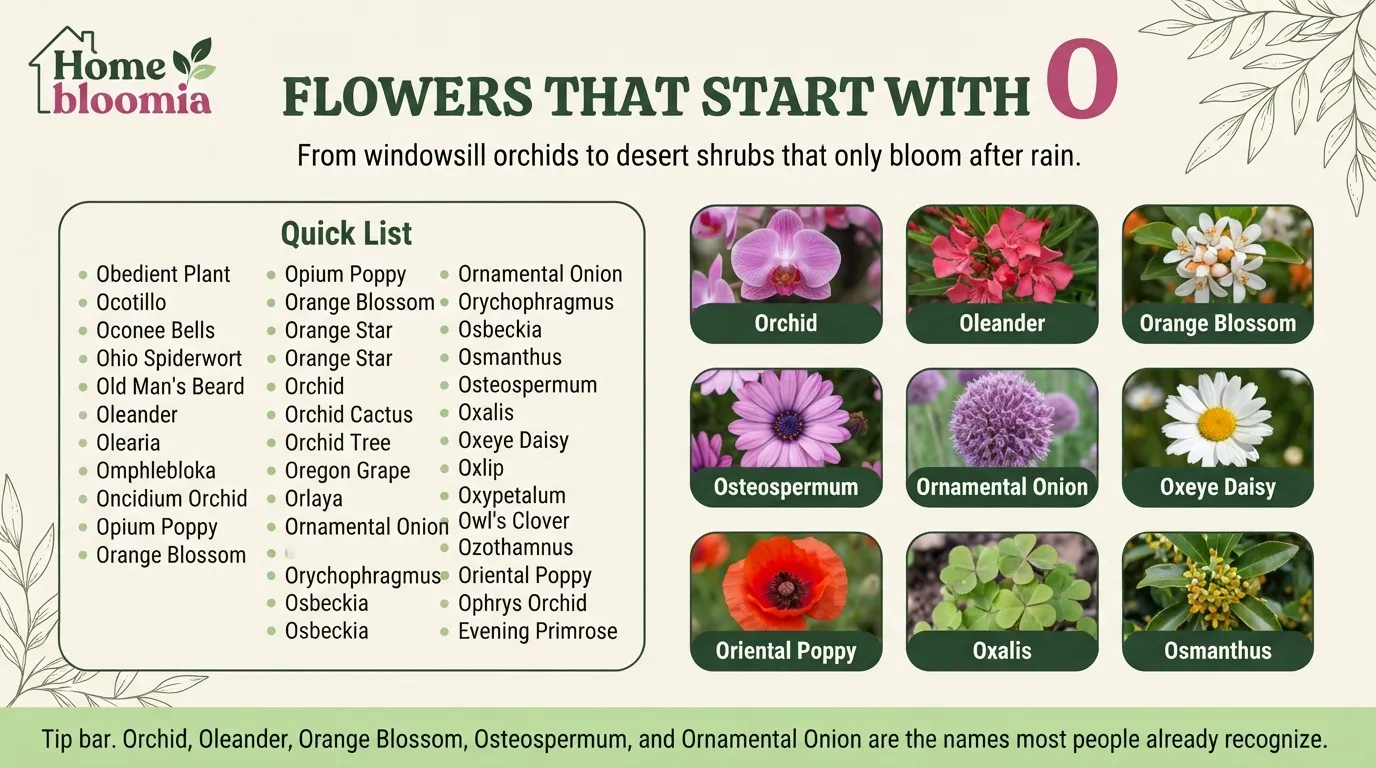
Quick answer: Flowers That Start With O are Orchid, Oleander, Orange Blossom, Osteospermum, and Ornamental Onion. Less familiar names on this list include Oconee Bells, Ophrys Orchid, and Ozothamnus — genuine flowers, just rarely grown outside specialist collections.
Flowers beginning with the letter O cover more ground than most people expect. The list runs from the orchid sitting on a windowsill to the flowering desert shrub that only blooms after rain, by way of spring bulbs, cottage-garden perennials, fragrant hedges, and a few genuine rarities most gardeners will never grow.
This guide covers O-flowers in full: what each one looks like, how it grows, where it fits in a yard or a pot, and which ones need real caution around pets or children. Rather than a single flat list, the flowers are grouped by growth habit first, then explored individually, then filtered by the practical questions most people are actually trying to answer, sun or shade, safe or risky, easy or difficult.
Quick List
Common names, alphabetical: Obedient Plant, Ocotillo, Oconee Bells, Ohio Spiderwort, Old Man’s Beard, Oleander, Olearia, Omphalodes, Oncidium Orchid, Opium Poppy, Orange Blossom, Orange Star, Orchid, Orchid Cactus, Orchid Tree, Oregon Grape, Orlaya, Ornamental Onion, Orychophragmus, Osbeckia, Osmanthus, Osteospermum, Oxalis, Oxeye Daisy, Oxlip, Oxypetalum, Owl’s Clover, Ozothamnus, Oriental Poppy, Ophrys Orchid, Evening Primrose
Botanical-name-first: Nerium oleander (Oleander), Osteospermum spp. (African Daisy), Leucanthemum vulgare (Oxeye Daisy), Physostegia virginiana (Obedient Plant), Papaver orientale (Oriental Poppy), Bauhinia spp. (Orchid Tree), Oenothera spp. (Evening Primrose), Tradescantia ohiensis (Ohio Spiderwort)
Full Comparison Table
| Common Name | Botanical Name | Type | Colors | Bloom Season | Light | Fragrant | Beginner-Friendly | Toxic to Pets |
|---|---|---|---|---|---|---|---|---|
| Orchid | Orchidaceae spp. | Indoor/tropical | White, pink, purple, yellow | Varies by species | Bright, indirect | Some varieties | Yes (moth orchid) | No (most types) |
| Oleander | Nerium oleander | Shrub | Pink, red, white | Summer–fall | Full sun | Mildly | No | Yes — highly toxic, all parts |
| Orange Blossom | Citrus spp. | Flowering tree | White | Spring | Full sun | Strong | Moderate | No |
| Osteospermum | Osteospermum spp. | Annual/tender perennial | Purple, pink, white, yellow | Spring–fall | Full sun | No | Yes | No |
| Oxeye Daisy | Leucanthemum vulgare | Perennial | White/yellow center | Late spring–summer | Full sun | No | Yes | No |
| Obedient Plant | Physostegia virginiana | Perennial | Pink, white, purple | Summer | Full sun–part shade | No | Moderate | No |
| Orlaya | Orlaya grandiflora | Annual | White | Late spring–summer | Full sun | No | Yes | No |
| Orange Star | Ornithogalum dubium | Bulb | Orange | Late winter–spring | Bright light | No | Moderate | Yes — mildly toxic |
| Oxalis | Oxalis spp. | Bulb/perennial | Pink, white, yellow | Spring–fall | Sun–part shade | No | Yes | Yes — toxic in large amounts |
| Orchid Cactus | Epiphyllum spp. | Tropical/epiphytic | Pink, red, white | Spring–summer | Bright, indirect | Some | Moderate | No |
| Evening Primrose | Oenothera spp. | Perennial | Yellow, pink | Late spring–summer | Full sun | Mild, evening | Yes | No |
| Oxlip | Primula elatior | Perennial | Soft yellow | Spring | Part shade | No | Moderate | No |
| Owl’s Clover | Castilleja/Orthocarpus spp. | Wildflower | Pink, magenta | Spring | Full sun | No | Moderate | No |
| Osmanthus | Osmanthus fragrans | Shrub | Cream-white | Fall | Sun–part shade | Strong | Moderate | No |
| Olearia | Olearia spp. | Shrub | White, lavender | Spring–summer | Full sun | No | Moderate | No |
| Osbeckia | Osbeckia spp. | Tropical shrub | Purple, pink | Warm season | Sun–part shade | No | Moderate | Limited data available |
| Ozothamnus | Ozothamnus diosmifolius | Shrub | White, pink | Spring | Full sun | No | Moderate | No |
| Opium Poppy | Papaver somniferum | Annual | Pink, purple, white, red | Late spring–summer | Full sun | No | Moderate | Yes — toxic; legal restrictions vary |
| Ornamental Onion | Allium spp. | Bulb | Purple, white | Late spring–early summer | Full sun | Mild (oniony) | Yes | Yes — toxic to pets |
| Ocotillo | Fouquieria splendens | Desert shrub | Red-orange | Spring–summer | Full sun | No | No | No |
| Oregon Grape | Mahonia aquifolium | Shrub | Yellow | Spring | Part shade–sun | No | Moderate | No |
| Omphalodes | Omphalodes cappadocica | Perennial | Blue | Spring | Part shade | No | Yes | No |
| Oxypetalum | Tweedia caerulea | Tender perennial | Sky blue | Summer | Full sun | No | Moderate | Limited data available |
| Oncidium Orchid | Oncidium spp. | Indoor/tropical | Yellow, brown, red | Varies | Bright, indirect | No | Moderate | No |
| Orychophragmus | Orychophragmus violaceus | Cool-season annual | Violet | Spring | Full sun | No | Moderate | No |
| Oriental Poppy | Papaver orientale | Perennial | Orange, red, pink | Late spring | Full sun | No | Moderate | Yes — mildly toxic |
| Orchid Tree | Bauhinia spp. | Flowering tree | Pink, white, purple | Winter–spring (warm climates) | Full sun | No | No | No |
| Oconee Bells | Shortia galacifolia | Woodland perennial | White | Spring | Part shade | No | No — rare/specialist | No |
| Ohio Spiderwort | Tradescantia ohiensis | Perennial | Blue, violet | Late spring–summer | Full sun–part shade | No | Yes | Mildly, skin irritant |
| Ophrys Orchid | Ophrys spp. | Terrestrial orchid | Pink, brown, green | Spring | Sun–part shade | No | No — specialist | No |
| Old Man’s Beard | Clematis vitalba | Climbing vine | White, feathery seed heads | Summer–fall | Full sun | No | Moderate | Mildly, skin/GI irritant |
Toxicity notes are general guidance only. Always check the ASPCA Animal Poison Control database before bringing a new plant into a home with pets.
Individual Flower Profiles
Orchid (Orchidaceae spp.)
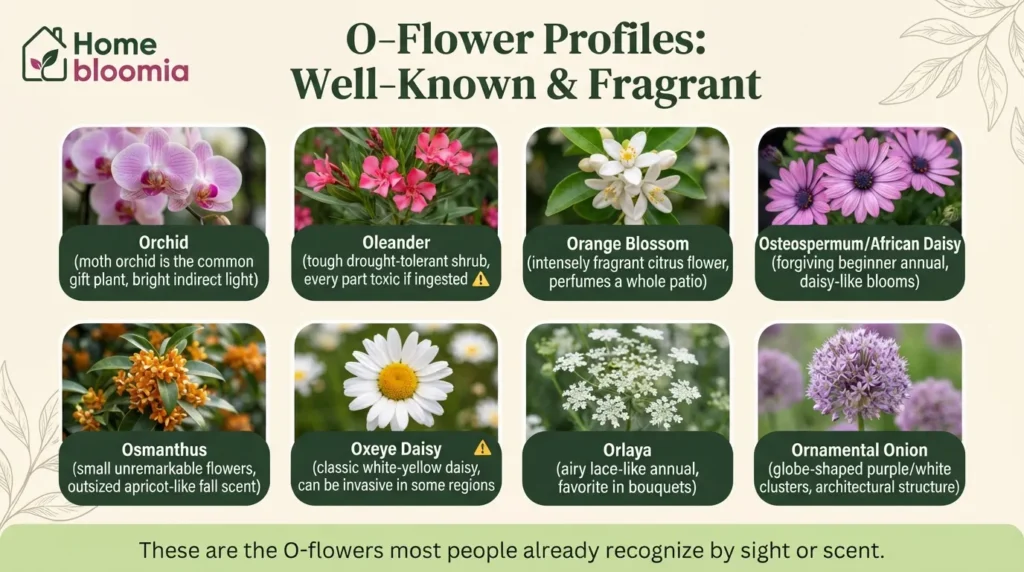
The orchid family is enormous — tens of thousands of species and hybrids — but the plant most people picture is the moth orchid (Phalaenopsis), the standard grocery-store gift plant. Orchids prefer bright, indirect light rather than direct sun, and they do best in a chunky bark-based orchid mix rather than regular potting soil, since their roots need airflow. Water when the mix has mostly dried out, typically every 7–10 days indoors, and avoid letting water sit in the crown of the plant. Rebloom can take several months of rest after flowering, so patience matters more than fussing.
Oleander (Nerium oleander)
A tough, drought-tolerant flowering shrub common in warm climates (Mediterranean gardens, the American Southwest and Gulf Coast), oleander produces clusters of pink, white, or red blooms through summer and into fall. It tolerates poor soil, heat, and salt spray, which is why it’s a common highway median and coastal planting. The serious caveat: every part of the plant is toxic if ingested, including dried leaves and stems, so it’s not a safe choice anywhere pets, livestock, or small children have access to the yard.
Orange Blossom (Citrus spp.)
The white, intensely fragrant flower of citrus trees, most associated with orange trees specifically. Orange blossom needs full sun, well-draining soil, and protection from hard frost, which limits it to warm climates or container growing that can be moved indoors for winter. The scent is strong enough that a single flowering tree can perfume an entire patio, which is why it’s a popular choice near seating areas.
Osteospermum (Osteospermum spp.)
Also called African daisy, this is one of the most forgiving flowering annuals for beginners. It produces daisy-like blooms in purple, pink, white, and yellow through spring and fall, often pausing in the hottest part of summer before picking back up. It performs best in full sun with regular but not excessive watering, and deadheading spent blooms encourages more flowers.
Oxeye Daisy (Leucanthemum vulgare)
A classic white-and-yellow daisy that naturalizes easily in meadows, roadside plantings, and cottage borders. It’s genuinely low-maintenance and tolerates poor soil, but in some regions it spreads aggressively enough to be considered invasive, worth checking local guidance before planting it loose rather than in a contained bed.
Obedient Plant (Physostegia virginiana)
Named because individual flowers on the spike can be pushed to one side and will stay there (a novelty more than a practical trait), this perennial produces upright spikes of pink, white, or purple flowers in summer. It spreads by underground rhizomes and can become assertive in loose, moist soil, so it’s often best in a bed where some spread is welcome or where it’s contained by a root barrier.
Orlaya (Orlaya grandiflora)
An airy annual with white, lace-like flower heads similar in appearance to Queen Anne’s Lace, but more refined. It’s a favorite among cut-flower growers for the texture it adds to bouquets. It prefers to be sown directly where it will grow, since it doesn’t always transplant well from seed trays.
Orange Star (Ornithogalum dubium)
A bulb that produces clusters of bright orange, star-shaped flowers in late winter to spring, a useful burst of color when little else is blooming. It does best in bright light and careful watering, since the bulbs are prone to rot in soggy conditions.
Oxalis (Oxalis spp.)
Sometimes called false shamrock, Oxalis has clover-like foliage (often deep purple in ornamental varieties) and small pink, white, or yellow flowers. It’s a popular houseplant because it’s forgiving and compact, though some outdoor species can spread more than intended in garden beds.
Orchid Cactus (Epiphyllum spp.)
Despite the name, this isn’t a true orchid — it’s an epiphytic cactus (grows on other plants or debris in the wild, not in soil) that produces large, showy flowers in spring and summer. It prefers bright but indirect light and a lighter, faster-draining mix than typical desert cacti, since it naturally grows in humid, jungle-adjacent conditions.
Evening Primrose (Oenothera spp.)
A perennial wildflower with yellow (or occasionally pink) flowers that, true to the name, often open in the evening and close by midday. It’s a good choice for informal, naturalized plantings and tolerates poor, dry soil well.
Oxlip (Primula elatior)
A soft yellow spring perennial related to the common primrose, best suited to part shade and consistently moist (but not waterlogged) soil. It struggles in hot, dry conditions, so it’s a better fit for cooler climates or shaded woodland-edge plantings.
Owl’s Clover (Castilleja/Orthocarpus spp.)
A wildflower with pink to magenta blooms, most at home in native or naturalized meadow-style plantings rather than formal beds. Performance varies significantly by region and local seed source.
Osmanthus (Osmanthus fragrans)
A fragrant flowering shrub whose small, unremarkable-looking cream-white flowers carry an outsized, apricot-like scent in fall. It’s commonly used as a hedge or near entryways specifically for the fragrance, since the blooms themselves are easy to overlook visually.
Olearia (Olearia spp.)
Sometimes called daisy bush, this shrub produces masses of small white or lavender daisy-like flowers in spring and summer. It’s popular in coastal gardens for its tolerance of salt spray and wind.
Osbeckia (Osbeckia spp.)
A tropical shrub or perennial with striking purple to pink flowers, best suited to warm, humid climates. It’s not frost-tolerant and is a less common choice outside tropical and subtropical gardens.
Ozothamnus (Ozothamnus diosmifolius)
Also known as rice flower for its tight clusters of small white or pink blooms, this shrub is popular in the cut-flower trade for its texture and long vase life.
Opium Poppy (Papaver somniferum)
An ornamental annual poppy with large, tissue-paper-like blooms in shades of pink, purple, white, and red, followed by decorative seed pods. It’s the source plant for opium alkaloids, which means its legal status varies by location, check local regulations before growing it, separate from any safety concern about ingestion.
Ornamental Onion (Allium spp.)
A bulb that produces globe-shaped clusters of small purple or white flowers on tall, leafless stems, adding strong architectural structure to a border. The foliage often yellows and fades before the flower is at its best, so it’s commonly paired with companion plants that hide the dying leaves.
Ocotillo (Fouquieria splendens)
A dramatic desert shrub with long, spiny, whip-like stems that stay bare most of the year and burst into small red-orange flowers at the tips after rain. It’s a defining plant of Southwestern xeric gardens and not suited to humid or cold climates.
Oregon Grape (Mahonia aquifolium)
A shrub with holly-like evergreen foliage and clusters of small yellow flowers in spring, followed by blue-black berries. It tolerates shade well, making it a useful choice for woodland or north-facing plantings where many flowering shrubs struggle.
Omphalodes (Omphalodes cappadocica)
A low-growing perennial with small, forget-me-not-like blue flowers in spring, best suited to part shade and moisture-retentive soil as a groundcover beneath larger shrubs or trees.
Oxypetalum (Tweedia caerulea)
A tender perennial (often grown as an annual in cooler climates) known for its unusual sky-blue flowers, a color that’s genuinely uncommon in the plant world. It typically needs staking or a support structure as it grows.
Oncidium Orchid (Oncidium spp.)
Sometimes called the “dancing lady” orchid for the shape of its blooms, this is a popular orchid genus for collectors who already have moth orchids and want variety. Sprays of smaller, often yellow-and-brown patterned flowers appear on arching stems.
Orychophragmus (Orychophragmus violaceus)
A cool-season annual with violet, four-petaled flowers, often used as an early spring filler in mixed beds since it blooms and fades relatively quickly before summer heat arrives.
Oriental Poppy (Papaver orientale)
A bold perennial poppy with large, crepe-paper flowers in orange, scarlet, salmon, and pink, typically blooming for a short but showy window in late spring. The foliage tends to die back after flowering, so it’s usually planted alongside later-blooming perennials to fill the visual gap.
Orchid Tree (Bauhinia spp.)
A flowering tree (not a true orchid) named for the orchid-like shape of its blooms, which appear in pink, white, or purple in winter and spring in warm climates. It’s grown as a specimen or courtyard tree rather than a border flower.
Oconee Bells (Shortia galacifolia)
A rare woodland perennial native to a small region of the Southeastern United States, producing white, bell-shaped flowers with a soft pink blush in spring. It requires cool, moist, humus-rich soil and light shade, conditions that are hard to replicate outside its native habitat, which is part of why it remains uncommon in general cultivation.
Ohio Spiderwort (Tradescantia ohiensis)
A native perennial with blue to violet three-petaled flowers, each lasting only a day but produced continuously through a long bloom window. It’s a good fit for prairie-style or naturalized plantings and tolerates a range of soil conditions.
Ophrys Orchid (Ophrys spp.)
A genus of terrestrial (ground-growing, not epiphytic) orchids native to Europe and the Mediterranean, notable for flowers that mimic the appearance of female insects to attract pollinators. These are specialist plants, rarely available through general nurseries, and better suited to experienced growers or collectors.
Old Man’s Beard (Clematis vitalba)
A vigorous climbing vine with small white flowers followed by feathery, beard-like seed heads that give the plant its name. It can be aggressive and, in some regions, is considered invasive, so check local guidance before planting it as a climber.
Read More Guide about different flowers like Flowers that start with E.
Types of Flowers That Start With O
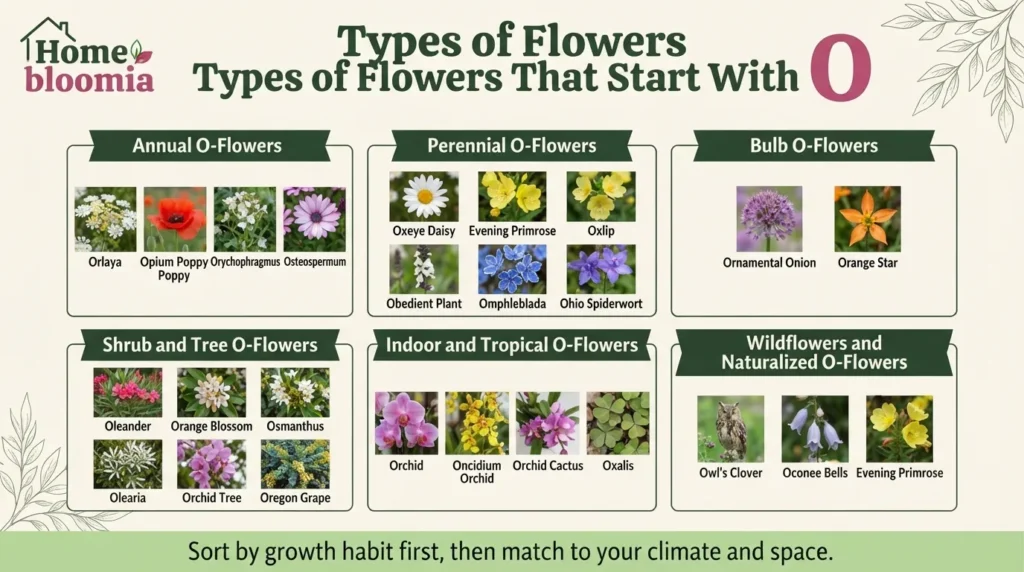
Annual O-Flowers
Fast, single-season color: Orlaya, Opium Poppy, Orychophragmus, and Osteospermum when grown as an annual.
Perennial O-Flowers
Return year after year: Oxeye Daisy, Evening Primrose, Oxlip, Obedient Plant, Omphalodes, and Ohio Spiderwort.
Bulb O-Flowers
Seasonal structure from underground storage: Ornamental Onion and Orange Star.
Shrub and Tree O-Flowers
Woody plants valued as much for structure as bloom: Oleander, Orange Blossom, Osmanthus, Olearia, Orchid Tree, and Oregon Grape.
Indoor and Tropical O-Flowers
Best suited to pots or greenhouse conditions: Orchid, Oncidium Orchid, Orchid Cactus, and Oxalis.
Wildflowers and Naturalized O-Flowers
Best in informal or native plantings: Owl’s Clover, Oconee Bells, and Evening Primrose.
O-Flowers by Color
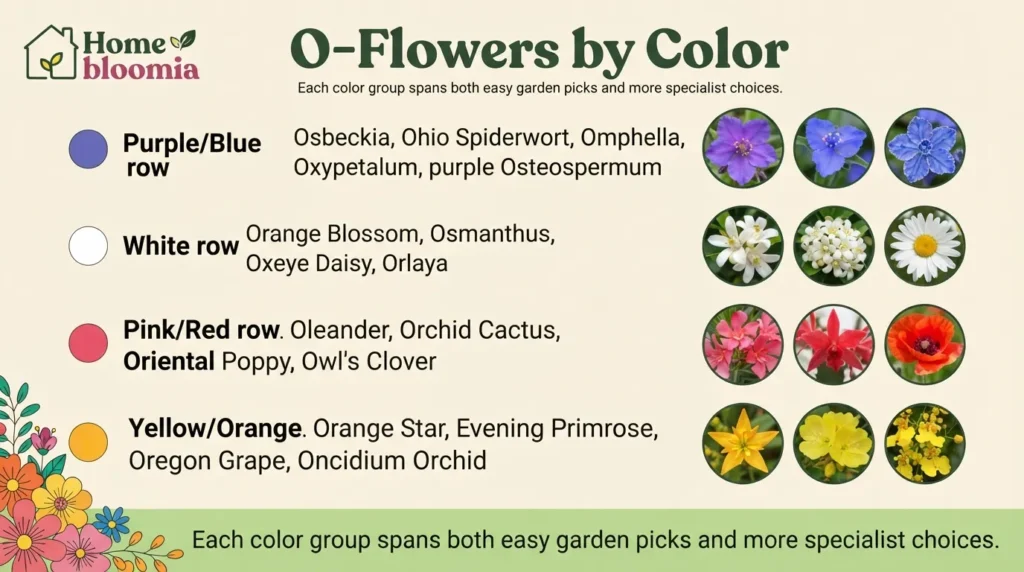
- Purple/Blue: Osbeckia, Ohio Spiderwort, Omphalodes, Oxypetalum, purple Osteospermum
- White: Orange Blossom, Osmanthus, Oxeye Daisy, Orlaya
- Pink/Red: Oleander, Orchid Cactus, Oriental Poppy, Owl’s Clover
- Yellow/Orange: Orange Star, Evening Primrose, Oregon Grape, Oncidium Orchid
Companion Planting Notes
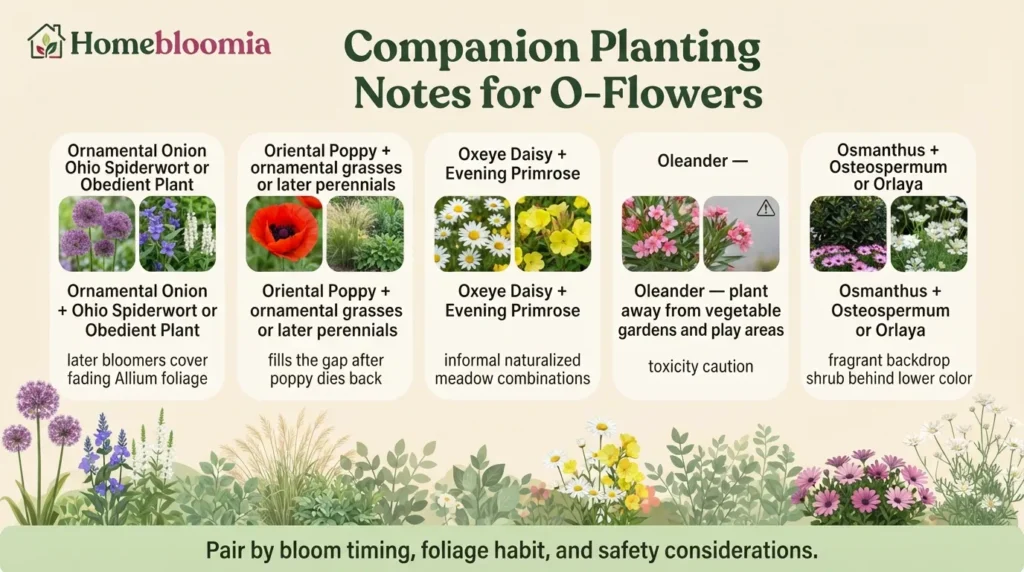
- Ornamental Onion pairs well with later-blooming perennials (like Ohio Spiderwort or Obedient Plant) that can visually cover its fading foliage after bloom.
- Oriental Poppy, which also dies back after flowering, benefits from neighboring plants with long-lasting foliage, such as ornamental grasses or later summer perennials, to fill the gap it leaves.
- Oxeye Daisy and Evening Primrose both suit informal, naturalized combinations — they read as “meadow” plants and generally look better in loose drifts with grasses than in tightly structured beds.
- Oleander, given its toxicity, is best planted away from vegetable gardens, play areas, and anywhere clippings might be composted for edible-garden use.
- Osmanthus works well as a fragrant backdrop shrub behind lower-growing color like Osteospermum or Orlaya, since its own flowers are visually unremarkable but valuable for scent.
Seasonal Care Calendar
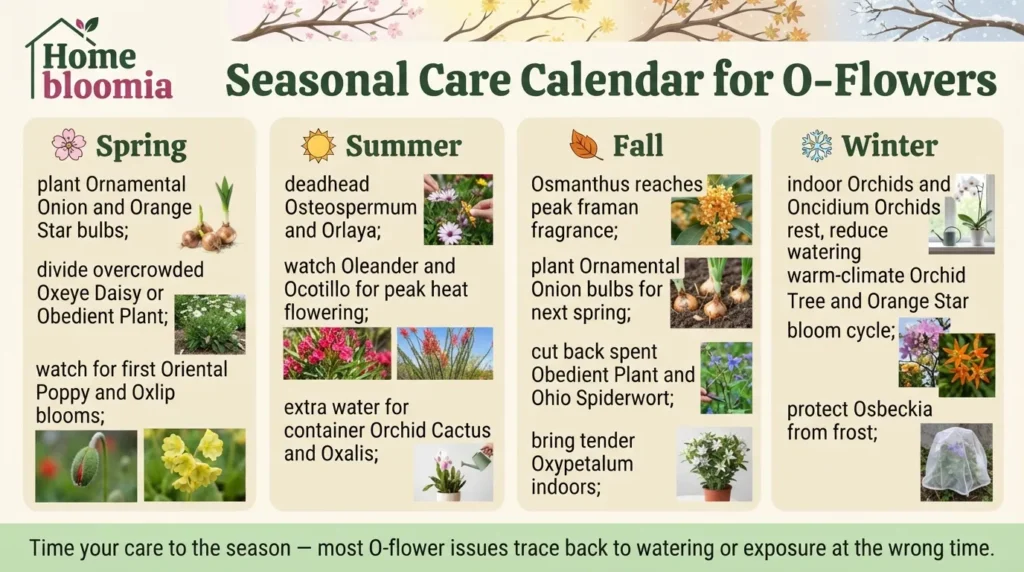
Spring: Plant summer bulbs like Ornamental Onion (if not planted in fall) and Orange Star as they finish blooming; divide overcrowded perennial clumps of Oxeye Daisy or Obedient Plant; watch for the first flush of Oriental Poppy and Oxlip.
Summer: Deadhead Osteospermum and Orlaya regularly to extend bloom; watch Oleander and Ocotillo for their peak flowering in heat; provide extra water to container-grown Orchid Cactus and Oxalis during hot stretches.
Fall: Osmanthus reaches peak fragrance; plant Ornamental Onion bulbs for next spring; cut back spent Obedient Plant and Ohio Spiderwort stems after frost; bring tender Oxypetalum indoors or treat as an annual loss in cold climates.
Winter: Indoor Orchids and Oncidium Orchids typically rest — reduce watering frequency; in warm climates, Orchid Tree and Orange Star begin their bloom cycle; protect Osbeckia and other tropical types from any frost exposure.
There are more seasonal flowers that you can see like Flowers that start with Z and Flowers that start with T.
Safety, Toxicity & Legal Notes
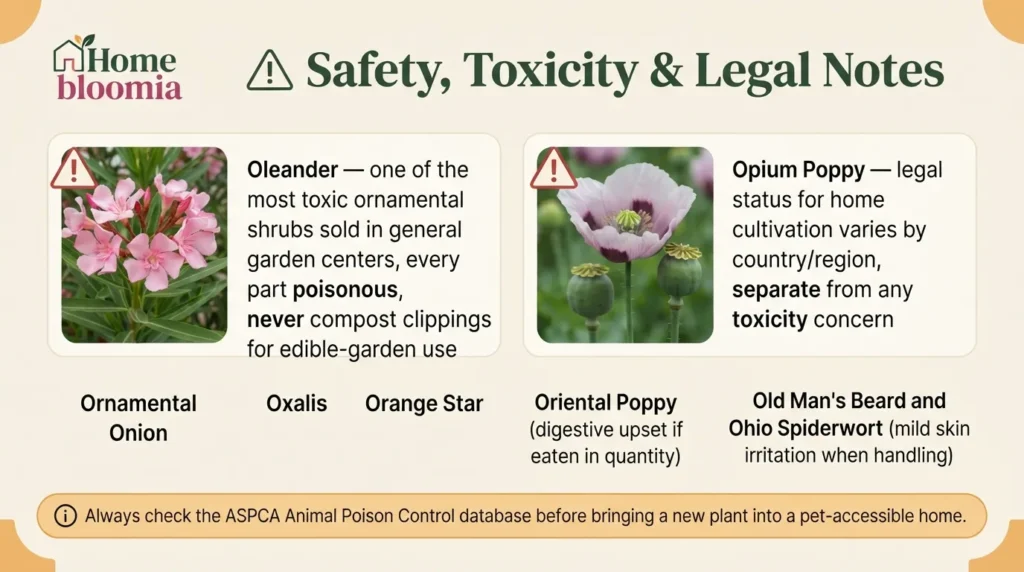
Two O-flowers deserve real caution beyond a passing mention:
- Oleander is one of the most toxic ornamental shrubs sold in general garden centers. Every part of the plant — leaves, stems, flowers, even smoke from burning trimmings — is poisonous if ingested. It should be avoided entirely in yards with pets, young children, or grazing livestock nearby, and clippings should never be composted for edible-garden use.
- Opium Poppy carries a different kind of caution: as the source plant for opium alkaloids, its legal status for home cultivation varies by country and, in some cases, by state or region. This is separate from any toxicity risk and worth checking before planting, regardless of intent.
Milder caution applies to Ornamental Onion, Oxalis, Orange Star, and Oriental Poppy, which can cause digestive upset in pets if eaten in quantity, and Old Man’s Beard and Ohio Spiderwort, which can cause mild skin irritation in sensitive individuals during handling.
Flower Meanings & Symbolism
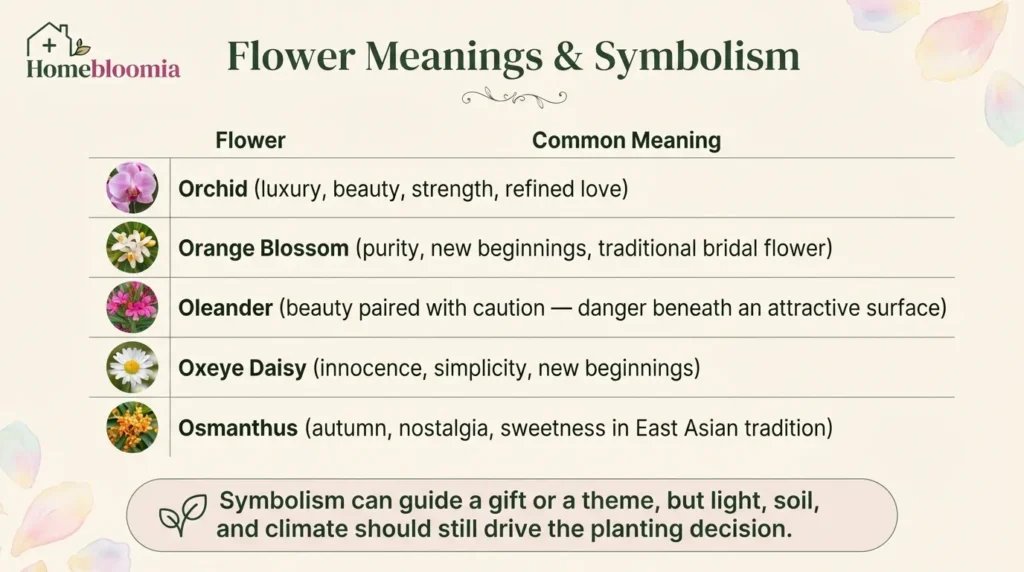
- Orchid — luxury, beauty, strength, and in some traditions, refined love
- Orange Blossom — purity and new beginnings; a traditional bridal flower in Western wedding customs
- Oleander — beauty paired with caution, sometimes used symbolically to represent danger beneath an attractive surface
- Oxeye Daisy — innocence, simplicity, and new beginnings
- Osmanthus — in East Asian tradition, associated with autumn, nostalgia, and sweetness, and used in tea and culinary contexts as well as ornamentally
Decision Helper: Which O-Flower Fits Your Space?
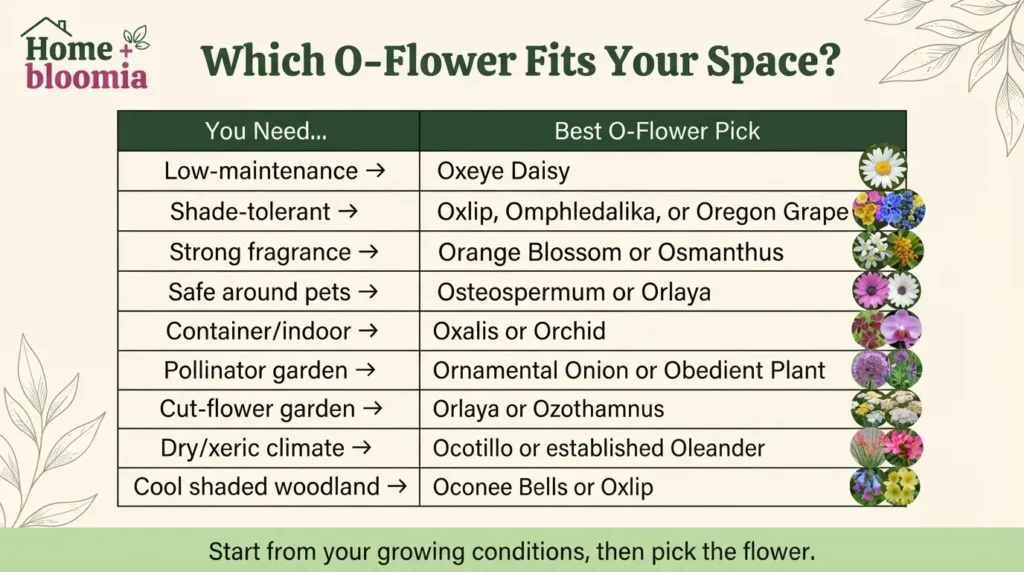
| You need… | Best O-flower pick |
|---|---|
| Low-maintenance | Oxeye Daisy |
| Shade-tolerant | Oxlip, Omphalodes, or Oregon Grape |
| Strong fragrance | Orange Blossom or Osmanthus |
| Safe around pets | Osteospermum or Orlaya |
| Container/indoor | Oxalis or Orchid |
| Pollinator garden | Ornamental Onion or Obedient Plant |
| Cut-flower garden | Orlaya or Ozothamnus |
| Dry/xeric climate | Ocotillo or established Oleander |
| Cool, shaded woodland | Oconee Bells or Oxlip |
FAQ
How many flowers start with the letter O?
Around 30–35 flowers are commonly recognized as starting with O once shrubs, bulbs, and tropical or indoor varieties are included alongside true garden flowers. This guide covers 31 of the most notable.
What is the most popular flower that starts with O?
The Orchid is by far the most widely recognized and commercially available O-flower, followed closely by Oleander (for landscaping) and Orange Blossom (for fragrance and symbolism).
Which flower starting with O is toxic to pets?
Oleander is the most seriously toxic, with every part of the plant posing a risk. Ornamental Onion, Oxalis, Orange Star, and Oriental Poppy carry milder toxicity risks and are generally a concern only if eaten in quantity.
Are there fragrant flowers that start with O?
Yes, Orange Blossom and Osmanthus are both known for strong, distinctive fragrance, and some Orchid varieties carry a light scent as well.
What’s a good beginner-friendly O-flower?
Oxeye Daisy, Osteospermum, and Orlaya are all easy to grow, tolerant of imperfect conditions, and forgiving of occasional missed watering.
What is the rarest flower starting with O?
Oconee Bells and Ophrys Orchid are both considered specialist or rare finds, more likely to be grown by dedicated collectors than found at a general nursery.
Which O-flowers are perennials that come back every year?
Oxeye Daisy, Evening Primrose, Oxlip, Obedient Plant, Omphalodes, and Ohio Spiderwort are all true perennials in the right climate zone.
Can I grow O-flowers indoors?
Yes, Orchid, Oncidium Orchid, Orchid Cactus, and Oxalis are all well-suited to indoor growing, given enough bright, indirect light.
What’s the difference between Orchid and Oncidium Orchid?
Oncidium is a specific genus within the broader orchid family. General “Orchid” most often refers to Phalaenopsis (moth orchid) in casual use, while Oncidium is a distinct genus with different growth habits and smaller, more numerous flowers per spray.
Is Opium Poppy legal to grow?
It varies significantly by country and sometimes by state or region, check local regulations before planting, separate from any consideration of toxicity.
What O-flower works best in a xeric or drought-tolerant garden?
Ocotillo and established Oleander are the strongest choices for genuinely dry, low-water landscaping.
Which O-flowers are good for pollinators?
Ornamental Onion, Obedient Plant, Evening Primrose, and Ohio Spiderwort are all reliable draws for bees and other pollinators.
Do any O-flowers bloom in winter?
In warm climates, Orchid Tree and Orange Star both bloom in winter to early spring; indoor Orchids can bloom year-round depending on species and care.
What’s the best O-flower for a cutting garden?
Orlaya and Ozothamnus are both favored by cut-flower growers for their texture and vase life, with Ornamental Onion adding structural height to arrangements.