Best Air Plants for Terrariums: 24 Best Types, Setup, Watering and Care
Air plants (Tillandsia) are the easiest way to build a clean, soil-free indoor display. They sit happily in glass bowls, open globes, hanging terrariums, wall planters, shells, and driftwood. The basic rule is simple: air plants need bright indirect light, airflow, water, and drying time. They should never be planted in soil, buried in wet moss, or left sitting in standing water.
The best air plant terrarium shows off the plant. It is not a sealed growing chamber that traps moist air around it. This guide covers 24 Best Air Plants for Terrariums , container choices, a step-by-step build, watering and drying routines, troubleshooting, lifespan and pups, and buying tips.
Quick Answer: Can Air Plants Live in Terrariums?
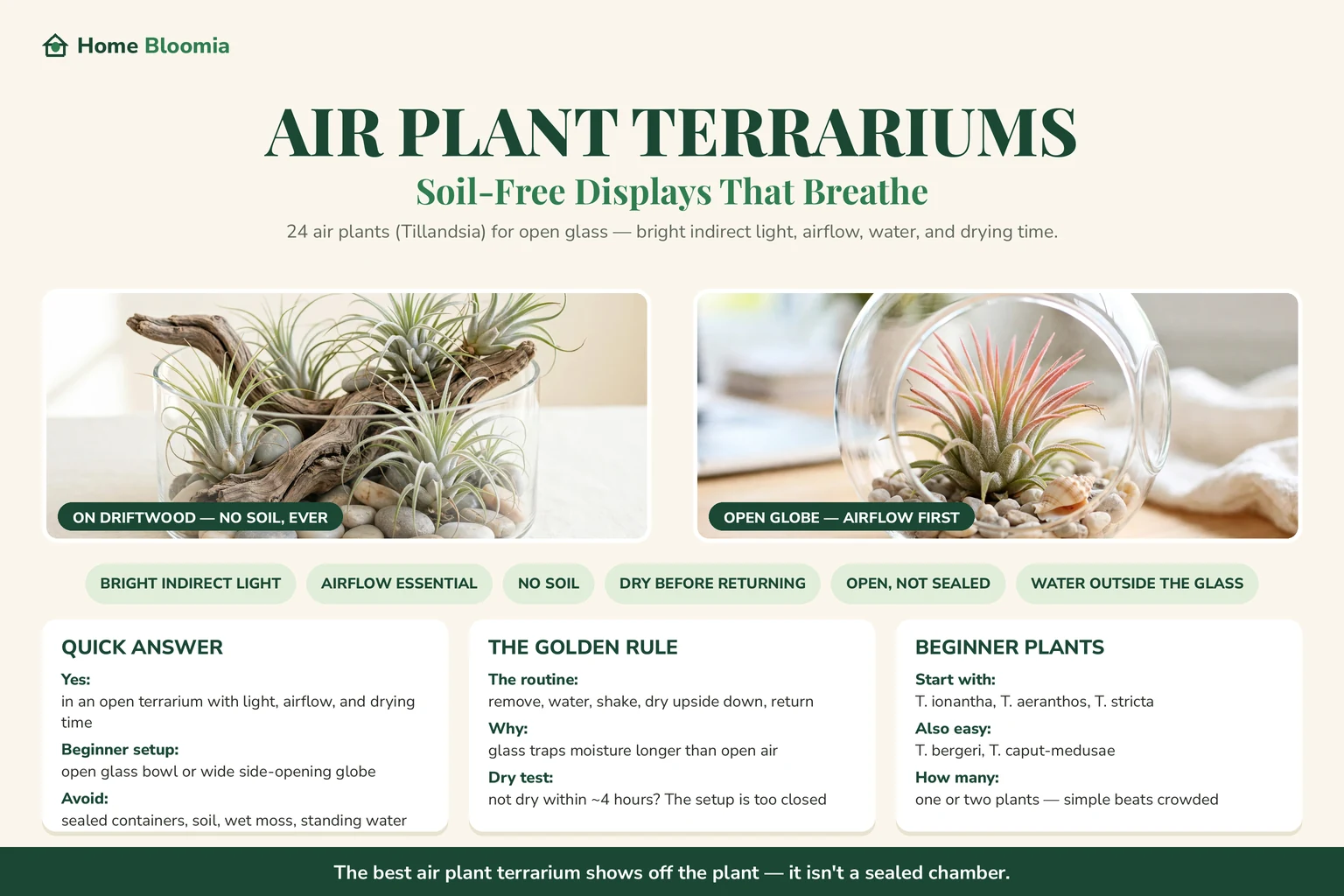
Yes, provided the terrarium has bright indirect light, good airflow, and enough drying time after watering. Open terrariums are far safer than closed ones. Place plants on dry pebbles, sand, shells, bark, or driftwood, never in soil or damp moss.
Best beginner setup
- Container: open glass bowl or wide side-opening globe
- Base: dry pebbles, shells, sand, or bark
- Plant: Tillandsia ionantha or T. aeranthos
- Watering method: remove the plant, water it, shake it, dry it upside down, then return it
- Avoid: sealed containers, soil, wet moss, and standing water
Benefits of Air Plants in Terrariums
- Clean and soil-free: no mess on tables, shelves, bathrooms, or kitchens.
- Variety of forms: small and colorful, soft, curly, silvery, or trailing.
- Flexible: plants lift out for watering, dry fully, and go back without disturbing roots or soil.
- Good for small spaces: one plant in a small globe is a complete display.
What Are Air Plants, and Why Do They Work in Terrariums?
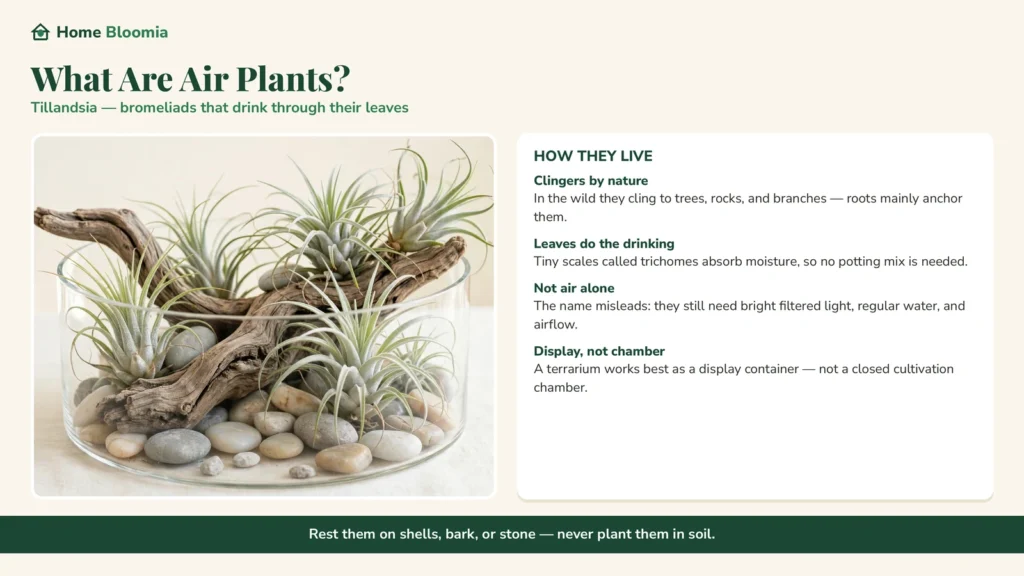
Air plants are Tillandsia, a genus of bromeliads that in nature cling to trees, rocks, and branches. Their roots mainly anchor them; the leaves absorb moisture through tiny scales called trichomes. That is why they can rest on shells, bark, or stone with no potting mix.
The name is misleading, though. Air plants don’t live on air alone. They need bright filtered light, regular water, and airflow so they dry after wetting. A terrarium works best as a display container, not a closed cultivation chamber. For a broader comparison of closed jars, open bowls, mosses, ferns, and succulents, see terrarium plants.
What Is the Best Air Plant for a Terrarium?
Choose by mature size first, display style second, and humidity fit third. Some tillandsias suit small globes; others need wide, open bowls so leaves can spread and dry.
Mesic types (greener, thinner leaves) tolerate more humidity. Xeric types (silvery, fuzzy leaves) prefer drier air and quicker drying.
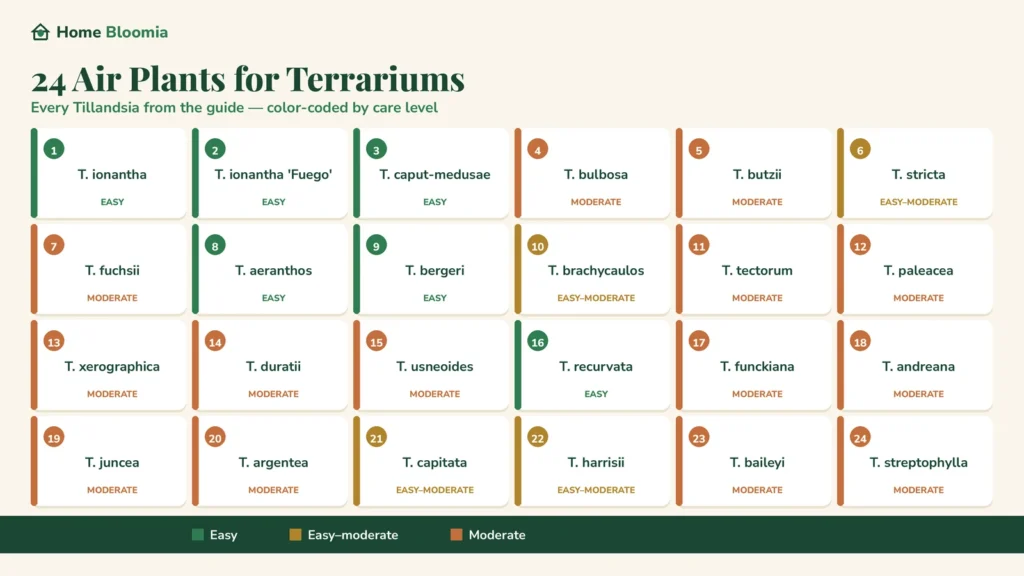
| Air Plant | Best Terrarium Use | Container Fit | Humidity Fit | Level | Care Note |
| T. ionantha | Small globes, beginner displays | Small globes, mini bowls, wall planters | Moderate | Easy | Compact; can blush red or pink in brighter light |
| T. ionantha ‘Fuego’ | Color accent | Small globes, open bowls | Moderate | Easy | Bright-red blush in good light |
| T. caput-medusae | Beach, shell, driftwood displays | Medium globes, open bowls | Moderate | Easy | Curved leaves; keep water out of the base |
| T. bulbosa | Sculptural humid displays | Open bowls, wide globes | Higher | Moderate | Bulbous base needs airflow to prevent rot |
| T. butzii | Humid displays | Wide globes, open containers | Higher | Moderate | Likes moisture, but still needs air movement |
| T. stricta | Tabletop and mixed displays | Small–medium containers | Moderate | Easy–moderate | Good texture and bloom potential |
| T. fuchsii | Mini, delicate designs | Small globes, wall planters | Moderate | Moderate | Fine leaves dry quickly |
| T. aeranthos | Simple glass displays | Small–medium open containers | Moderate | Easy | Tough and compact; good for beginners |
| T. bergeri | Clumping accent | Medium open containers | Moderate | Easy | Forms attractive clusters |
| T. brachycaulos | Color-focused displays | Open bowls, medium glass | Moderate | Easy–moderate | Strong red tones in bright indirect light |
| T. tectorum | Dry open displays | Open bowls, airy containers | Lower | Moderate | Fuzzy silver leaves want strong drying |
| T. paleacea | Silvery texture | Open bowls | Lower | Moderate | Avoid trapped water in the base |
| T. xerographica | Large centerpiece | Large open bowls only | Low–moderate | Moderate | Too large for tight globes |
| T. duratii | Dramatic curling form | Large open bowls | Lower | Moderate | Needs space; dries quickly |
| T. usneoides (Spanish moss) | Hanging accents | Open hanging displays | Moderate–higher | Moderate | Needs airflow and regular moisture |
| T. recurvata (ball moss) | Small clumps | Small open containers | Lower–moderate | Easy | Tolerant, tidy clumps |
| T. funckiana | Fine, wispy texture | Small globes, mini bowls | Moderate | Moderate | Thin leaves dry fast; check often |
| T. andreana | Tiny accent | Small globes, wall planters | Moderate–higher | Moderate | Slender, delicate; don’t let it stay dry long |
| T. juncea | Tall vertical displays | Open tall containers | Moderate | Moderate | Long leaves need space |
| T. argentea | Mini texture displays | Small globes, tiny bowls | Moderate | Moderate | Fine leaves need steady care and airflow |
| T. capitata | Statement plant | Medium–large open containers | Moderate | Easy–moderate | Works well as a focal point |
| T. harrisii | Dry, bright displays | Open bowls, airy glass | Lower | Easy–moderate | Silver leaves prefer drying between waterings |
| T. baileyi | Curved-form displays | Medium open containers | Moderate | Moderate | Avoid water sitting near the base |
| T. streptophylla | Large sculptural displays | Large open bowls | Low–moderate | Moderate | Leaf curl shifts with hydration |
Best Air Plants for Small Terrariums
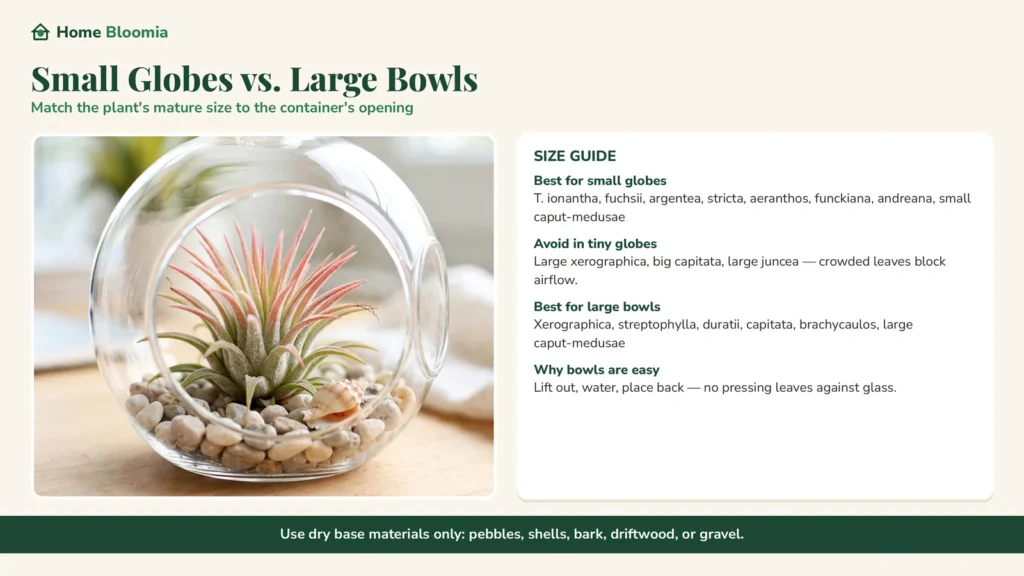
Small globes need plants that slide through the opening without damage. The best choices are T. ionantha, fuchsii, argentea, stricta, aeranthos, funckiana, andreana, and small caput-medusae. They fit in globes, mini bowls, wall planters, and desktop displays and lift out easily for watering.
Avoid large xerographica, big capitata, and large juncea in tiny globes. They look fine at first but crowded leaves block airflow and make watering harder.
Best Air Plants for Large Glass Bowls and Open Displays
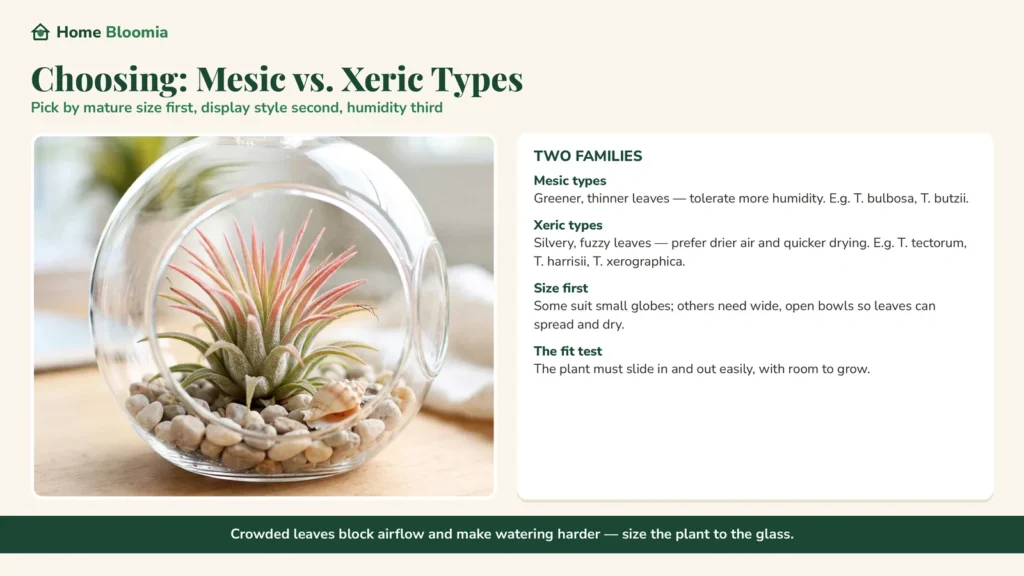
Large bowls give air plants room to spread, dry, and show their natural shape. They suit sculptural plants such as xerographica, streptophylla, duratii, capitata, brachycaulos, and large caput-medusae. A wide open bowl is one of the easiest containers to maintain: lift the plant out, water it, and place it back without pressing leaves against glass. Use dry base materials only: pebbles, shells, bark, driftwood, or gravel.
Tillandsia Ionantha vs. Xerographica
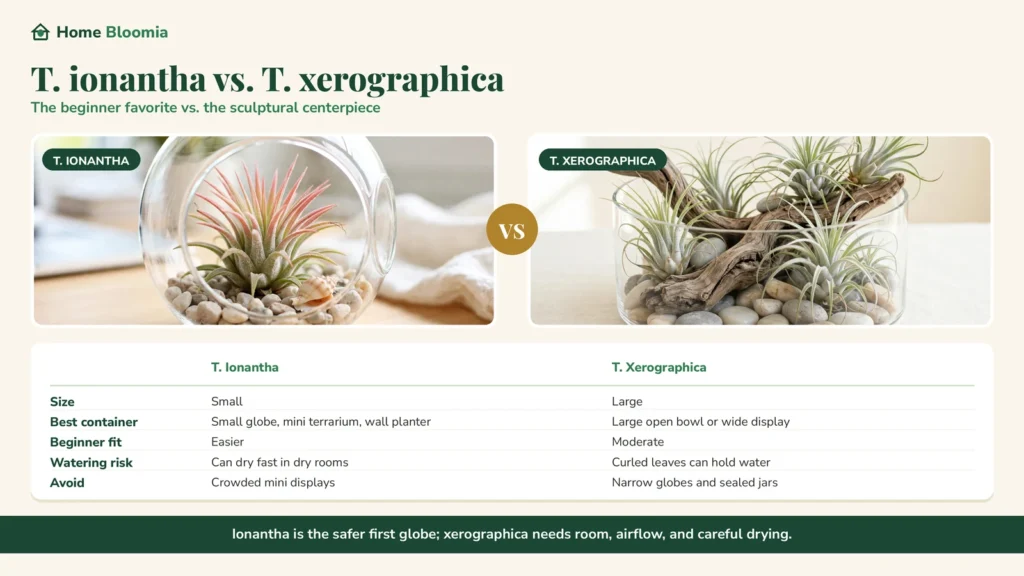
| Feature | T. ionantha | T. xerographica |
| Best container | Small glass globe, mini terrarium, wall planter | Large open bowl or wide display |
| Size | Small | Large |
| Beginner fit | Easier | Moderate |
| Watering risk | Can dry fast in dry rooms | Curled leaves can hold water |
| Best look | Compact colorful accent | Sculptural centerpiece |
| Avoid | Crowded mini displays | Narrow globes and sealed jars |
Ionantha is the safer choice for a first globe. Xerographica needs more room, better airflow, and careful drying after watering.
Open vs. Closed Terrariums for Air Plants
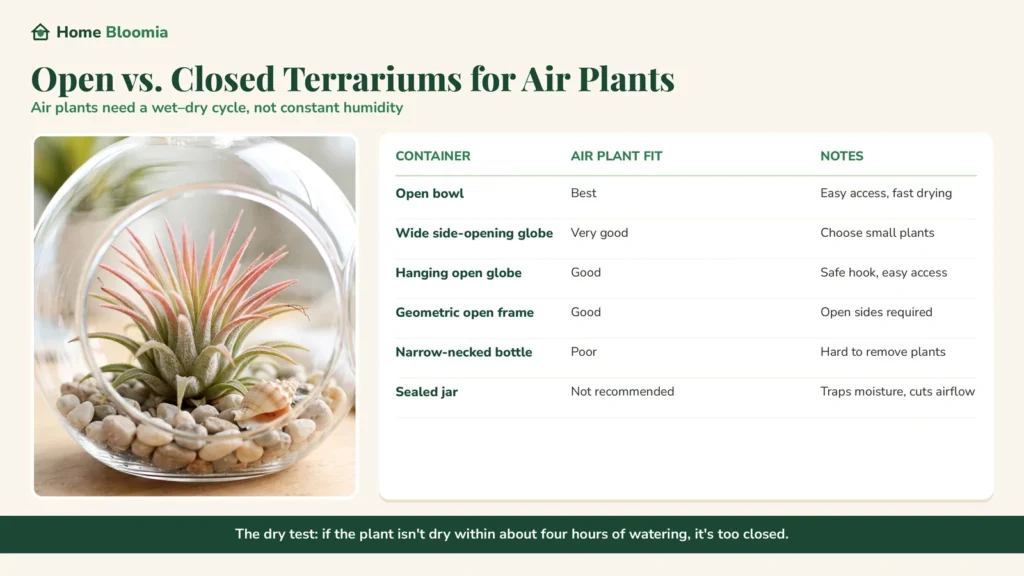
Open terrariums suit most species: more airflow, easier watering, faster drying. Partly enclosed ones can work for humidity-tolerant (mesic) types, but need extra attention and frequent opening. Fully sealed terrariums aren’t recommended: they trap moisture, cut airflow, and raise the risk of mold and rot. Air plants need a wet-dry cycle, not constant humidity.
A simple test: if the plant doesn’t dry within a few hours of watering (up to about four hours in a typical room), the container is too closed or the room too humid.
| Container | Air Plant Fit | Notes |
| Open bowl | Best | Easy access, fast drying |
| Wide side-opening globe | Very good | Choose small plants |
| Hanging open globe | Good | Needs a safe hook and easy access |
| Geometric open frame | Good | Open sides required |
| Narrow-necked bottle | Poor | Hard to remove plants |
| Sealed jar | Not recommended | Traps moisture |
Best Air Plant Containers
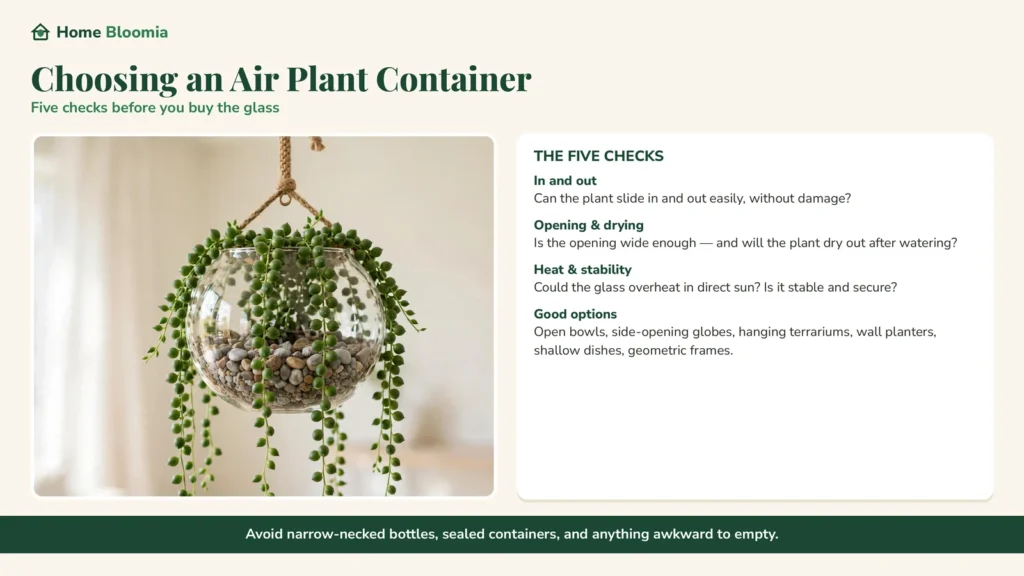
Check five things before choosing:
- Can the plant slide in and out easily?
- Is the opening wide enough?
- Will it dry out after watering?
- Could the glass overheat in direct sun?
- Is the container stable and secure?
Good options: open glass bowls, side-opening globes, hanging terrariums, wall planters, shallow dishes, and geometric frames. Avoid narrow-necked bottles, sealed containers, and anything awkward to remove.
Air Plants in Glass Globes
Globes are popular because they’re simple, light, and easy to hang or place on a desk. Use small tillandsia, with a wide side opening. Place dry sand, pebbles, gravel, shells, or driftwood inside, and rest the plant on top rather than burying the base. Water outside the globe and return the plant only after it’s dry.
Hanging Air Plant Terrariums
Hanging terrariums save shelf space and suit bright spots. Choose ones that are easy to take down for watering, keep them away from heating vents and hot windows, and use secure hooks. Small plants such as ionantha, aeranthos, stricta, fuchsii, and argentea work best.
Glass Bowl vs. Hanging Terrarium
Glass bowls are sturdy, open, and accessible, so they suit beginners. Hanging terrariums add height and drama but are harder to reach and monitor. Either works when the plant gets light, airflow, and drying time.
Quick Container Match
- Glass bowls: best for beginners and larger plants
- Glass globes: small plants and desk displays
- Hanging terrariums: bright spaces with vertical room
- Wall planters: small plants on reachable walls
- Geometric frames: modern open displays
What to Put in an Air Plant Terrarium
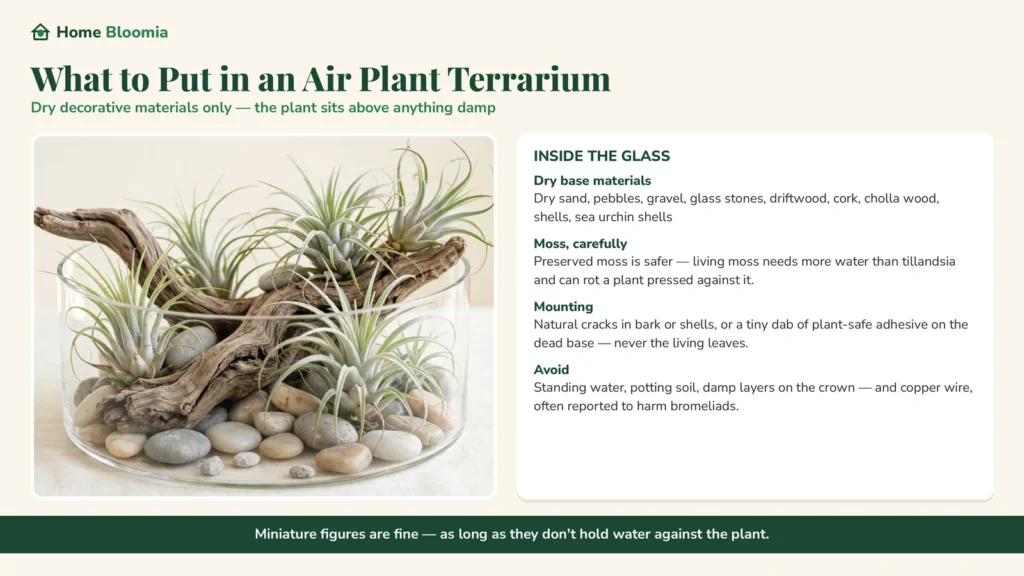
Use dry decorative materials, not soil: dry sand, pebbles, gravel, glass stones, driftwood, cork, cholla wood, shells, sea urchin shells, and preserved moss. Miniature figures are fine if they don’t hold water against the plant.
Build the display so the plant sits above anything that could hold moisture. Preserved moss is safer than living moss, which needs more water than tillandsia and can rot a plant pressed against it. If mounting is needed, use natural cracks in bark or shells, or a tiny dab of plant-safe adhesive on the dead base, never the living leaves. Avoid standing water, potting soil, and damp layers touching the base or crown. Copper wire is commonly advised against, since copper is often reported to harm bromeliads.
DIY Air Plant Terrarium: Step by Step
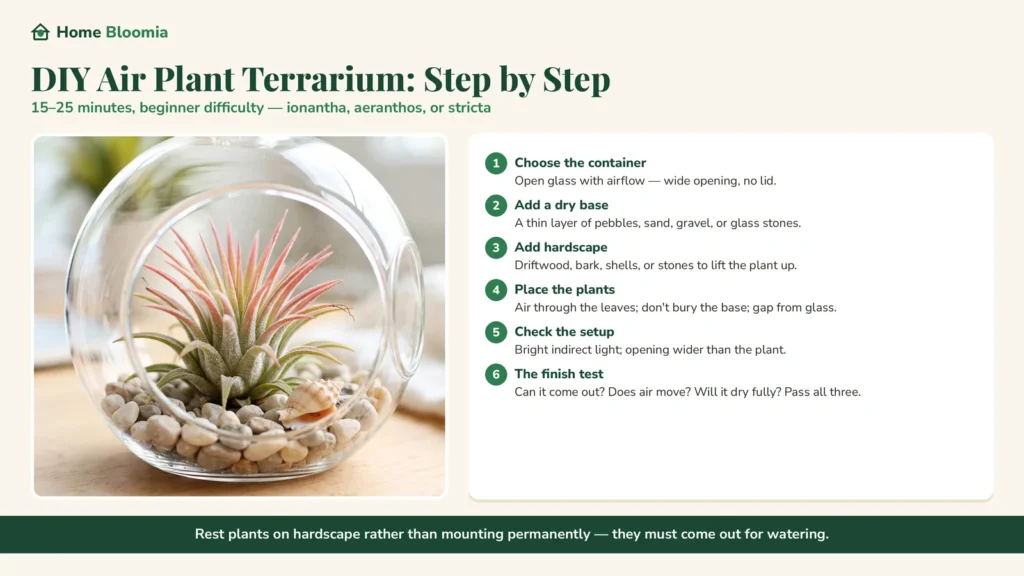
Project snapshot: 15–25 minutes, beginner difficulty, open glass bowl or wide globe, best plants ionantha, aeranthos, and stricta. The main risk is trapped water.
Materials: open glass container, one to five air plants, sand/gravel/pebbles, shells/driftwood/bark/stones, optional preserved moss, spray bottle or water jug, soft cloth, optional plant-safe adhesive or fishing line.
- Choose a container with airflow. Wide, open, no lid.
- Add a dry base. A thin layer of pebbles, sand, gravel, or glass stones. Keep it thin in small globes so it doesn’t crowd the plant.
- Add driftwood, bark, shells, or stones. These give structure and lift the plant above the base. Prefer resting plants on hardscape to permanent mounting, since you’ll need to remove them for watering.
- Place the air plants. Let air move through the leaves, don’t bury the base, and leave a gap between plant and glass.
- Check light, airflow, and access. Bright indirect light, an opening larger than the plant’s widest part, and room to grow.
Before calling it finished, ask: Can the plant come out? Does air move around it? Will it dry fully after watering? A good setup passes all three.
Air Plant Care for Terrariums
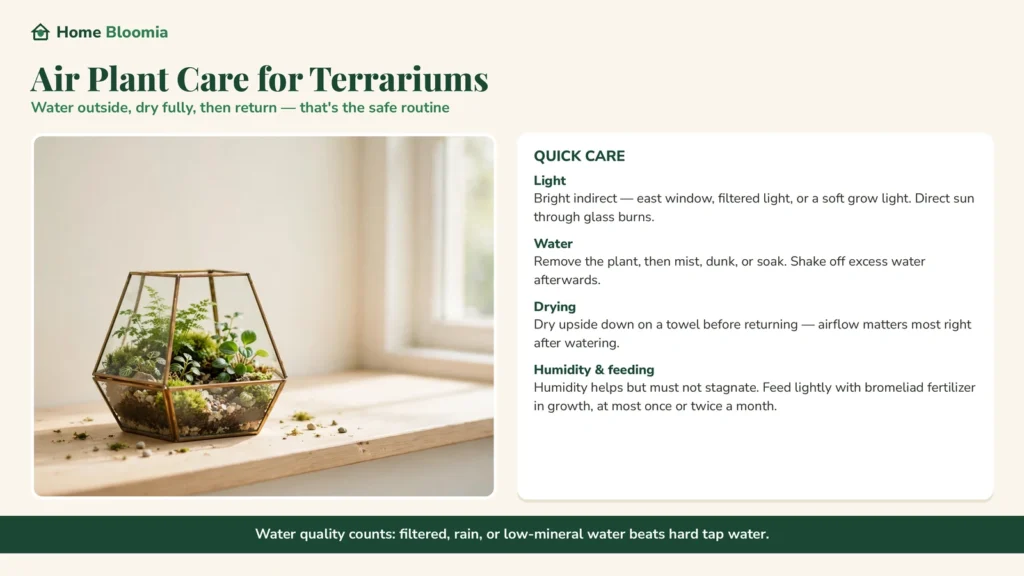
Glass changes the moisture and heat around the plant: water stays trapped longer and sun through glass can be intense. The safest routine is to water outside the terrarium, dry fully, then return the plant.
Quick Care
- Light: bright indirect
- Water: remove, then mist, dunk, or soak
- Drying: upside down before returning
- Humidity: helpful, not stagnant
- Airflow: essential after watering
- Fertilizer: light and occasional
Light
Bright indirect light: an east-facing window, a filtered window, or a soft grow light. Avoid direct sun through glass, which heats the container and burns leaves. Low light is tolerable briefly but not for long-term health.
Watering
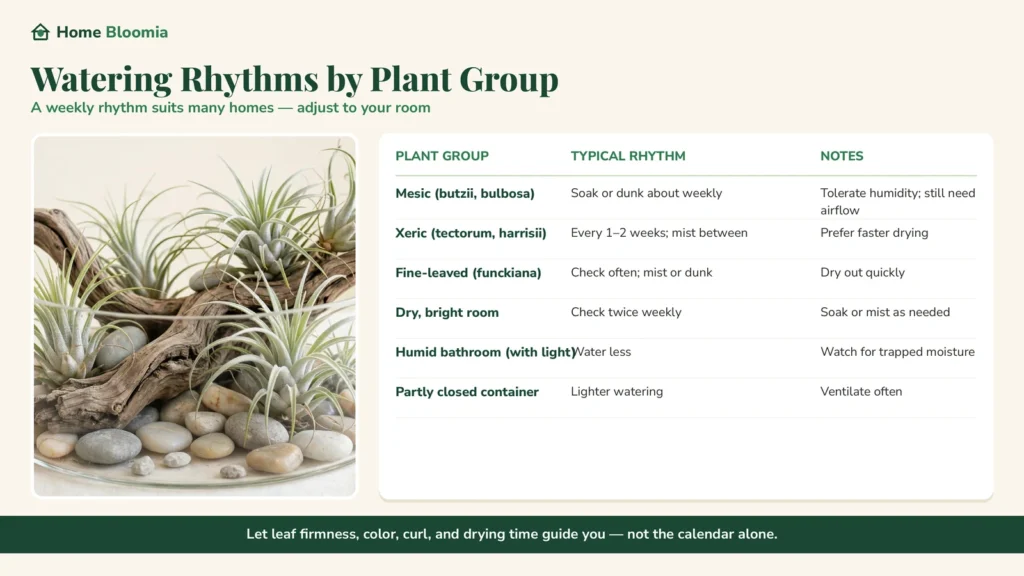
Most air plants should be removed before watering. After soaking or dunking, shake off excess water and dry upside down on a towel. A weekly rhythm works for many homes but should be adjusted: dry, warm, bright rooms need more; humid rooms need less.
| Plant Group | Typical Rhythm | Notes |
| Mesic (green, thin leaves; e.g. butzii, bulbosa) | Soak or dunk about weekly | Tolerate more humidity; still need airflow |
| Xeric (silver, fuzzy; e.g. tectorum, harrisii, xerographica) | Soak or dunk every 1–2 weeks; mist between | Prefer faster drying |
| Fine-leaved (funckiana, andreana, fuchsii) | Check often; mist or dunk as needed | Dry out quickly |
| Room Condition | Adjustment |
| Dry, bright room | Check twice weekly; soak or mist as needed |
| Humid bathroom with light | Water less; watch for trapped moisture |
| Small glass globe | Remove plant for watering; dry fully |
| Large open bowl | Easier, safer drying |
| Partly closed container | Lighter watering; ventilate often |
Humidity
Air plants like some humidity, but humidity is not wetness. Mesic varieties (butzii, bulbosa) handle more moisture than xeric silver types (tectorum, harrisii, xerographica). Humid-tolerant plants still need airflow. Bathrooms work only with good natural light and ventilation; humidity can’t substitute for brightness.
Water Quality
Filtered, rain, or low-mineral water is generally better than hard tap water, which can leave white mineral marks on glass and leaves. If your tap water is heavily chlorinated, let it sit before use. Avoid softened water high in salt. Good water won’t fix poor light or airflow, but it helps produce healthier leaves over time.
Airflow
Airflow dries plants after watering and reduces mold and rot. Wide globes, open containers, and open frames allow more than sealed ones. It matters most right after watering, especially for bulbosa and caput-medusae, which hide water near the base.
Temperature
Normal indoor temperatures suit most air plants. Keep them away from cold drafts, heating and AC vents, and hot glass. If a container feels hot to the touch, move it.
Fertilizer
Feed lightly with diluted bromeliad or air plant fertilizer during active growth, perhaps once or twice a month at most. Don’t use ordinary houseplant fertilizer unless it’s labeled safe for air plants, and don’t use fertilizer to make up for poor light or watering.
Misting vs. Soaking
- Misting: light hydration between deeper waterings. Use carefully inside the terrarium, since too much mist wets the base material and leaves water spots.
- Dunking: a middle option that wets leaves more than misting.
- Soaking: stronger hydration when leaves are dry or curled. Do this outside the container.
The safest flow: remove the plant, water it, shake it, dry it upside down, return it. Adjust by season: warm, dry months need more; cool or humid months need less. Let leaf firmness, color, curl, and drying time guide the routine.
Where to Place an Air Plant Terrarium
Near a window with bright indirect light and gentle air movement: an east-facing window, a filtered west window, a desk near a window, or a bright kitchen. Avoid dark shelves, closed cabinets, hot direct sun, heater vents, AC vents, and overheated glass. Bathrooms work only if they have natural light and airflow. Grow lights help in dim spaces. For placement ideas based on balance and room flow, see feng shui plants.
Air Plant Terrarium Ideas
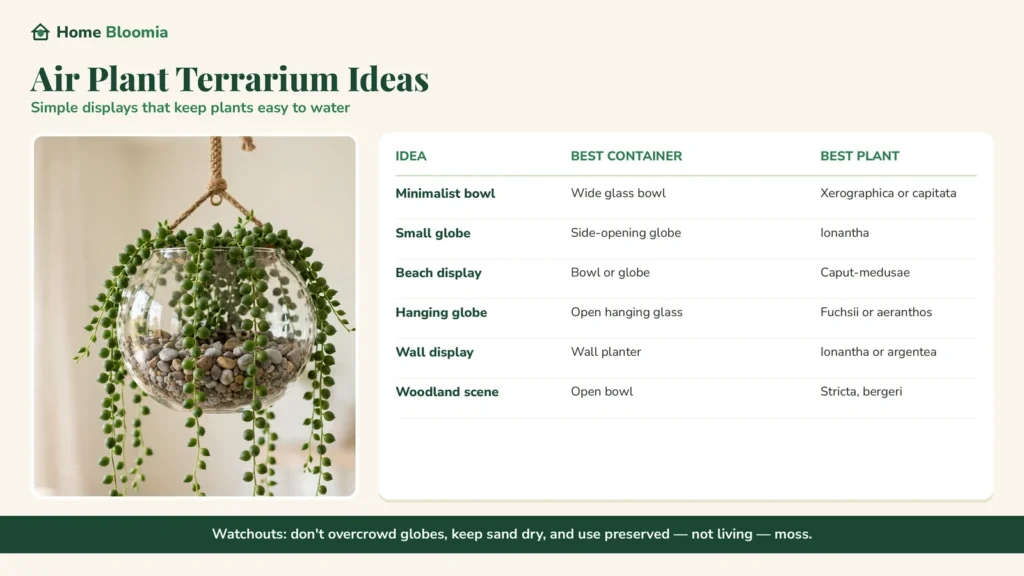
| Idea | Best Container | Best Plant | Skill Level | Main Watchout |
| Minimalist bowl | Wide glass bowl | Xerographica or capitata | Beginner | Avoid direct sun |
| Small globe | Side-opening globe | Ionantha | Beginner | Don’t overcrowd |
| Beach display | Bowl or globe | Caput-medusae | Beginner | Keep sand dry |
| Hanging globe | Open hanging glass | Fuchsii or aeranthos | Moderate | Needs easy access |
| Wall display | Wall planter | Ionantha or argentea | Moderate | Needs a bright location |
| Woodland scene | Open bowl | Stricta, bergeri | Beginner | Use preserved, not living, moss |
Beach-Themed Terrarium
Dried sand, shells, driftwood, and sea glass with two or three air plants. Caput-medusae suits shell displays. Rest plants on a shell or raised stone rather than burying them in sand, and keep the sand dry.
Hanging Glass Ideas
One ionantha in a globe looks neat and is easier to maintain than a crowded display. Use secure hooks and lightweight materials, and keep globes out of harsh direct light.
Wall Terrarium Ideas
Small plants mounted on cork bark or glass work well in bright rooms. Use ionantha, fuchsii, argentea, or aeranthos, and keep the plant removable even if it looks permanent.
Beginner Ideas
Single-plant bowls are the easiest. Try a tabletop piece with driftwood or shells, a mini globe, or a geometric open frame. Seasonal fillers such as dried pinecones, preserved moss, shells, and small stones can change the look without touching the plants. Avoid damp natural material that can mold. For flowers to pair with these displays in a room, see flowers that start with C.
Air Plants in Vivariums and Bioactive Terrariums
Air plants can add naturalistic décor to vivariums, mounted on vines, bark, cork, or branches above the wet substrate. The main challenge is moisture control: enclosure misting can leave tillandsia too wet when airflow is poor. Mounted plants shouldn’t sit on damp substrate or stay wet all day, and mounting should be secure and avoid unsafe adhesives. Animal habitats and home displays have different needs, so enclosure safety and animal health come first.
Air Plants vs. Moss, Succulents, and Artificial Plants
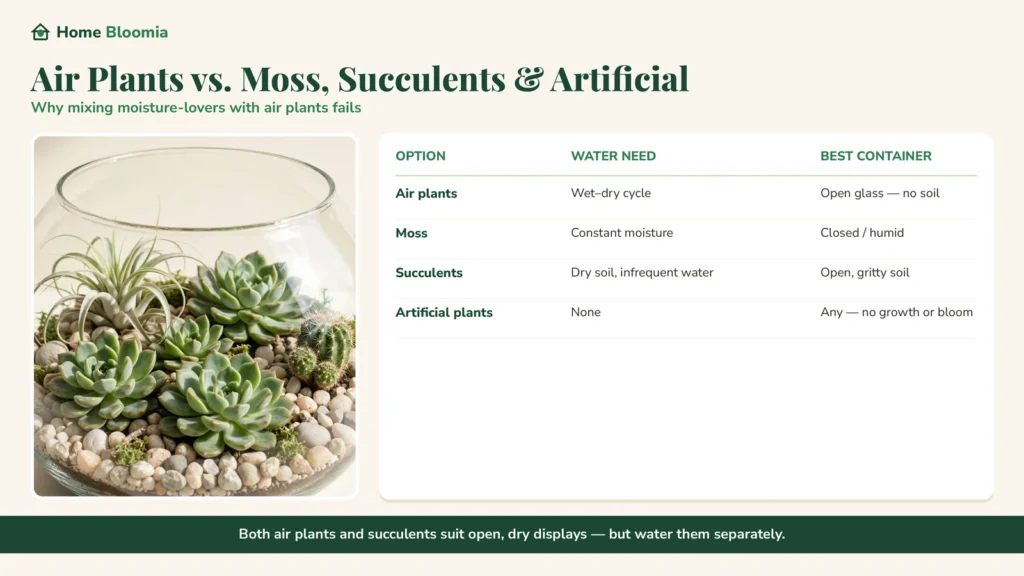
| Option | Water Need | Light | Best Container | Notes |
| Air plants | Wet-dry cycle | Bright indirect | Open | No soil |
| Moss | Constant moisture | Low–medium | Closed/humid | Can rot air plants if pressed against them |
| Succulents | Dry soil, infrequent water | Bright | Open | Use gritty soil |
| Artificial plants | None | None | Any | No growth or bloom |
- Air plants vs. moss: moss wants steady water; air plants want moisture followed by drying. Preserved moss is safest in air plant displays. If you mix, keep tillandsia above the damp area.
- Air plants vs. succulents: both suit open, dry displays, but succulents root in gritty soil while air plants don’t use soil. Water them separately. See succulents for terrariums.
- Real vs. artificial: real air plants grow, change color, bloom, and produce pups. Artificial ones suit dark rooms or sealed decor with no care at all.
Air Plant Terrarium Kit vs. DIY
Kits are convenient for beginners. DIY gives better control over container size, plant type, hardscape, color theme, and access.
A good kit includes: a ventilated container, labeled air plants, dry base material, clear watering instructions, an opening large enough to remove plants, and no wet moss packed around the plants. Avoid kits with tiny sealed containers, unlabeled plants, or no care instructions.
Common Mistakes With Air Plant Terrariums
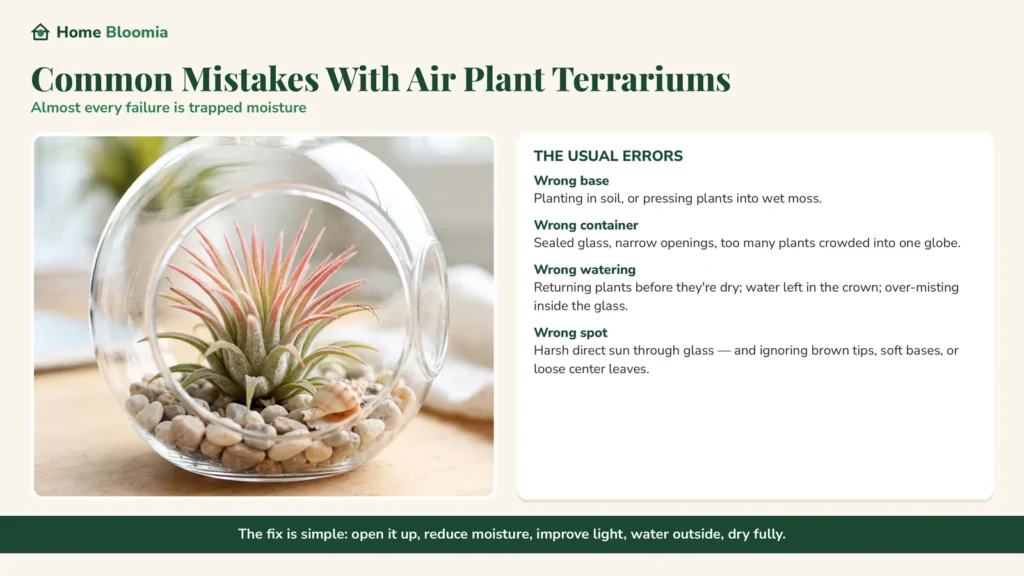
- Planting air plants in soil instead of resting them on dry materials
- Using sealed containers with no airflow
- Crowding too many plants into one globe
- Returning plants before they’re dry
- Pressing plants into wet moss
- Leaving water in the crown or base
- Placing glass in harsh direct sun
- Using a container with a narrow opening
- Over-misting inside the glass
- Ignoring brown tips, soft bases, or loose center leaves
The usual fix is simple: open the container, reduce trapped moisture, improve light, water outside the glass, and dry fully.
Troubleshooting
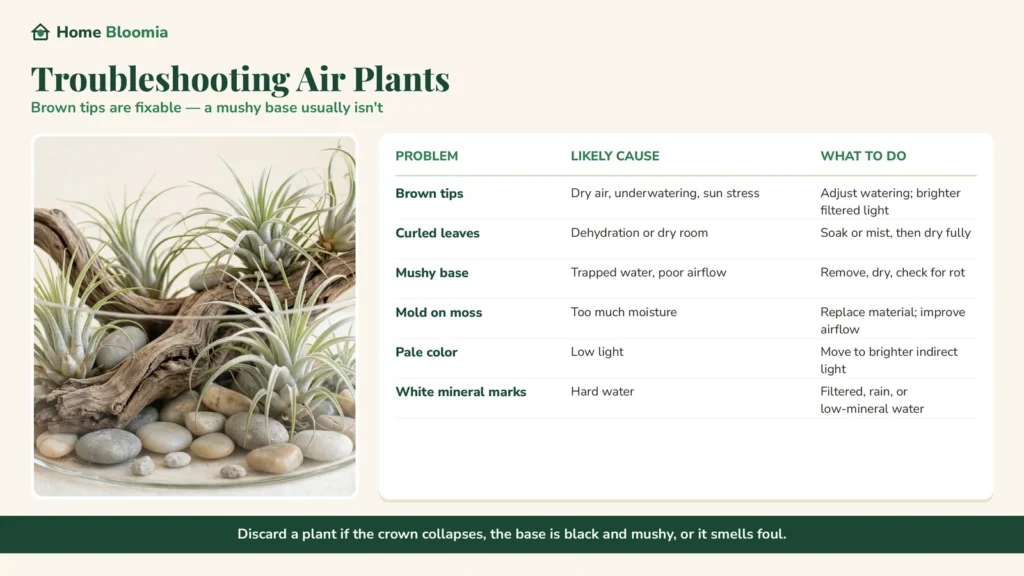
| Problem | Likely Cause | What to Do |
| Brown tips | Dry air, underwatering, or sun stress | Adjust watering; move to brighter filtered light |
| Curled leaves | Dehydration or dry room | Soak or mist properly, then dry fully |
| Mushy base | Trapped water or poor airflow | Remove, dry, and check for rot |
| Loose center leaves | Advanced rot | Inspect the crown; discard if the base collapses |
| Mold on moss | Too much moisture | Replace wet material; improve airflow |
| Pale color | Low light | Move to brighter indirect light |
| Burn marks | Hot direct sun through glass | Move away from harsh sun |
| White mineral marks | Hard water | Use filtered, rain, or low-mineral water |
| Mealybugs | Pest infestation | Isolate the plant; treat gently |
| Scale insects | Pest infestation | Remove carefully and monitor new growth |
| No growth | Low light, weak watering, or stress | Improve light and the watering/drying rhythm |
A soft or foul-smelling base is more serious than brown tips. Discard a plant if the crown collapses, the base is black and mushy, it smells foul, or the center leaves pull out easily.
Air Plant Lifespan and Pups
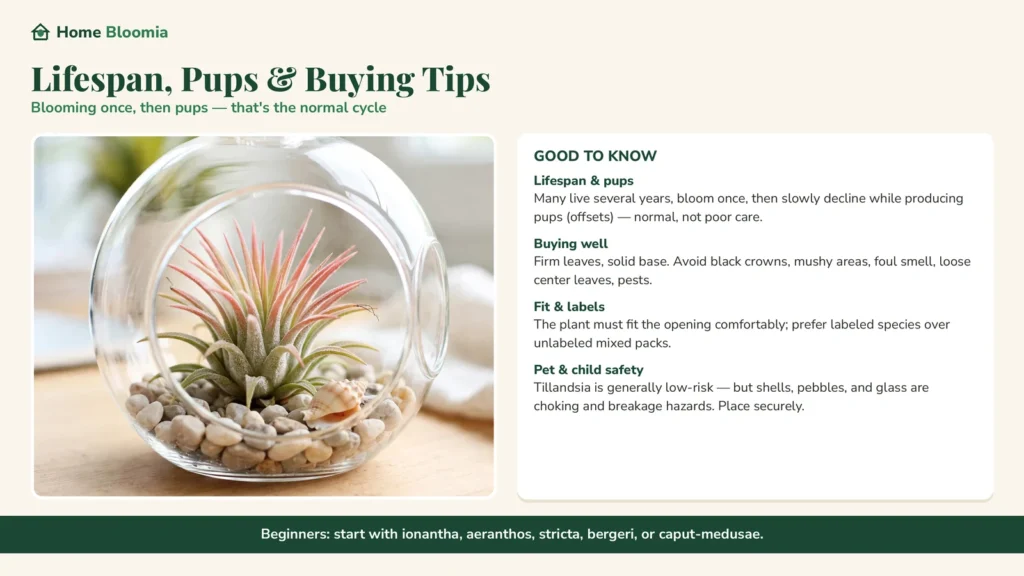
With good care, many air plants live for several years in open glass displays, though lifespan varies by species and conditions. Many tillandsia bloom once and then slowly decline while producing pups (offsets). This is a normal life cycle, not necessarily poor care. Pups can grow into new plants; wait until they’re large enough to handle safely before separating them. A terrarium doesn’t change this cycle, and replacing plants is normal in a decorative display.
Pet and Child Safety
Tillandsia is generally considered low-risk for pets, but plant safety depends on species and the amount chewed, so check the ASPCA database for specifics. The bigger concerns are small items: shells, glass pieces, and pebbles can be choking hazards, and glass globes can break. Hang or place displays securely and out of reach.
Buying Tips
- Choose plants with firm leaves and a solid base.
- Avoid black crowns, mushy areas, foul smell, loose center leaves, or visible pests.
- Pick plants that fit the container opening comfortably.
- Prefer labeled species, since size, humidity needs, and drying preferences are clearer.
- Avoid unlabeled mixed packs for small containers.
- Beginners should start with ionantha, aeranthos, stricta, bergeri, or caput-medusae before trying larger or more sensitive types.
Conclusion
Air plants can grow well in terrariums when the setup offers airflow, bright indirect light, and proper drying. The safest beginner choice is an open glass container with dry materials and compact tillandsia. Water outside the terrarium when possible, shake off excess moisture, and return the plant only after it dries. Start with one or two beginner-friendly plants before building a larger display, since a simple open terrarium is easier to maintain than a crowded sealed one.
FAQs
What are air plants for terrariums?
Tillandsia species (bromeliads) that absorb water through their leaves and need no soil, displayed in open glass containers.
Can air plants live in a closed terrarium?
It isn’t recommended. Closed glass traps moisture and reduces airflow, raising the risk of mold and rot.
How often should I water air plants?
About weekly for many homes, adjusted for light, warmth, and humidity. Dry, bright rooms need more; humid rooms need less.
Do air plants need sunlight in terrariums?
They need bright indirect light, not hot direct sun through glass, which can overheat the container and burn leaves.
Do air plants need soil in terrariums?
No. Rest them on dry pebbles, sand, shells, bark, or driftwood.
Can you mist air plants instead of soaking?
Yes for light hydration between waterings, but soaking or dunking outside the terrarium gives deeper watering and is usually safer for the container.
How do I build a terrarium for air plants?
Choose an open container, add a thin dry base, add hardscape such as shells or driftwood, rest the plants on top, and place it in bright indirect light.
Why are my air plants turning brown in a terrarium?
Common causes are dry air, underwatering, sun stress through glass, or rot from trapped water. Check the base: brown tips are fixable, a mushy base is not.
Are air plants good for beginners?
Yes, especially ionantha, aeranthos, stricta, and caput-medusae in an open container.
Can air plants clean the air in terrariums?
There’s no good evidence that a few small air plants meaningfully purify indoor air. Choose them for their appearance and low-mess care.
How do air plants survive in terrariums?
By absorbing water through their leaves, using light and airflow, and drying between waterings, which an open container allows.
How do I set up an air plant terrarium step by step?
Pick an open container, add a dry base, add driftwood or shells, place the plants, and check light, airflow, and access. See the step-by-step section above.
What are the best low-light air plants for terrariums?
No air plant thrives in true low light. T. aeranthos, ionantha, and stricta tolerate dimmer conditions better than most, but they still need bright indirect light or a grow light.
Which air plants need less humidity?
Silvery, fuzzy xeric types such as tectorum, harrisii, xerographica, paleacea, and duratii prefer drier air and quicker drying.