60 Flowers That Start With L: Full Guide, Types & Care
Quick Answer: Flowers starting with L include Lavender, Lilac, Lily, Lily of the Valley, Lobelia, Lotus, Larkspur, Lantana, Lisianthus, Liatris, Lunaria, Lupine, Linaria, Lewisia, and Lobster Claw. These cover fragrant spring bloomers, summer border flowers, container plants, orchids, aquatic flowers, rock-garden plants, and tropical specialties.
Flowers starting with L include some of the most familiar names in gardening, Lavender, Lily, Lilac, Lotus, Lobelia, Larkspur, Lantana, Lisianthus, Liatris, and Lupine are all garden-center staples. The letter also reaches into less common territory: Lechenaultia, Lewisia, Lycoris, Lady’s Slipper orchids, Lachenalia, and Lobster Claw give it real range beyond the obvious names.
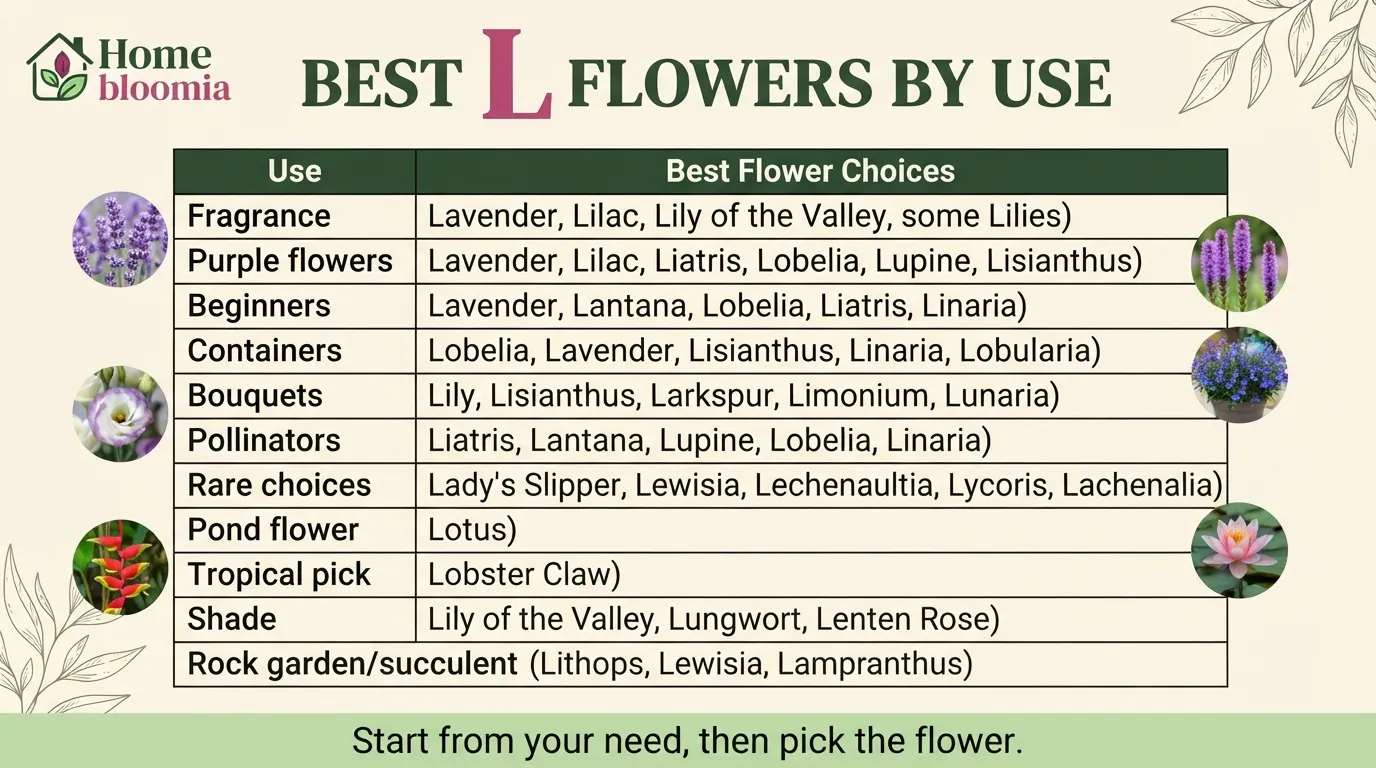
Best L Flowers by Use
| Use | Best Flower Choices |
| Fragrance | Lavender, Lilac, Lily of the Valley, some Lilies |
| Purple flowers | Lavender, Lilac, Liatris, Lobelia, Lupine, Lisianthus |
| Beginners | Lavender, Lantana, Lobelia, Liatris, Linaria |
| Containers | Lobelia, Lavender, Lisianthus, Linaria, Lobularia |
| Bouquets | Lily, Lisianthus, Larkspur, Limonium, Lunaria |
| Pollinators | Liatris, Lantana, Lupine, Lobelia, Linaria |
| Rare choices | Lady’s Slipper, Lewisia, Lechenaultia, Lycoris, Lachenalia |
| Pond flower | Lotus |
| Tropical pick | Lobster Claw |
| Shade | Lily of the Valley, Lungwort, Lenten Rose |
| Rock garden/succulent | Lithops, Lewisia, Lampranthus |
For more strong bouquet, border, and color choices, see Flowers That Start With Z.
60 Flower Names With L — Full Table
| # | Common Name | Botanical Name | Main Color | Plant Type | Best Use |
| 1 | Laburnum | Laburnum | Yellow | Flowering tree | Spring flower chains |
| 2 | Lace Flower | Orlaya grandiflora | White | Annual | Cottage gardens, soft filler |
| 3 | Laceleaf | Anthurium andraeanum | Red, pink, white | Tropical flowering plant | Indoor display |
| 4 | Lachenalia | Lachenalia | Yellow, red, orange | Bulb | Pots, mild-climate displays |
| 5 | Lady Banks’ Rose | Rosa banksiae | Yellow, white | Climbing rose | Walls, arches |
| 6 | Ladybells | Adenophora | Blue, violet | Perennial | Woodland borders |
| 7 | Lady’s Bedstraw | Galium verum | Yellow | Perennial wildflower | Meadow planting |
| 8 | Lady’s Eardrop | Fuchsia | Pink, purple, red | Tender perennial | Hanging baskets |
| 9 | Lady’s Mantle | Alchemilla mollis | Yellow-green | Perennial | Edging, soft texture |
| 10 | Lady’s Slipper | Cypripedium | Pink, yellow, white | Orchid | Woodland gardens, specialty |
| 11 | Lady Tulip | Tulipa clusiana | Pink, white, yellow | Bulb | Spring beds, rock gardens |
| 12 | Lamb’s Ear | Stachys byzantina | Purple, pink | Perennial | Edging, dry gardens |
| 13 | Lanceleaf Coreopsis | Coreopsis lanceolata | Yellow | Perennial | Pollinator beds |
| 14 | Lantana | Lantana camara | Yellow, orange, pink, red | Tender perennial/shrub | Heat-tolerant color |
| 15 | Larkspur | Delphinium ajacis | Blue, pink, purple, white | Annual | Cottage gardens, cut flowers |
| 16 | Lavatera | Lavatera trimestris | Pink, white | Annual | Summer borders |
| 17 | Lavender | Lavandula | Purple, blue, white | Perennial herb | Fragrance, borders |
| 18 | Leadwort | Plumbago auriculata | Blue, white | Shrub/perennial | Warm-climate borders |
| 19 | Leather Flower | Clematis viorna | Pink, purple | Perennial vine | Trellises, native gardens |
| 20 | Lechenaultia | Lechenaultia | Blue, red, yellow | Shrub/groundcover | Rock gardens |
| 21 | Lenten Rose | Helleborus | White, pink, purple | Perennial | Shade, winter interest |
| 22 | Leontopodium | Leontopodium nivale | White | Alpine perennial | Rock/alpine gardens |
| 23 | Leopard Lily | Iris domestica/Lilium pardalinum | Orange, spotted | Perennial | Specialty borders |
| 24 | Leopard’s Bane | Doronicum orientale | Yellow | Perennial | Early spring color |
| 25 | Lesser Celandine | Ficaria verna | Yellow | Perennial | Damp woodland |
| 26 | Leucadendron | Leucadendron | Yellow, red, cream | Shrub | Cut stems, dry gardens |
| 27 | Leucanthemum | Leucanthemum vulgare | White, yellow | Perennial | Daisy-style borders |
| 28 | Leucojum | Leucojum aestivum | White | Bulb | Spring gardens |
| 29 | Lewisia | Lewisia cotyledon | Pink, orange, white | Perennial | Rock gardens, containers |
| 30 | Liatris | Liatris spicata | Purple, pink, white | Perennial | Pollinator gardens |
| 31 | Lilac | Syringa vulgaris | Purple, pink, white | Flowering shrub | Fragrance, hedges |
| 32 | Lily | Lilium | White, pink, orange, yellow | Bulb perennial | Cut flowers, summer beds |
| 33 | Lily of the Nile | Agapanthus | Blue, white | Perennial | Patio containers |
| 34 | Lily of the Valley | Convallaria majalis | White | Perennial | Shade, fragrant spring |
| 35 | Limonium | Limonium | Purple, blue, white | Perennial/annual | Cut flowers, dried |
| 36 | Lindheimer’s Beeblossom | Gaura lindheimeri | White, pink | Perennial | Airy borders |
| 37 | Linaria | Linaria maroccana | Mixed | Annual | Borders, filler |
| 38 | Linnaea | Linnaea borealis | Pink | Creeping perennial | Woodland groundcover |
| 39 | Liriope | Liriope muscari | Purple, lavender | Perennial | Edging, groundcover |
| 40 | Lisianthus | Eustoma grandiflorum | Purple, pink, white, blue | Annual/tender perennial | Bouquets, beds |
| 41 | Lithodora | Lithodora diffusa | Blue | Perennial groundcover | Rock gardens |
| 42 | Livingstone Daisy | Dorotheanthus bellidiformis | Pink, yellow, orange | Annual | Sunny beds |
| 43 | Lobelia | Lobelia erinus | Blue, purple, white | Annual/tender perennial | Containers, edging |
| 44 | Lobster Claw | Heliconia rostrata | Red, yellow, green | Tropical perennial | Tropical gardens |
| 45 | Lobularia | Lobularia maritima | White, pink, purple | Annual/short-lived perennial | Edging, fragrance |
| 46 | Lonicera | Lonicera | White, yellow, pink | Flowering vine/shrub | Climbers, fragrance |
| 47 | Loosestrife | Lythrum/Lysimachia | Purple, yellow | Perennial | Moist beds |
| 48 | Lotus | Nelumbo nucifera | Pink, white | Aquatic perennial | Ponds, water gardens |
| 49 | Love in a Mist | Nigella damascena | Blue, white, pink | Annual | Cottage gardens, seed pods |
| 50 | Love Lies Bleeding | Amaranthus caudatus | Red, burgundy | Annual | Dramatic borders |
| 51 | Lungwort | Pulmonaria officinalis | Pink, blue, purple | Perennial | Shade, early pollinators |
| 52 | Lunaria | Lunaria annua | Purple, white | Biennial | Cottage gardens, seed pods |
| 53 | Lupine | Lupinus | Blue, purple, pink, white | Perennial/annual | Vertical color |
| 54 | Lychnis | Lychnis coronaria | Pink, red, white | Perennial/biennial | Cottage gardens |
| 55 | Lycoris | Lycoris radiata | Red, pink, white | Bulb perennial | Late-season color |
| 56 | Lampranthus | Lampranthus spp. | Pink, orange, purple, yellow | Succulent groundcover | Dry rock gardens, edging |
| 57 | Leucospermum | Leucospermum spp. | Orange, red, yellow | Flowering shrub | Cut flowers, dry warm gardens |
| 58 | Ledebouria | Ledebouria socialis | Pale green-white | Bulb (foliage-forward) | Pots, novelty indoor bulb |
| 59 | Lophospermum | Lophospermum erubescens | Pink, purple | Tender vine | Hanging baskets, trellises |
| 60 | Lithops | Lithops spp. | White, yellow | Succulent (“living stone”) | Windowsill/collector succulent |
Common Flowers That Start With L
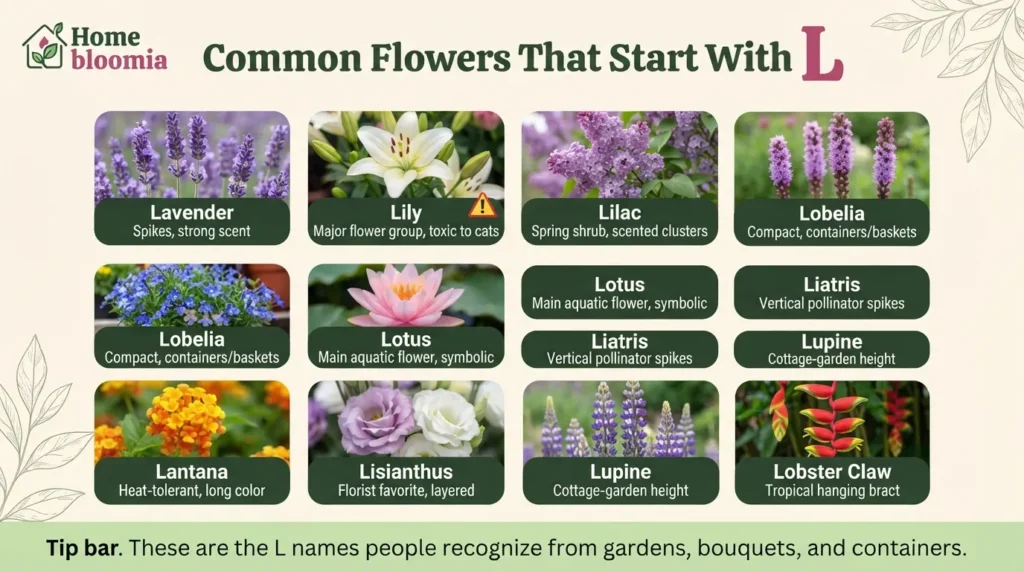
The most common L-flowers people recognize from gardens, bouquets, containers, and seasonal displays are Lavender, Lily, Lilac, Lily of the Valley, Lobelia, Lotus, Larkspur, Lantana, Lisianthus, Liatris, Lupine, and Lunaria.
- Lavender combines purple flower spikes, gray-green foliage, and strong scent. It needs full sun and sharply drained soil, and works in herb gardens, borders, containers, and pollinator beds.
- Lily is really a major flower group rather than one shape, some are trumpet-style, others open wide and dramatic. Strong in summer beds and cut arrangements, but caution is needed around pets, since several lily species are seriously toxic to cats.
- Lilac is a spring-flowering shrub known for large, scented flower clusters, most often purple but also white and pink. Useful for hedges, spring focal points, and fragrance planting.
- Lobelia is compact and especially useful in containers, baskets, and edging — blue and purple forms are the most popular.
- Lotus is the main aquatic flower in this group, growing in ponds with large leaves and flowers rising above the water. It also carries strong symbolic weight around purity and renewal.
- Liatris adds vertical flower spikes to summer borders and pollinator gardens without feeling heavy, and is one of the stronger choices for bees and butterflies.
- Lantana is valued for heat tolerance and long seasonal color, especially useful in warm climates and containers; treated as an annual in colder regions.
- Lisianthus is best known as a florist flower for its soft, layered petals and strong vase appeal, though it can be grown outdoors in suitable conditions.
- Lupine brings height and cottage-garden character with upright flower spikes in a wide color range.
- Lobster Claw is a tropical outlier,hanging red-and-yellow bracts, best suited to warm climates, conservatories, or greenhouse displays.
For similar recognizable-name browsing, see Flowers That Start With E.
Rare Flowers That Start With L
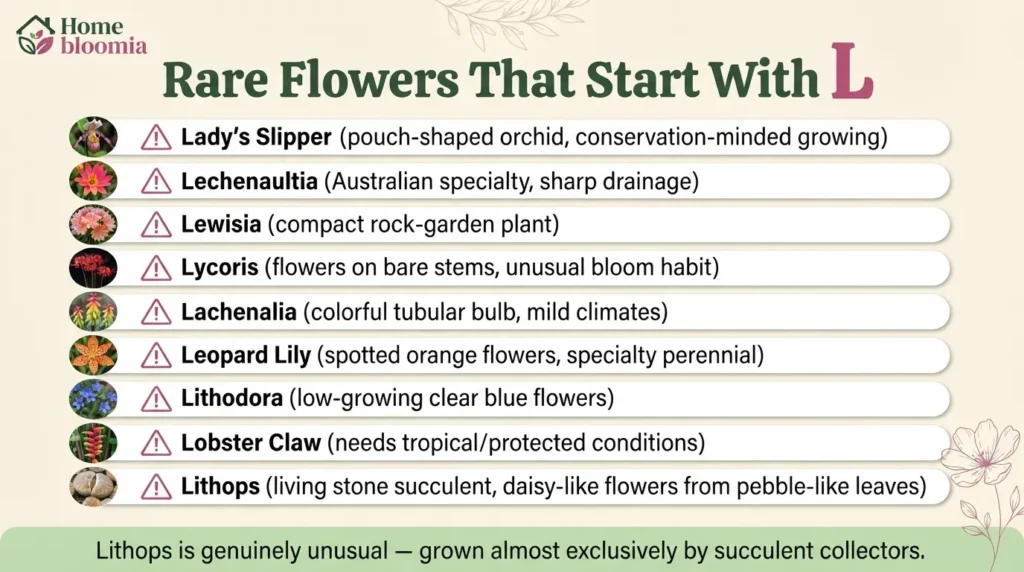
- Lady’s Slipper is a rare orchid with pouch-shaped blooms, more associated with woodland habitat and conservation-minded growing than ordinary bedding.
- Lechenaultia is an Australian-associated specialty group needing sharp drainage, more familiar to collectors than casual gardeners.
- Lewisia is a compact rock-garden and container plant performing best in sharply drained soil.
- Lycoris, sometimes called surprise lily or spider lily, produces flowers on bare stems before the foliage follows an unusual and memorable bloom habit.
- Lachenalia is a colorful tubular bulb flower more common in mild climates and specialty bulb collections.
- Leopard Lily is valued for spotted orange flowers and a bold summer look, better as a specialty perennial than a basic bedding plant.
- Lithodora is a low-growing plant with clear blue flowers, often used in sunny edges and rock gardens.
- Lobster Claw also belongs here for most home gardeners, since it needs tropical or protected conditions.
- Lithops, the “living stone” succulent, is genuinely unusual — its small, daisy-like flowers emerge from what looks like a pair of pebbles, and it’s grown almost exclusively by succulent collectors on bright windowsills.
How This 60-Flower List Was Curated
This guide includes 60 flowers and flowering plants starting with L, avoiding weak entries added only to inflate the count. It covers true flowers, flowering shrubs, flowering vines, aquatic flowers, bulb flowers, and well-known ornamental plants where the bloom (or, for Lithops and Ledebouria, the overall ornamental display) is central to why the plant is grown.
Inclusion rules: a name was included when the common name starts with L, the plant is widely recognized for its flowers or overall ornamental display, it’s useful in gardens/bouquets/containers/specialty planting, and it adds real value rather than just padding the count.
What wasn’t counted as a main flower: foliage-first plants, ferns, lichens, and general tree names weren’t added unless clearly justified, which is why even the expanded version here stops at 60 rather than reaching arbitrarily further.
For the letter before or after this one, see Flowers That Start With K or continue to Flowers That Start With B.
Symbolism and Cultural Recognition
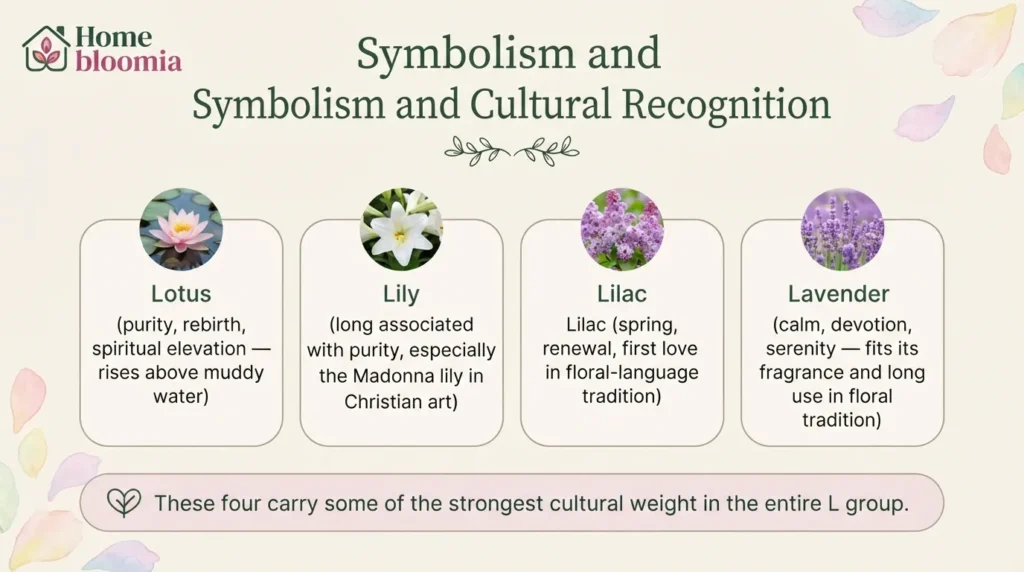
Lotus is one of the strongest symbolic flowers in this group, widely linked with purity, rebirth, and spiritual elevation because it rises cleanly above muddy water. Lily has long been associated with purity, especially through the Madonna lily in Christian art and historical symbolism. Lilac is tied to spring, renewal, and older floral-language themes of first love. Lavender is commonly linked with calm, devotion, and serenity, a meaning that fits both its fragrance and its long use in floral traditions.
Plants vs. Flowers That Start With L
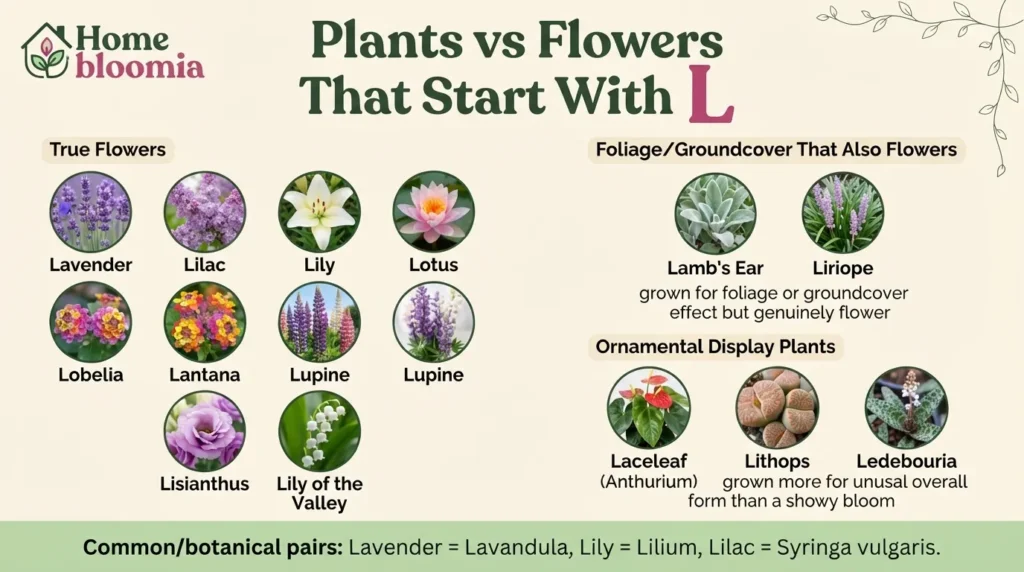
Lavender, Lilac, Lily, Lotus, Lobelia, Lantana, Lupine, Lisianthus, and Lily of the Valley fit naturally as true flowers since the bloom is the main reason they’re known or grown. Flowering shrubs like Lilac and Lady Banks’ Rose also fit because their blooms match search intent directly.
Some names need more care: Lamb’s Ear and Liriope are often grown for foliage or groundcover effect, but both do flower and can be included when clearly labeled. Laceleaf is grown as a tropical display plant with a colorful spathe commonly treated as part of its ornamental flower display. Lithops and Ledebouria are grown more for their unusual overall form than a showy bloom, but both genuinely flower and are worth including with that distinction made clear.
Common and botanical name pairs: Lavender → Lavandula; Lily → Lilium; Lilac → Syringa vulgaris; Liatris → Liatris spicata; Lobelia → Lobelia erinus; Lotus → Nelumbo nucifera; Lily of the Valley → Convallaria majalis; Lisianthus → Eustoma grandiflorum; Love in a Mist → Nigella damascena; Love Lies Bleeding → Amaranthus caudatus.
Types of Flowers That Start With L
Perennials
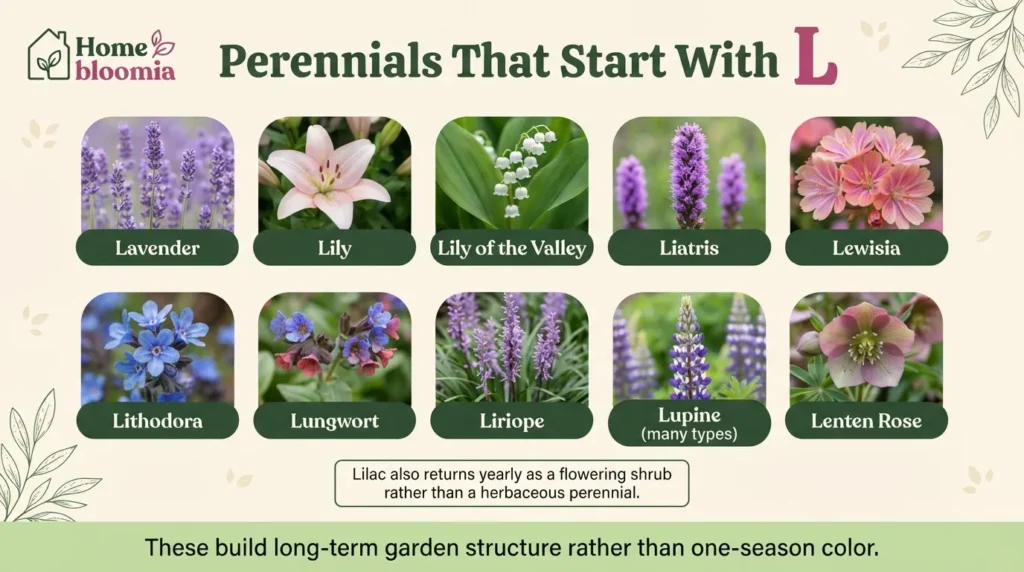
Lavender, Lily, Lily of the Valley, Liatris, Lewisia, Lithodora, Lungwort, Liriope, and many Lupines. Lilac also returns yearly as a flowering shrub rather than a herbaceous perennial. Lenten Rose is another strong shade/early-season perennial.
Annuals
Larkspur, Linaria, Love in a Mist, Love Lies Bleeding, Lavatera, and Livingstone Daisy. Lobelia, Lantana, and Lisianthus shift between annual and perennial use depending on climate.
Purple Flowers
Lavender, Lilac, Liatris, Lobelia, Lupine, Lisianthus, Liriope, Lungwort, and Love in a Mist — these build a cool-toned border alongside white flowers like Lily, Leucojum, and Lace Flower.
Fragrant Flowers
Lavender leads for combined flower-and-foliage scent. Lilac gives a fuller spring perfume; Lily of the Valley offers sweet shaded fragrance. Some Lilies are fragrant depending on type, and Lonicera (honeysuckle) adds fragrance as a flowering vine or shrub.
Beginner-Friendly Choices
Lavender, Lantana, Lobelia, Liatris, Linaria, and Lanceleaf Coreopsis. The right choice depends on site: Lavender needs sun and drainage, Lobelia prefers moisture, Lantana handles heat, Liatris suits sunny pollinator beds.
Indoor/Protected-Space Picks
Laceleaf, container-grown Lobelia and Lavender, florist-grown Lisianthus, and — genuinely strong indoor picks — Lithops and Ledebouria, both suited to bright windowsill growing as succulent specialty plants. Lobster Claw can work in a greenhouse or conservatory with enough warmth and humidity.
Container and Small-Space Picks
Lobelia is one of the best L-flowers for containers, suiting edges, baskets, and compact spaces. Lavender, Lisianthus, Linaria, Lobularia, Lewisia, Lachenalia, and Lampranthus (a genuine succulent groundcover addition) all fit containers when light and moisture needs are met. For more compact garden ideas, see Flowers That Start With A.
Pollinator-Friendly and Meadow Picks
Liatris, Lantana, Lupine, Linaria, Lanceleaf Coreopsis, Lobelia, and Lindheimer’s Beeblossom — best planted in layered groups rather than isolated single plants.
Cut Flower and Bouquet Favorites
Lily, Lisianthus, Larkspur, Limonium, Liatris, Love Lies Bleeding, and Lunaria. Lily and Lisianthus bring the strongest florist value; Larkspur adds height; Limonium works as filler; Lunaria is valued for its silvery seed pods after flowering.
Water and Pond Flower Picks
Lotus is the true water flower here. Lily of the Nile, despite the name, is a border/container plant, not a pond flower — worth noting since the name commonly causes confusion.
Quick Planning: Growing and Garden Planning
Bloom Season and Color Planning
Spring often opens with Lilac, Lily of the Valley, and Lunaria. Late spring into early summer brings Lupine and Larkspur for stronger vertical form. Summer carries Lavender, Lily, Lisianthus, Liatris, and Lotus, while warm-season plantings keep Lobelia and Lantana going later. This spread makes L-flowers genuinely useful for season-long sequence planning.
Light, Soil, and Zone Notes
| Flower | Light | Soil | Moisture | General Zone Fit | Best Setting |
| Lavender | Full sun | Well-drained | Low–moderate | 5–9 | Herb beds, borders, containers |
| Lilac | Full sun | Fertile, well-drained | Moderate | 3–7 | Shrub borders, spring focal points |
| Lily | Full sun–part shade | Rich, well-drained | Moderate | 4–9 | Beds, cut flower gardens |
| Lily of the Valley | Part shade–shade | Humus-rich | Moderate–moist | 3–8 | Shade gardens |
| Lobelia | Sun–part shade | Moist, fertile | Moderate–high | Often grown as annual | Containers, edging |
| Lotus | Full sun | Aquatic soil | High | 4–10 | Ponds, water gardens |
| Liatris | Full sun | Well-drained | Low–moderate | 3–9 | Pollinator beds, meadow |
| Lupine | Full sun | Well-drained, not overly rich | Moderate | 4–8 | Cottage gardens, naturalistic beds |
| Lithops | Full sun (bright indoor) | Sharp, gritty drainage | Very low | Indoor/collector | Windowsill, succulent collections |
A pond flower, a shade flower, and a dry border flower shouldn’t be treated as if they all want the same setting.
Pollinator, Pet, and Safety Points
Liatris, Lantana, Lupine, Lobelia, Linaria, Lanceleaf Coreopsis, and Lindheimer’s Beeblossom all help make a garden more pollinator-active. On safety: Lilies and Lily of the Valley should be handled with real caution around pets, true lilies (Lilium species) are among the most acutely dangerous plants for cats, capable of causing kidney failure from even small amounts of pollen or petal material. Lantana and several other ornamentals can also cause problems if eaten. Local behavior matters too — some L-flowers spread more aggressively in moist soil or mild climates, so check regional guidance before planting widely.
Conclusion
Flower names starting with L cover far more variety than a simple alphabet list suggests, fragrant spring bloomers, upright summer flowers, compact container plants, meadow-friendly picks, bouquet favorites, and true pond flowers, plus genuine rarities like Lithops and Lycoris. .
FAQ
How many flowers start with the letter L?
This guide covers 60 genuinely distinct entries, though counts vary across sources depending on how strictly “flower” is defined.
What is the most popular flower that starts with L?
Lily and Lavender are the two most universally recognized; Lilac is a close third for fragrance-driven recognition.
Which flower starting with L smells the best?
Lavender, Lilac, and Lily of the Valley are the strongest fragrance picks.
Which flowers that start with L are perennials?
Lavender, Lily, Lily of the Valley, Liatris, Lewisia, Lithodora, Lungwort, Liriope, and most Lupines.
Are there indoor flowers that start with L?
Yes, Laceleaf, Lithops, and Ledebouria are all genuinely well-suited to indoor/windowsill growing.
Which L-flowers are good for beginners?
Lavender, Lantana, Lobelia, Liatris, and Linaria.
What are rare flowers that start with L?
Lady’s Slipper, Lewisia, Lechenaultia, Lycoris, Lachenalia, and Lithops.
What is the best L-flower for containers?
Lobelia is the strongest all-around container pick, with Lavender, Lisianthus, and Lampranthus close behind.
Which flowers that start with L are good for bouquets?
Lily, Lisianthus, Larkspur, Limonium, and Lunaria.
Is Lotus the only water flower that starts with L?
Among common names, yes, Lily of the Nile is not a true pond plant despite its name.
Are all plants that start with L counted as flowers?
No, several (Lamb’s Ear, Liriope) are often grown primarily for foliage or groundcover effect, though they do flower.
What are purple flowers that start with L?
Lavender, Lilac, Liatris, Lobelia, Lupine, Lisianthus, Liriope, and Lungwort.
What is the difference between common and Latin flower names?
Common names vary by region and can overlap between unrelated plants; botanical (Latin) names are standardized and reduce confusion when checking care needs or safety information.
References
- Royal Horticultural Society — How to Grow Lavender, Lilium, Syringa vulgaris, Convallaria majalis, Lobelia erinus, How to Grow Lupins
- Missouri Botanical Garden — Plant Finder (Nelumbo nucifera, Liatris spicata, Lantana camara, Eustoma grandiflorum)
- ASPCA Animal Poison Control — Toxic and Non-Toxic Plants List (Lily of the Valley, true Lilies)